Beware of Provocative Narratives Regarding the National Police Bill Disturbing National Stability

By: Dirandra Falguni )*
In recent times, the discourse on revising Law Number 2 of 2002 concerning the Indonesian National Police (UU Polri) has resurfaced. This revision plan has attracted public attention, especially because of several points that are considered controversial and have the potential to significantly change the face of the Polri institution. In the midst of increasingly complex political dynamics, the public needs to be aware of the potential for provocation that accompanies this discourse.
The discourse on revising the Polri Law cannot be separated from the narrative game that is deliberately formed to shape public opinion. One form of provocation that needs to be watched out for is the use of national security or public order issues as a justification for expanding police authority. Narratives like this can make the public accept the revision passively, without realizing its long-term impact on civil liberties.
In addition, there is also a narrative that corners parties who are critical of the revision, as if they do not support the state or are even anti-police. This is a form of polarization that can divide society, even though criticism of state institutions is a legitimate part of democracy.
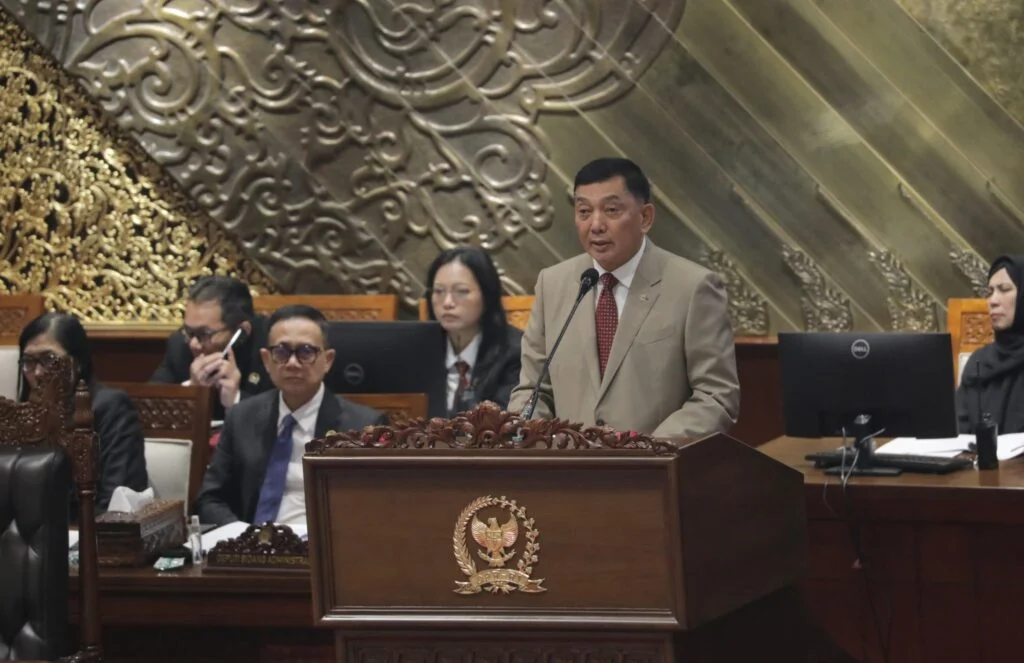
In fact, the DPR itself stated that it has not started discussing the policy because there has been no Presidential Letter (Surpres). The Speaker of the DPR RI, Puan Maharani emphasized that her party has not received a Surpres regarding the draft law (RUU) related to the amendment to Law Number 2 of 2002 concerning the National Police. She said that the draft of the Polri Bill circulating on social media is not an official draft.
Puan also confirmed that the Problem Inventory List (DIM) of the Polri Bill currently circulating is not an official draft. This is because the DPR leadership has not yet received a Surpres regarding the bill.
Deputy Chairman of Commission III of the DPR RI, Ahmad Sahroni, said that the DPR cannot cover up the discussion session on the Polri Bill. Therefore, Sahroni asked that there be no fear as if the DPR was covering up the discussion of the bill. In line with Puan, Sahroni said that until now the Surpres on the Polri Bill has not been submitted to the DPR so there has been no discussion regarding the bill. The government of President Prabowo Subianto has not submitted a draft revision of the government’s version of the Polri Law. The DPR will continue to monitor the government’s attitude and official statement regarding the revision of the law that has been in effect for 23 years.
Previously, Deputy Speaker of the DPR Sufmi Dasco Ahmad also said that the revision of the Polri Law would not be discussed in the near future. Dasco claimed that there had been no Presidential Decree regarding the Polri Bill. The Polri Bill is included in the DPR’s draft initiative laws. The discussion has been carried out since 2024. Chairman of the Nasdem Party Faction Group of Commission III of the DPR RI, Rudianto Lallo, said that his party was ready to discuss the revision of the Polri Law if it was considered urgent. However, currently Commission III of the DPR is still prioritizing the Draft Law on Amendments to Law Number 8 of 1981 concerning Criminal Procedure Law or the RUU KUHAP, which is targeted for completion in October 2025.
The DPR RI has a track record of prioritizing transparency in discussing the revision of the KUHAP. A similar approach will also be applied in the revision of the Polri Law, where various parties will be invited to provide input, including academics, legal practitioners, and civil society organizations that have competence in the fields of police and criminal law.
The DPR also ensured that the revision of the Polri Law would be an example of transparency in legislation. Each stage of the discussion will be clearly conveyed to the public and involve active participation from various parties. Thus, the resulting regulation will have strong legitimacy and can be accepted by all elements of society.
The government and the DPR have shown a strong commitment to maintaining openness and public participation in the discussion of the revision of the National Police Law. Until now, the DPR is still waiting for a Presidential Decree from the government as an official basis for discussing this regulation.
This updated regulation will later provide clearer legal certainty for the police in carrying out their duties of law enforcement, protection, and service to the community. In addition, this revision also aims to strengthen the internal and external oversight mechanisms for the police institution so that it remains transparent, accountable, and oriented towards the public interest.
The emergence of various negative narratives regarding the discourse on the revision of the National Police Law must be responded to wisely by the public. The people as the owners of the highest sovereignty in a democratic country must actively monitor the legislative process, but should not be easily incited by issues that can disrupt national stability. If the public is apathetic, then the space for participation will be filled by interest groups that may have hidden agendas.
In this context, the revision of the Police Law is not just a technical issue, but is directly related to the future of democracy and citizen freedom. By conducting supervision, the public can encourageg so that the revision is carried out wisely, based on real needs in the field, and not merely to strengthen the political position of a particular party. The mass media also has a responsibility to present information objectively and not get caught up in a single narrative. Investigative journalism efforts and public discussion forums can be channels to open up a healthy and enlightening debate space. )* The author is a Contributor to Beritakapuas.com
