

By: Dina Wahyuni )*
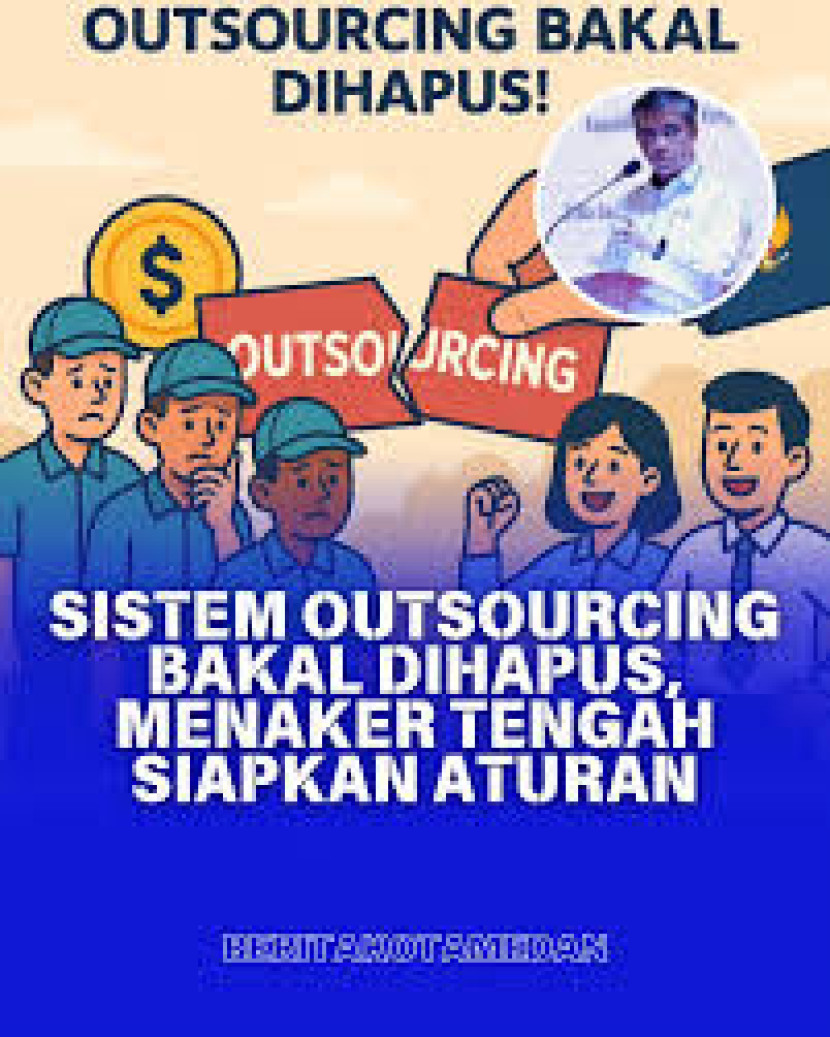
The government’s move to eliminate the outsourcing system of labor is a real manifestation of the state’s commitment to the welfare of workers. Through policies designed in stages and with great care, the government under the leadership of President Prabowo Subianto is trying to answer the aspirations that have long been voiced by various groups of workers. The elimination of the outsourcing system , especially involving workers through agents, is considered a structural correction of employment practices that have long been considered detrimental to workers.
Minister of Manpower, Yassierli, said that the government is aware of the negative impacts of an uncontrolled outsourcing system. Many workers who have served for years remain on contract, without career clarity, and only receive minimum wages. This phenomenon shows that the system closes the space for workers to develop, obtain adequate social protection, and enjoy the fruits of their labor fairly. In such conditions, the state must be present not only as a mediator, but also as a protector of the basic rights of the working people.
President Prabowo demonstrated responsive leadership by capturing the concerns of workers from various sectors, including those voiced by union leaders. The head of state’s direction to eliminate outsourcing practices that are not in favor of workers is now the basis for formulating a more humane employment policy. Minister Yassierli emphasized that the policy will be outlined in official regulations, including in the form of ministerial regulations as a follow-up to the constitutional mandate.
This step was not taken hastily. The government is conducting a comprehensive study to ensure that the elimination of outsourcing is carried out realistically and responsibly. This approach also shows that the state is not turning a blind eye to the challenges that business actors may face, but still places worker welfare as a top priority.
The Indonesian Constitution guarantees the right of every citizen to work and receive fair treatment in employment relations. Therefore, all forms of work practices that create uncertainty and discrimination must be eliminated. In this context, the outsourcing system through recruitment agencies is often a source of such uncertainty, because it treats workers as commodities rather than subjects with rights.
The new approach taken by the government has also received appreciation from economic observers. Executive Director of the Institute for Development of Economics and Finance (Indef), Esther Sri Astuti, assessed that the policy of eliminating outsourcing can provide certainty of work status for outsourced workers. She assessed that companies will be encouraged to appoint workers as permanent employees, which means certainty of income, social security protection, and access to other normative rights.
Although it is likely that some companies will face challenges in adjusting this policy, especially in terms of cost burden, the government is believed to create a constructive dialogue space to align the interests of the business world and workers. The commitment to provide adequate social security and clear legal protection will strengthen the position of workers in a fair national employment system.
This policy is also a form of affirmation that the state does not submit to capitalist interests alone, but rather sides with the working class as the backbone of the national economy. Widespread support from workers also strengthens the legitimacy of this step. The President of the Confederation of Indonesian Trade Unions (KSPI), Said Iqbal, in various forums expressed his belief that President Prabowo showed real support for the common people, including teachers, farmers, and workers. This belief emerged along with the President’s promise on Labor Day 2025 which emphasized his commitment to eliminating outsourcing .
One of the important points in this policy is the distinction between the practice of outsourcing work and outsourcing labor through agents. The government does not rule out the possibility for companies to hand over part of the production process to third parties, such as the manufacture of certain components or services. However, the practice of outsourcing workers through agents who are then not given the rights and protection they deserve must be stopped. The government is also paying attention to the disguised form of outsourcing in the form of internship or partnership programs that are often used to avoid employment obligations.
With the elimination of outsourcing of labor through agents, workers are no longer in a vulnerable position of unilateral termination of employment without guarantees. They will get job certainty, social security, protection against work accidents, and the right to fairer welfare. This is a real form of the government’s determination to make economic development a means of improving the quality of life of all people, not just a handful of parties.
This policy not only improves the national employment structure, but also becomes the foundation for building healthy industrial relations. The government realizes that a strong economy can only be achieved if the business world and workers walk hand in hand in a work climate that is mutually respectful and fair.
With the spirit of labor reform being rolled out, Indonesia is moving towards a more humane work system. Under the leadership of President Prabowo Subianto, the country has reaffirmed that in every policy, the interests of the people, especially workers, will always be the mainstay.
)* Public Policy Observer
