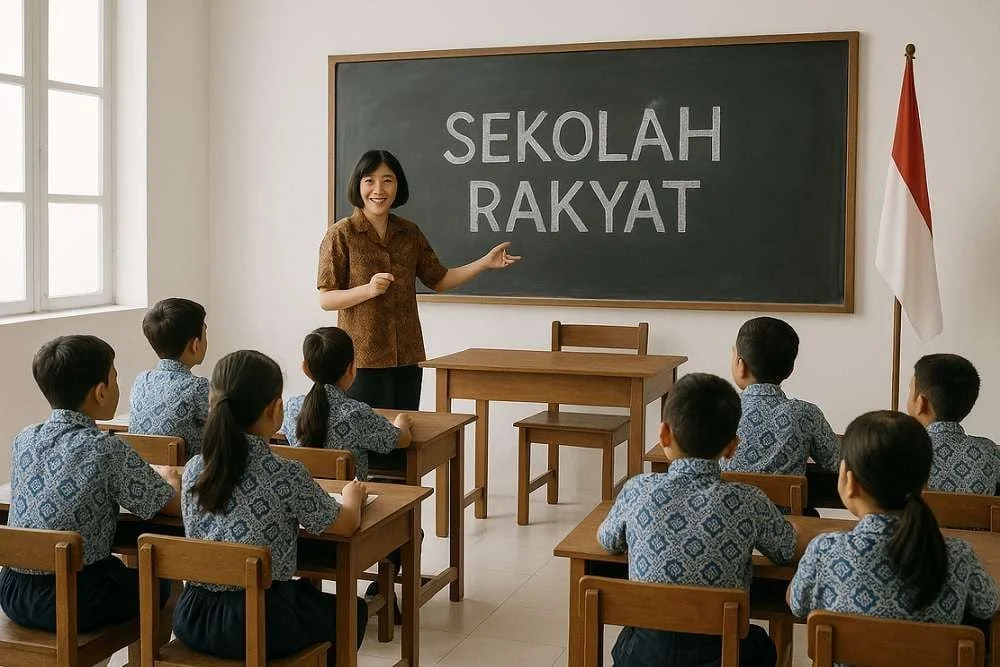

Jakarta – The government has emphasized that the People’s Schools program is a solution to provide equal access to education for children from underprivileged families. This program is designed not only as an educational intervention, but also as a long-term strategy to break the cycle of poverty by providing safe, free, and quality learning services.
This initiative was initiated by President Prabowo Subianto and is being implemented through the coordination of the Ministry of Social Affairs (Kemensos) and is fully supported by the Ministry of Finance (Kemenkeu). The government ensures that the program’s implementation does not disrupt the sustainability of other priority programs.
Roni Parasian, Senior Analyst at the Directorate General of Economic and Fiscal Strategy at the Ministry of Finance, emphasized efficient budget management as key to the program’s sustainability.
“The government is able to combine various cross-ministerial programs, allowing the People’s Schools to run effectively without burdening the State Budget. All of the President’s agendas remain aligned,” said Roni.
As a first step, the Pioneer People’s Schools will begin in the 2025/2026 academic year, utilizing renovated state facilities. The government is targeting the construction of special buildings starting in 2026 and expanding coverage by 2029. Currently, 165 pilot schools have been established across various regions, demonstrating a strong commitment to equitable access to education.
The Secretary General of the Ministry of Social Affairs, Robben Rico, stated that this program was created in response to the slow decline in poverty rates and the continued high number of out-of-school children (ATS).
“In East Java alone, there are more than 400,000 high school-aged children who are out of school. Most of them drop out due to economic reasons. The People’s School (Sekolah Rakyat) is a concrete solution by providing free education through a boarding system,” he explained.
The boarding model is considered an appropriate approach to ensure children from vulnerable families receive a stable, safe, and supportive learning environment. Meals, dormitories, and teacher supervision will provide greater opportunities for them to develop.
Education observer Ina Liem also expressed support from civil society. She views the boarding concept as a breakthrough relevant to current social challenges.
“Regular schools alone are not enough. These children need a safe and protected space 24/7 so they can learn without the disruption of violence or exploitation,” he stressed.
Through cross-agency collaboration and phased planning, the government aims to make the Boarding Schools a key instrument in accelerating equitable access to education and reducing social disparities. This program is also projected to support the achievement of Indonesia’s vision of developing a superior, equal generation from an early age.
Through this solution-oriented policy, the government demonstrates that providing education is not merely a moral commitment, but a concrete strategy for creating opportunities for children who have been marginalized economically and geographically.
