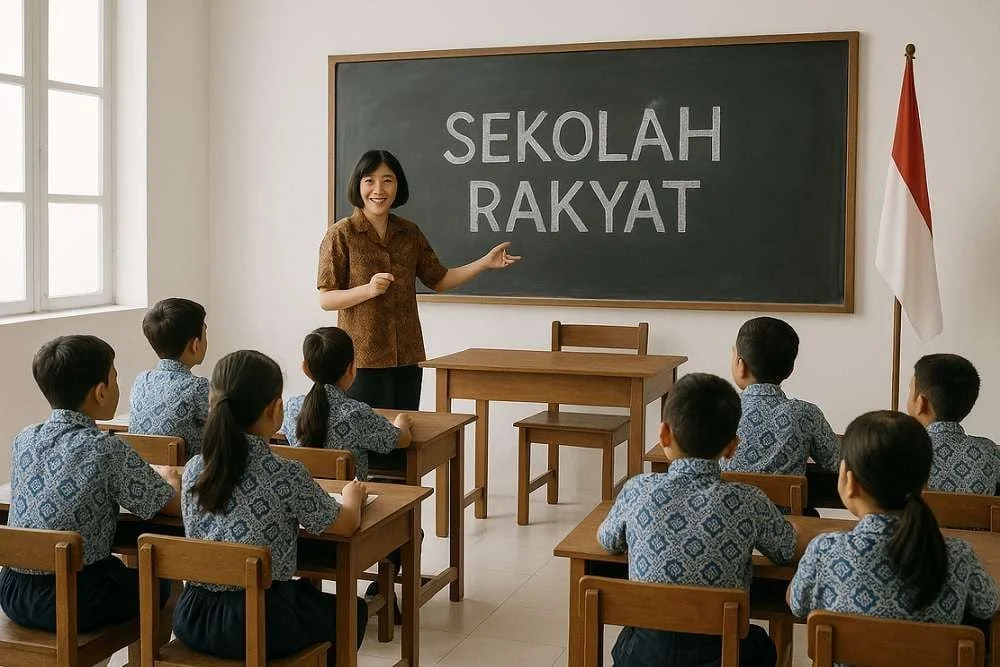

Jakarta, suaradewata.com – The government continues to accelerate the implementation of the People’s School Program as part of its broader agenda to equalize access to national education. President Prabowo Subianto recently inaugurated 166 People’s Schools across Indonesia’s 34 provinces.
This program is designed to reach children from poor and extreme poor families and serves as a strategic tool for improving human resource quality from an early age. The government aims to gradually expand capacity to hundreds of thousands of students over the next few years.
President Prabowo emphasized that with the operation of 166 People’s Schools this year, the number of students will increase significantly until the end of 2026. Currently, the number of People’s School students is recorded at around 15,000 children and is projected to reach 30,000 students by the end of this year.
“Today, it’s only 15,000, but I’ve been told it will reach 30,000 by the end of the year. Ultimately, our target is for each Elementary School campus to have 1,000 students, so our target is 500,000 students,” Prabowo said.
He emphasized that the People’s School is a long-term investment by the state to break the chain of poverty through education.
Furthermore, the President explained that the ultimate target of this program is to build a People’s School ecosystem capable of accommodating up to 500,000 students nationwide.
Each People’s School unit is designed to have a capacity of around 1,000 students with adequate educational facilities and is oriented towards character building, competence, and student independence.
The government ensures that physical development and learning systems are carried out in stages but in a measured manner, so that the quality of education is maintained along with the expansion of the number of schools.
Social Affairs Minister Saifullah Yusuf, known as Gus Ipul, stated that the Ministry is currently preparing the selection process for students at the People’s School for the current year. He confirmed that a quota of 30,000 students has been allocated and will be implemented soon, following the completion of the permanent building.
“We’re currently preparing for this year’s selection process. There’s an allocation of 30,000 students this year. Once all the permanent buildings are completed, God willing, we can accommodate those 30,000,” said Gus Ipul.
He emphasized that the main target of the People’s School is children from extremely poor (decile-1) and poor (decile-2) families, with prospective students determined through a decision by the regional head.
Support for the People’s School Program also comes from the local government. The Regent of Pinrang, South Sulawesi, HA Irwan Hamid, reiterated his commitment to fully support this national priority program. He stated that the People’s School provides fairer access to education for underprivileged communities.
“The existence of the People’s School is expected to open wider access to education for the community, especially for children from underprivileged families, thereby creating fairer opportunities to obtain a decent education,” Irwan emphasized.
Irwan added that the People’s School is expected to be able to produce a young generation that is not only intellectually intelligent, but also morally strong.
“Through the People’s School, we hope to produce a young generation that is intellectual, adaptable to current developments, while still upholding good ethics and morals. This is a long-term investment for the future of the Pinrang community,” he concluded.
People’s Schools are seen as a manifestation of the state’s commitment to the future of children from the most vulnerable families. Access, quality, and sustainability of education are prioritized by People’s Schools as a strategic instrument for breaking the cycle of poverty while preparing a generation with competitiveness and character.
