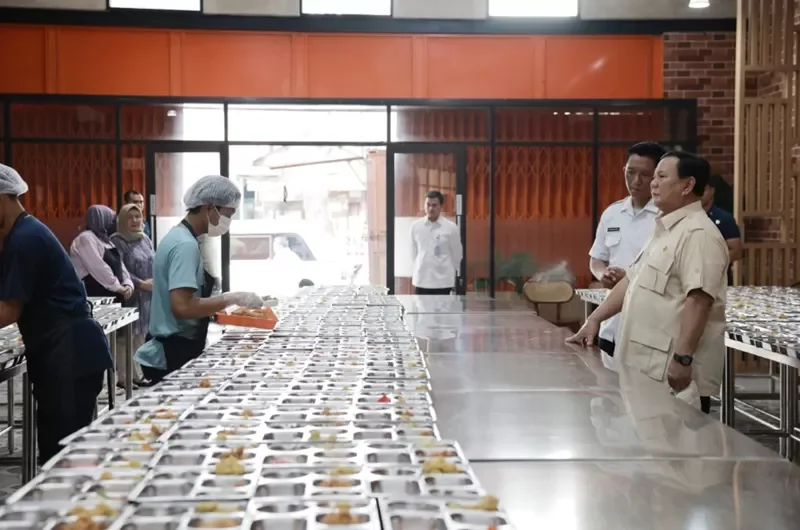
MBG Becomes the Initial Foundation for Improving Nutrition and Strengthening National Education

By: Nadia Prameswari
The Free Nutritious Meals (MBG) program is increasingly being emphasized as a strategic government policy to build the foundation of Indonesia’s human resources. Amidst various public discussions, political support for this program is growing. The Indonesian House of Representatives (DPR RI) views the MBG not merely as social assistance, but as a long-term investment integrated with the broader agenda of strengthening national education.
Vita Ervina, a member of Commission IX of the Indonesian House of Representatives (DPR RI), assessed the MBG as a concrete step towards improving the health and nutritional status of Indonesian children. In a statement to the media in Magelang, she stated that children’s nutritional quality is the primary foundation for the development of a healthy, intelligent, and competitive generation.
According to Vita, the nutritional intervention through the MBG program will have a direct impact on children’s growth and development. Adequate nutritional intake is considered crucial for improving students’ concentration, endurance, and cognitive development. Therefore, this program not only addresses health aspects but also serves as an integral part of strengthening the quality of education.
He emphasized that human development must begin with the most basic principle: nutritional needs. Without good physical health and adequate nutritional intake, the learning process will not be optimal. Therefore, MBG is positioned as a long-term investment, the results of which may not be immediately visible, but will determine the nation’s future competitiveness.
Vita also stated that Commission IX of the Indonesian House of Representatives (DPR RI) will continue to carry out its oversight function constructively to ensure the program is running according to its objectives. She believes this oversight is part of the legislature’s commitment to supporting policies that support the future of the nation’s generations.
Said Abdullah, Chairman of the House of Representatives Budget Agency (Banggar), affirmed similar support. He confirmed Cabinet Secretary Teddy Indra Wijaya’s explanation that the MBG budget had been discussed and agreed upon by the government and the House of Representatives in the 2025 and 2026 State Budgets.
Said emphasized that all factions in the House of Representatives (DPR) approved the State Budget, which allocated funds for the MBG. He described this approval as a form of collective political commitment to support President Prabowo Subianto’s priority programs, particularly in improving child nutrition.
According to Said, the House of Representatives (DPR) is ethically and constitutionally responsible for this decision. He views the MBG as a concrete intervention to improve the quality of the nation’s generation by enhancing nutritional status. In his perspective, supporting the MBG budget is part of the DPR’s responsibility to ensure sustainable human development policies.
Said also believes that improving children’s nutrition is closely correlated with the quality of national education. Healthy and well-nourished children are better prepared to learn, have sufficient energy for activities, and are able to develop optimally. Therefore, he views the MBG as a crucial foundation for strengthening the education system from the ground up.
Meanwhile, Cabinet Secretary Teddy Indra Wijaya explained that the education budget allocation remains at the required 20 percent of the state budget, reaching Rp 769.1 trillion this year. He stated that the composition and allocation of the budget, including the MBG, had been discussed jointly between the government and the House of Representatives (DPR).
According to Teddy, the MBG program is the initial foundation for improving the quality of education going forward. By meeting students’ nutritional needs, the teaching and learning process is believed to be more effective and productive. He emphasized that this program actually strengthens the education sector because health and education are two interrelated aspects.
Within the broader framework of national development, the MBG reflects a cross-sectoral approach that integrates health and education policies. This program is designed to ensure that every Indonesian child has an equal opportunity to grow healthily and develop optimally.
This policy is also considered relevant in the context of Indonesia’s demographic dividend. A healthy and educated productive generation is key to driving economic growth and increasing global competitiveness. Therefore, investing in child nutrition is seen as a crucial long-term strategy.
The synergy between the government and the House of Representatives (DPR) in agreeing on the MBG budget demonstrates a shared vision for developing superior human resources. This support is crucial for the program’s consistent, measurable, and sustainable implementation.
With this shared commitment, MBG is expected to become not only a program to meet daily needs but also a significant milestone in transforming the quality of Indonesian human resources. By investing in nutrition and strengthening early childhood education, the government affirms its commitment to the future generation as the nation’s greatest asset.
If implemented optimally, MBG has the potential to become a strong foundation in producing a healthier, more productive, and more competitive generation of Indonesians, while also emphasizing the direction of national development that is oriented towards the quality of human resources.
Ultimately, the success of the MBG will reflect the nation’s commitment to prioritizing human development. When Indonesian children grow up healthy, learn optimally, and develop to their full potential, the foundation for a progressive Indonesia is truly laid—starting from the plates in classrooms to the creation of a superior generation in the future.
Senior National Development Analyst
