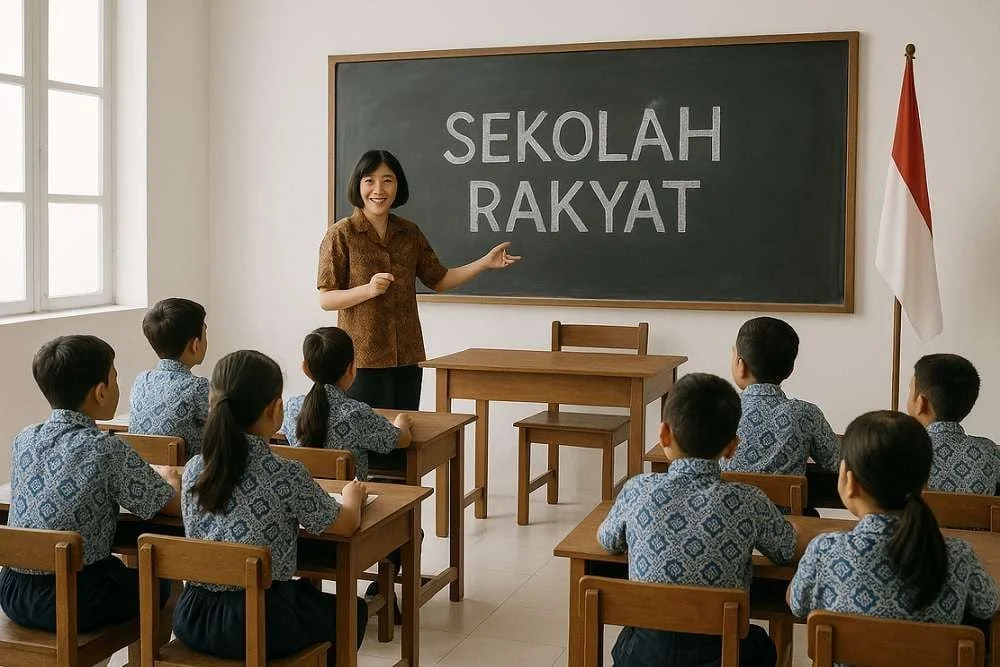
The Government Strengthens the Commitment of Community Schools to Expand Access to Inclusive Education

By: Aditya Nugraha
The government continues to demonstrate a strong commitment to expanding access to inclusive education through the People’s School (SR) program, which is increasingly being felt by the community, particularly those from underprivileged backgrounds. Amidst budget efficiency policies, this program remains a priority because it is considered to have a direct impact on improving the welfare and quality of human resources.
Minister of State Secretary Prasetyo Hadi emphasized that the budget efficiency policy is not aimed at cutting strategic programs, but rather at reducing spending deemed unproductive. He explained that the government is combing through budget items that don’t provide significant benefits and then reallocating these funds to strengthen priority programs such as People’s Schools and Free Nutritional Meals (MBG).
He believes that the budget reallocation is an effort to ensure that every use of state funds truly has a tangible impact on the community. Programs that can ease the burden on the community and improve the quality of life, including in the education sector, are the primary focus of this policy.
In line with this, Coordinating Minister for Economic Affairs Airlangga Hartarto also emphasized that the government’s flagship programs will not be affected by budget efficiency. The government will continue to strive to keep the 2026 State Budget (APBN) deficit under control, without sacrificing programs that directly impact the public.
This commitment emphasizes that the People’s School is a crucial instrument in the national development strategy. This program not only provides access to education for children from underprivileged families but also serves as a means of character building and improving the quality of the younger generation.
The implementation of People’s Schools in various regions has demonstrated a tangible positive impact. Students receive not only academic learning but also character development through various activities, including arts and the strengthening of disciplinary values. Support in the form of school supplies is also part of the government’s efforts to ensure the continuity of students’ education.
Direct interaction between local government and Elementary School students also has a positive psychological impact. The presence of leaders among the students is believed to increase motivation to learn and foster self-confidence, especially among children from lower-income backgrounds.
Students have experienced significant changes since joining the program. They not only gain knowledge but also develop attitudes and are encouraged to aspire to higher goals. The supportive learning environment, coupled with the active involvement of teachers, creates a more inclusive and constructive educational atmosphere.
At the national level, attention to the People’s School program continues to be strengthened. The central government actively monitors and evaluates program implementation in various regions to ensure targeted and effective implementation.
The on-site inspection conducted by Coordinating Minister for Political and Security Affairs, Djamari Chaniago, at a public high school in Pekanbaru is part of this effort. The government wants to ensure that the program is running according to its initial objectives and is providing optimal benefits to students.
In the evaluation, the government observed significant progress in a relatively short period of time. This was seen as the result of synergy between schools, local governments, and various stakeholders involved in the program’s implementation.
People’s Schools are also seen as a strategic solution for improving the quality of human resources, especially for communities that previously had limited access to education. Through an integrated approach between academic learning and character development, this program is expected to produce a generation that is not only intellectually intelligent but also mentally and morally strong.
The role of teachers is a key factor in the success of this program. The government believes that educators have a significant responsibility in shaping students’ character and personality. Therefore, teachers’ dedication and commitment to guiding students are crucial aspects that must be continuously strengthened.
On the other hand, the boarding school system implemented in several People’s Schools is considered capable of supporting more intensive development. Students not only learn in the classroom but also receive mentoring outside of class hours, which contributes to their academic and character development.
The students also acknowledged that the People’s School provides opportunities they previously lacked access to. The comprehensive educational facilities provided are a key contributing factor in fostering a passion for learning. This program is seen as paving the way for them to achieve a brighter future.
Overall, the People’s School is increasingly demonstrating its strategic role as a solution to expanding access to education in Indonesia. With a strong commitment from the government and support from various parties, this program is expected to continue to grow and reach a wider community.
By strengthening this program, the government is not only striving to improve the quality of education but also to promote equitable development and social welfare. The People’s School is clear evidence that education can be a key instrument in breaking the cycle of poverty and creating a superior generation ready to face future challenges.
*) Observer of Development and Human Resources Issues
