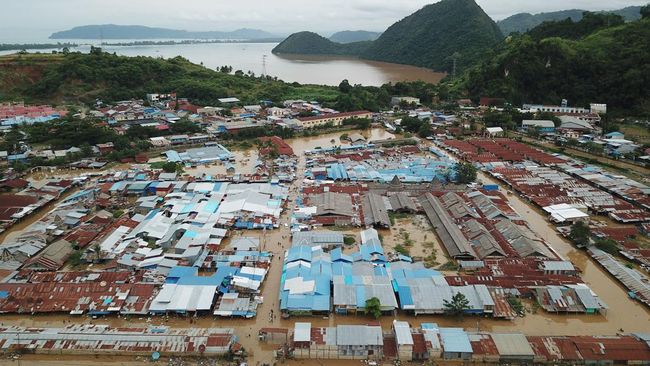

Jakarta — Several regencies across flood-affected areas in Sumatra have demonstrated significant progress in post-disaster recovery efforts. Various recovery indicators—ranging from the resumption of local government functions and the restoration of infrastructure connectivity to the availability of temporary housing and access to clean water—reflect tangible steps toward increasingly stable and well-organized conditions.
The Minister of Home Affairs, who also serves as Head of the Task Force for the Acceleration of Post-Disaster Rehabilitation and Reconstruction in Aceh, North Sumatra, and West Sumatra, Muhammad Tito Karnavian, stated that the government moved swiftly once the emergency response phase ended to ensure a well-directed recovery process. Mapping existing challenges became a crucial initial step.
“The essence is that we are reading or mapping the current situation. After the emergency response phase, some areas have completed it, while others are still extending the emergency response for the next 15 days,” Tito said in Jakarta.
Tito emphasized that most of the affected areas have shown meaningful progress. Recovery has been marked by the return of local government operations, the restoration of main road access, the resumption of health and education services, and the gradual revival of community economic activities.
“Of the 18 affected regencies and cities in Aceh, 11 areas have been declared gradually returning to normal, while the remaining seven are still the focus of further handling,” he added.
Recovery progress is also clearly visible in Aceh Tamiang Regency. The Aceh Tamiang Regency Government has now entered a more structured recovery phase after receiving 600 units of Temporary Housing (Huntara) from Danantara Indonesia. Managing Director of Stakeholder Management and Communications at Danantara, Rohan Hafas, emphasized that the construction of temporary housing goes beyond merely providing shelter for affected residents.
“Recovery does not stop at physical construction, but moves toward ensuring that housing truly provides space for families to resume their daily lives,” he said.
Vice President of CSR & SMEPP at Pertamina, Rudi Arfianto, stressed that in addition to housing, meeting basic needs such as access to clean water is also a key priority. Clean water access is a vital necessity in post-disaster conditions.
“Therefore, this collaboration is carried out to ensure that communities can promptly obtain proper access to clean water,” he explained.
Meanwhile, Director of Operations of PT Elnusa Tbk, Andri Haribowo, added that this initiative is designed as both a short-term solution and a foundation for long-term recovery.
“This initiative not only addresses short-term needs, but also serves as a foundation for more resilient recovery in the future,” Andri said.
The increasingly visible recovery is expected to accelerate the return of community welfare while strengthening regional resilience in facing future disasters. This accelerated rehabilitation is the result of strong synergy between the central government, regional governments, and cross-institutional and state-owned enterprise collaboration.
