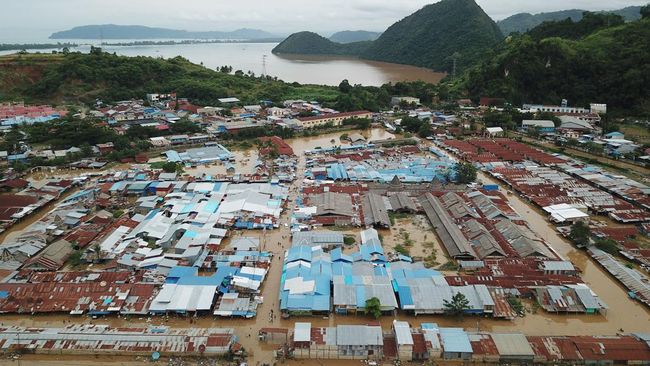
Government Guarantees Planned Assistance for Economic and Social Sectors Following Sumatra Floods

By: Gavin Asadit )*
The Government of the Republic of Indonesia has affirmed that post-flood response efforts following the major floods affecting several regions on the island of Sumatra are being carried out in a planned, measured, and sustainable manner, particularly to restore the economic and social sectors of affected communities. The floods and landslides that have occurred since late 2025 through early January 2026 have had widespread impacts, not only on public safety but also on regional development stability.
According to the latest data from the National Disaster Management Agency (BNPB) as of early January 2026, thousands of residents have been affected across the provinces of Aceh, North Sumatra, and West Sumatra. Extreme rainfall with high intensity and prolonged duration caused major rivers to overflow and triggered landslides in vulnerable areas. In addition to loss of life, damage has been recorded to residential areas, educational facilities, healthcare facilities, agricultural land, and transportation infrastructure that serves as the backbone of social and economic activity.
In this context, Coordinating Minister for Economic Affairs Airlangga Hartarto emphasized that the recovery of affected communities’ economies has been directed to take place through a cross-sectoral approach involving ministries, local governments, and the business sector to accelerate the revival of local economic activity. The government believes that swift economic recovery will have a direct impact on improving community welfare in the post-disaster period.
The government has also prioritized infrastructure recovery as the main foundation for economic and social revival. The construction of temporary housing for residents who lost their homes has been carried out in stages while awaiting the development of permanent housing. Repairs to roads, bridges, and other transportation facilities are being accelerated to reopen logistics access and restore community mobility. Budgetary support and oversight of the reconstruction process have also been strengthened.
The government recognizes that the impacts of such disasters cannot be addressed in a fragmented manner. Therefore, recovery policies are directed not only at the emergency response phase, but also encompass medium- and long-term rehabilitation and reconstruction. A rebuilding approach oriented toward disaster risk reduction has also become a key focus to ensure that similar events do not result in the same level of impact in the future.
To maintain social stability among affected communities, social assistance has been distributed gradually through various social protection schemes. Basic needs assistance, logistical services, and psychosocial support are being ensured for vulnerable groups, including children, the elderly, and persons with disabilities. In this regard, Minister of Social Affairs Saifullah Yusuf stated that compensation for families of deceased victims, assistance for livable housing, and business capital support for affected families have been incorporated into an integrated national social recovery program.
In the health sector, the government has placed serious attention on the issue given the damage to several healthcare facilities and the increased risk of disease outbreaks following the floods. Strengthening health services has been carried out through the deployment of additional medical personnel and the restoration of affected facilities. Minister of Health Budi Gunadi Sadikin stated that hundreds of healthcare workers have been prepared and deployed to affected areas to ensure continued public health services and to mitigate the risk of epidemics.
Meanwhile, the economic impact of the floods has been assessed as significant. Trade activities have been disrupted, agricultural land damaged, and many micro, small, and medium enterprises (MSMEs) forced to temporarily halt operations. Economic losses are estimated to reach tens of trillions of rupiah. As such, regional economic recovery has been placed as one of the government’s top priorities. Livelihood recovery programs, support for MSMEs, and the restoration of the agriculture and fisheries sectors have been included in the national recovery agenda.
Deputy Speaker of the House of Representatives (DPR RI) Cucun Ahmad Syamsurijal also stated that accelerating infrastructure repairs is crucial, as road and bridge access is considered key to economic recovery and the distribution of aid to affected areas. Synergy between the central government and the DPR continues to be maintained to ensure the smooth implementation of rehabilitation programs.
The government acknowledges that post-flood recovery in Sumatra requires time, policy consistency, and the involvement of all stakeholders. Therefore, recovery efforts are not focused solely on physical reconstruction, but are also directed toward strengthening community social capacity, enhancing local economic resilience, and promoting disaster education as part of a long-term strategy. The government believes that rebuilding affected areas must adhere to principles of sustainability, taking into account spatial planning, environmental carrying capacity, and regional economic potential, so that communities do not return to conditions of vulnerability to similar disasters.
Coordination among the central government, regional governments, law enforcement agencies, the business sector, and civil society continues to be strengthened to ensure that all programs are effective and well-targeted. The government emphasizes that the state’s presence in post-disaster situations is not merely a temporary response, but a constitutional responsibility to protect all citizens and the entire territory of Indonesia.
With this commitment, the government remains optimistic that the recovery of economic and social sectors in flood-affected areas of Sumatra can proceed gradually, inclusively, and sustainably, enabling communities to return to normal and productive lives.
)* The author is a Social and Community Affairs Observer
