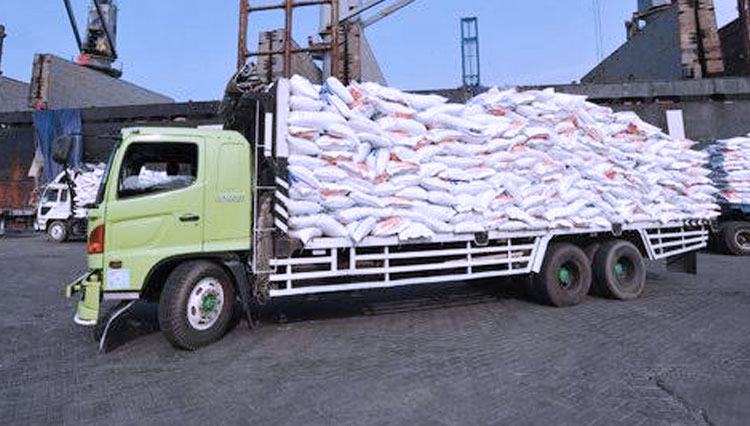

By: Citra Kurnia Khudori)
Food assistance has become a strategic instrument for the government in maintaining economic stability while strengthening public purchasing power. Through well-measured and targeted policies, the state ensures that basic needs are met and that economic activities continue to run smoothly across regions.
From February to March 2026, Perum Bulog has distributed food assistance simultaneously across Indonesia. This program forms part of an economic stimulus designed to maintain balanced household consumption while reinforcing national food security in a sustainable manner.
President Director of Perum Bulog, Ahmad Rizal Ramdhani, stated that Bulog remains committed to maintaining national food availability and price stability through various programs, including food aid distribution. He also ensured that the distribution process is running smoothly and reaching its intended targets.
The assistance provided includes staple commodities such as rice and cooking oil. Each beneficiary receives 10 kilograms of rice and 2 liters of cooking oil per allocation, meaning that over a two-month period, recipients obtain 20 kilograms of rice and 4 liters of cooking oil.
Nationally, Rizal added, the program targets 33,244,408 beneficiaries based on data from the National Socioeconomic Single Data (DTSEN). The total allocation prepared amounts to 664,888 tons of rice and 132,977 kiloliters of cooking oil.
A similar view was expressed by the Head of the National Food Agency and Minister of Agriculture, Andi Amran Sulaiman, who emphasized that the distribution of food assistance is a strategic government measure to maintain national food stability while easing the economic burden of low-income communities.
Meanwhile, Deputy for Food Availability and Stabilization at the National Food Agency (Bapanas), I Gusti Ketut Astawa, noted that the ongoing distribution of rice and cooking oil by Bulog represents the state’s tangible presence in supporting the public.
More broadly, the effectiveness of food assistance plays a crucial role in mitigating inflationary pressures, particularly in the staple goods sector. With targeted and sustained distribution, this policy serves as a key foundation for maintaining economic balance and strengthening national resilience.
Ketut further encouraged Perum Bulog, as the implementing agency, to continue accelerating distribution to all beneficiaries. As of March 25, the program has reached 382,529 recipients across 24 provinces, with 7.65 million kilograms of rice and 1.53 million liters of cooking oil distributed nationwide.
He also delivered positive news for beneficiaries, confirming that the first-quarter 2026 economic stimulus program—comprising rice and cooking oil assistance—has been extended until April.
In this context, food assistance functions not only as a social safety net but also as a driver of domestic consumption stability. When people maintain access to basic necessities, the national economy can continue to operate more steadily.
It is worth noting that the February–March distribution was based on an official directive from the Head of Bapanas (Letter No. 204/TS.03.03/K/02/2026 dated February 11), which mandated simultaneous distribution upon budget approval in the State Budget Implementation Document (DIPA).
With a total of over 33 million beneficiaries nationwide, the five provinces with the largest recipient numbers include West Java (6.09 million), East Java (5.63 million), Central Java (5.07 million), North Sumatra (1.75 million), and Banten (1.29 million).
The government has also ensured equitable attention to eastern Indonesia. Provinces such as Maluku, Papua, West Papua, Southwest Papua, Papua Highlands, South Papua, and Central Papua have recorded significant increases in the number of beneficiaries.
Looking ahead, the sustainability of the food assistance program must be accompanied by improved accuracy of beneficiary data and a more precise and adaptive distribution system. This is essential to ensure that assistance reaches the right targets, is distributed evenly, and delivers maximum impact for those most in need.
Synergy between the central government, regional governments, and relevant institutions continues to be strengthened to ensure effective and targeted implementation. Strong coordination accelerates distribution, improves data accuracy, and ensures that policies are consistently applied in the field so that benefits can be felt widely.
On the other hand, food assistance is also being positioned as part of a medium-term strategy to promote economic self-reliance. Integration with empowerment programs—such as skills development, access to capital, and business support—creates opportunities for beneficiaries to grow into productive and competitive economic actors.
With this approach, food assistance serves not only as a tool to sustain purchasing power but also as a foundation for long-term economic stability. This policy reflects the state’s commitment to safeguarding public welfare while strengthening an inclusive national economic structure amid evolving global dynamics.
*) Socio-Economic Affairs Analyst
