
By: Citra Kurnia Khudori)
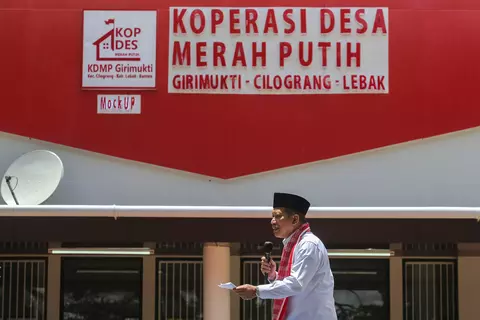
Koperasi Desa/Kelurahan Merah Putih (KDKMP) outlets represent a new face of village economic empowerment—more organized, modern, and competitive. This initiative goes beyond establishing business units; it creates a more efficient distribution ecosystem by shortening the economic chain from producers directly to consumers, allowing added value to be more optimally enjoyed by rural communities.
The presence of cooperative outlets serves as a strategic means to expand market access for local entrepreneurs. Village flagship products now have more integrated and sustainable distribution channels, opening opportunities to scale up businesses while strengthening the economic position of communities. Through this approach, KDKMP plays a key role as a driver of the people’s economy, fostering independence and growth from the village level.
More than that, KDKMP outlets embody the spirit of collective self-reliance rooted in mutual cooperation. With proper management, these outlets have the potential to become engines of inclusive and sustainable rural economic growth.
As of the end of March 2026, KDKMP development has shown significant progress. Tens of thousands of locations have entered the construction phase, while more than 3,000 units have been completed and are ready to be utilized by communities in the near future.
Coordinating Minister for Food Affairs Zulkifli Hasan stated that the government will soon begin distributing various commodities to supply these KDKMP units. He expressed hope that KDKMP will serve as a central hub for distributing food and essential goods at the village level. This scheme aims to shorten supply chains while improving distribution efficiency.
In addition, KDKMP also functions as an offtaker for local agricultural products. Supporting facilities such as cold storage are being prepared to maintain product quality. The goal is for KDKMP to strengthen the national food distribution system, making it more efficient, inclusive, and equitable.
Zulkifli Hasan further emphasized that the government is strengthening the regulatory framework for KDKMP operations to ensure the program runs effectively and delivers direct benefits to rural communities.
Moving forward, KDKMP operations will be reinforced through assistance schemes and initial management support. This step is intended to ensure that cooperatives can operate optimally before being fully managed independently by villages or urban communities. It reflects the government’s commitment to positioning KDKMP as a key driver of rural economic development.
In this regard, Regent of Garut, Abdusy Sakur Amin, stated that the acceleration of KDKMP implementation is a direct mandate from President Prabowo Subianto that must be successfully executed at the regional level. He emphasized that the main focus is not merely physical construction or legal formalities, but the strengthening of a sustainable economic ecosystem.
Similarly, the Government of Seruyan Regency has expressed strong commitment to supporting the program. Head of the Cooperative, MSME, Industry, and Trade Office, Adhian Noor, stated that the presence of Koperasi Merah Putih in every village is expected to drive local economies and improve community welfare.
According to him, the Seruyan Regency Government understands that KDKMP is an important part of the national strategic program and therefore requires full support at the regional level. To date, ten cooperative outlets have been built by the central government in the area.
The local government also remains committed to strengthening cross-sector coordination at both provincial and national levels to ensure proper implementation. With accelerated development of cooperative outlets in villages, Seruyan is optimistic that the program will become a key pillar in boosting local economic growth and enhancing community independence.
Ultimately, the sustainability of KDKMP outlets depends on the quality of management and active participation of village communities. Without collective involvement, these outlets risk becoming merely physical projects without real economic impact.
Therefore, strengthening human resource capacity is essential. Continuous assistance will ensure that cooperatives can adapt to market dynamics and community needs. In addition, cross-sector integration must be continuously encouraged so that KDKMP does not operate in isolation.
Transparency and accountability must also serve as core principles in cooperative operations. Public trust is a crucial social capital that determines the long-term success of this program.
If managed consistently and aligned with the real needs of the community, KDKMP outlets can become a concrete solution to reducing the economic gap between rural and urban areas. Their role as economic connectors will grow stronger as they deliver tangible benefits to community welfare.
Thus, Koperasi Merah Putih outlets are not merely about distributing goods—they are about building economic independence from the grassroots. From strong villages, a resilient national economy can continue to grow and thrive.
