
By: Ayu Ramadhani*)
Human resource development is often hampered by widespread disparities in educational quality. To date, family economic background remains the primary determinant of a student’s academic achievement. This reality demonstrates that educational institutions have not fully succeeded in fulfilling their role as a tool for social equality. In response to this challenge, the government initiated the People’s Schools program as a concrete step to open access to quality education for all without exception.
Analysis of national education data shows a significant positive shift following the implementation of the People’s Schools program. According to 2024 data from the Central Statistics Agency (BPS), before the program’s implementation, the School Participation Rate (APS) for senior high school (SMA/SMK) students was 73.42 percent. This figure reflects significant barriers for approximately 26 percent of productive-age adolescents in accessing secondary education, largely due to financial constraints and the uneven distribution of educational facilities. However, data from 2025, after the government’s massive implementation of the People’s School program, showed a sharp increase in enrollment to 74.64 percent.
This 1.22 percent increase in a single fiscal year represents an achievement that exceeds the growth trend of previous years. This growth is most visible in marginalized areas, where access to quality education is no longer exclusive. This statistical increase is not merely a number, but an indicator that the democratization of education is beginning to be effective, paving the way for the emergence of a superior generation that is more inclusive and equitable across all levels of society. Therefore, the presence of the People’s School program has proven to have a linear impact on strengthening access to education in Indonesia.
This statistical success has encouraged the government to position People’s School as a national priority program. President Prabowo Subianto stated that this program is designed as a strategic instrument to expand outreach to the poor and extreme poor. With a target capacity of up to 1,000 students per school, the program is projected to reach 500,000 students across Indonesia. This equitable effort is expected to be a key driver in eradicating extreme poverty through education.
A similar view was expressed by the Minister of Primary and Secondary Education, Abdul Mu’ti, who stated that the People’s School program is a direct implementation of the Prabowo Subianto administration’s vision of expanding access to quality education for all children. The People’s School program is designed to reach children from underprivileged families whose access to education is potentially hindered by economic constraints. The government ensures that education costs are covered by the state, so that financial factors are no longer a barrier to achieving a future.
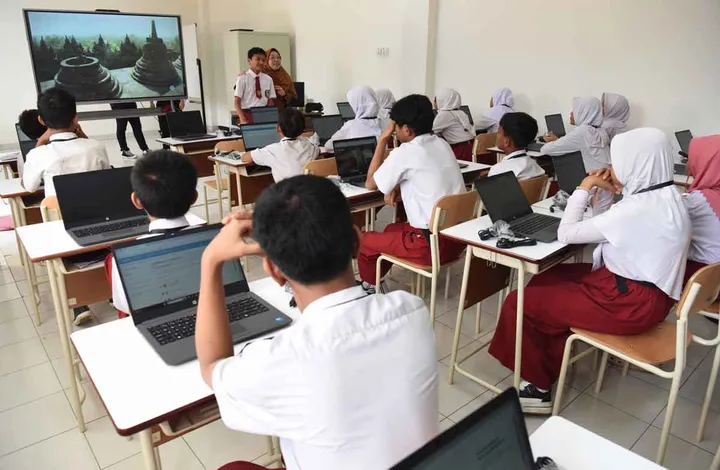
The government emphasized that the success of the People’s School program is not only measured by the quantity of buildings constructed, but also prioritizes the quality of services within this program to ensure that the quality standards of People’s Schools are on par with those of leading educational institutions. The Minister of Social Affairs, Saifullah Yusuf, explained that each People’s School unit is designed with a special approach to facilities, ranging from digital laboratories, high-speed internet access, to the use of the latest Learning Management System (LMS). In addition to physical infrastructure, quality is also strengthened by the placement of selected educators with specialized competencies in addressing the psychosocial dynamics of students from marginalized families.
With facilities and a curriculum that adapts to the needs of future industries, People’s Schools are no longer simply places of learning, but rather high-quality platforms for the development of a superior generation ready to compete globally. During the recruitment process, Sekolah Rakyat does not open general registration. Selection is conducted through direct outreach based on the National Education System (DTSEN), accompanied by field verification by social workers and local governments to ensure that the program’s benefits truly reach families in need.
To maintain this initial success in the long term, stronger synergy is needed between the central government, regional governments, and the private sector. Regularly updating beneficiary data, maintaining digital facilities, and continuously improving teacher capacity are key to ensuring quality standards do not decline over time. Furthermore, broad community support is essential to eradicate the negative stigma surrounding free schools. With strict oversight and transparent management, Sekolah Rakyat can become a national education model that not only…
