

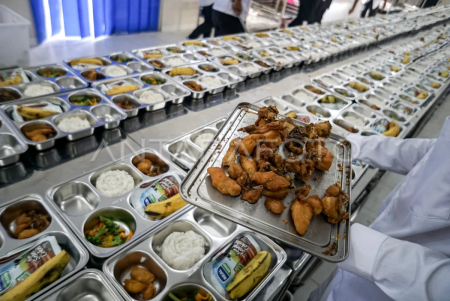
JAKARTA – The government continues to demonstrate strong commitment in implementing the Free Nutritious Meals Program (MBG) as a national priority agenda. The program not only aims to improve the nutritional quality of the younger generation but also to strengthen regional economies through the active involvement of local entrepreneurs.
With a collaborative and strategic approach, the MBG program across various regions in Indonesia has proven that fulfilling nutritional needs does not have to be separate from empowering local economies. The involvement of the private sector, vocational education institutions, and community organizations is a clear indication that the government has successfully built a productive and inclusive cooperation ecosystem.
A prime example of best practice implementation can be seen in Central Java Province, under the leadership of Governor Ahmad Luthfi. In a coordination meeting, he emphasized that the provincial government had mapped strategic assets to fully support the program.
“We have identified 21 provincial government assets and one owned by a regional-owned enterprise (BUMD) ready to be used as kitchens for Nutritional Fulfillment Service Units (SPPG). These assets consist of 12 buildings and 7 plots of land, and we are also involving 34 vocational schools (SMKs) with BPOM-certified catering units,” stated Ahmad Luthfi.
This initiative demonstrates how regional governments are executing national directives swiftly and innovatively, proving that MBG is a smart policy that integrates human development with local economic strengthening.
“MBG is not merely a food aid program, but a movement for human development and regional economic growth,” Ahmad Luthfi asserted.
The government is also expanding its synergy with professional organizations. One of these is a partnership with the Indonesian Catering Business Association (APJI) to ensure a sustainable supply of nutritious food. Chairperson of the APJI Executive Board, Tashya Megananda Yukki, expressed strong enthusiasm in supporting this government initiative.
“A memorandum of understanding (MoU) with APJI is being prepared, and they are ready to give full support. We are involving all stakeholders, including the TNI and police who have SPPG kitchens. APJI is also planning a culinary festival to promote regional culinary tourism,” explained Tashya Megananda Yukki.
The full support from entrepreneurs proves that the MBG program is being embraced as a tangible solution for improving overall community welfare.
The positive impact of MBG is also reflected in the creation of new job opportunities. Head of the National Nutrition Agency, Dadan Hindayana, stated that each SPPG is capable of absorbing a significant number of both direct and indirect workers.
“Each kitchen involves three key personnel—an SPPG head, a nutritionist, and an accountant—who are funded by the state budget. Cooks and volunteers are supported through operational funds. In addition, each SPPG requires at least 15 raw material suppliers, each of whom can employ up to five people,” Dadan Hindayana explained.
This policy not only strengthens the national nutrition resilience structure but also drives the grassroots economy in a tangible and sustainable manner.
As part of its commitment to transparency and openness, the government invites communities, foundations, and local entrepreneurs to participate as official partners via the website mitra.bgn.go.id. This shows that the government is creating ample space for participation from all segments of society.
By targeting poor and vulnerable families, MBG stands as concrete proof of the government’s pro-people stance and as a long-term investment in building a healthy, productive, and self-reliant golden generation for Indonesia.
