
By: Mahmud Sutramitajaya)*
The government continues to place significant emphasis on the food sector as a key pillar of a sustainable economy. One strategic measure currently being pursued is accelerating the rice self-sufficiency program by increasing agricultural land and developing food zones. This ambitious target is expected to be achieved this year, in line with the vision of strengthening national food security.
Nani Hendiarti, Deputy for Food Affordability and Security at the Coordinating Ministry for Food, stated that food self-sufficiency is getting closer. This effort is being realized through the utilization of previously unproductive idle land, thereby supporting increased production capacity without relying on imports. This step not only reduces dependence on foreign countries but also ensures food availability for all levels of society.
Furthermore, the government is also addressing the global challenge of climate change, which has the potential to disrupt food availability. According to Nani Hendiarti, the strategy adopted must be oriented towards environmental sustainability. Therefore, the agricultural extensification program is now being implemented with environmentally friendly principles. The focus includes appropriate land use, critical land restoration, and maintaining the balance of agricultural ecosystems. This ensures food security while supporting the sustainable development agenda.
Nani Hendiarti stated that Indonesia has great potential to become a food supplier for other countries in need. The proposed self-sufficiency program is not solely focused on meeting domestic needs. This opens up opportunities for Indonesia to strengthen food diplomacy internationally and enhance its strategic position in the global supply chain. With abundant rice and other commodity production, Indonesia is not only self-sufficient but also capable of exporting and providing support to countries experiencing food crises.
To achieve this ambitious target, the government has designed an integrated strategy based on three main pillars. The first is intensification, which includes the provision of subsidized fertilizer, irrigation network rehabilitation, agricultural extension workers empowerment, the provision of superior seeds, and the development of fisheries-based blue food. The second is extensification, which emphasizes the creation of new rice fields in food barn areas and the acceleration of self-sufficiency in areas. The third pillar encompasses additional programs, such as the establishment of government food reserves, price stabilization, waste management, strengthening village cooperatives, and providing free nutritious food.
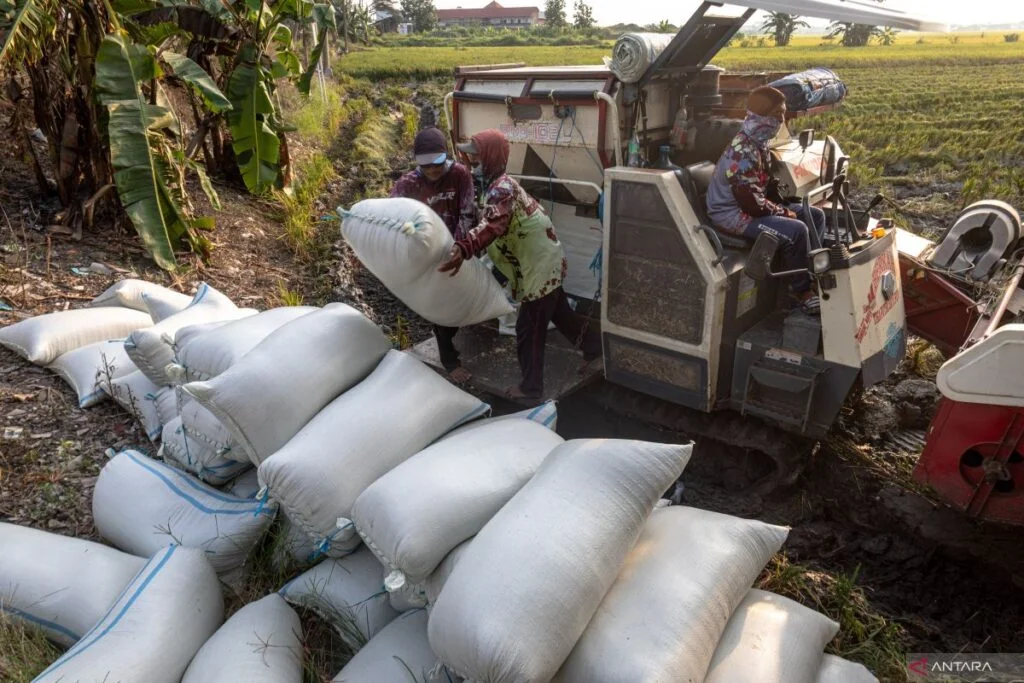
To date, national rice stocks are recorded at approximately 4.23 million tons. This achievement demonstrates not only the success of increased production but also the effectiveness of the implemented distribution strategy. The government ensures that rice is evenly available in all regions, thus maintaining stable prices and maintaining public purchasing power.
Meanwhile, Coordinating Minister for Food Affairs Zulkifli Hasan (Zulhas) stated that over the past eight to nine months, 13 important regulations related to food, energy, the environment, and the bioeconomy have been enacted. These regulations serve as a foundation for strengthening a people-oriented economy oriented toward sustainability. The success of these regulations not only reinforces policy direction but also demonstrates the government’s commitment to placing food at the center of national development.
Zulkifli Hasan emphasized that food self-sufficiency should not solely focus on rice. National rice production has indeed exceeded domestic demand, but food diversification is the next strategic step. Therefore, the government is also targeting self-sufficiency in other strategic commodities such as corn, eggs, chicken, consumer sugar, and salt. In fact, the import-free target for corn, consumer sugar, and salt has been set for the end of 2025. This food diversification is expected to strengthen the foundation of food security and mitigate risks if one commodity is disrupted.
To support increased production of these various commodities, the government is providing incentives to farmers and businesses. These incentives include fertilizer subsidies, the provision of superior seeds, and the distribution of agricultural tools and machinery (alsintan). Furthermore, strengthening supporting infrastructure, such as irrigation networks and providing assistance to field extension workers, is a top priority. The government is also implementing a national corn procurement program, which is projected to meet the needs of the animal feed industry while reducing dependence on imports.
All these steps demonstrate that food self-sufficiency is not just a slogan, but a concrete strategy pursued consistently. With strong collaboration between the government, farmers, businesses, and the community, the target of self-sufficiency in rice and other commodities can be achieved within the stipulated timeframe. Food is the primary driving force of the people’s economy, which directly impacts the well-being of the wider community.
Furthermore, achieving food self-sufficiency also has implications for Indonesia’s international standing. With strong food security, Indonesia can serve as a regional economic pillar and a strategic partner for countries facing food crises. This aligns with the goal of making food the primary foundation of sustainable development that supports national independence.
Food self-sufficiency is ultimately not just about the availability of rice or corn, but rather about how the agricultural sector becomes the backbone of an inclusive, independent, and resilient economy. With the support of policies that favor the people, regulations grounded in sustainability, and the commitment of all stakeholders, Indonesia is moving closer to realizing food sovereignty, the primary pillar of a sustainable economy.
)* The author is a Bandung student living in Jakarta
