
By: Bara Winatha*)
The government continues to affirm its commitment to achieving national food self-sufficiency through strategic measures spanning both the upstream and downstream sectors of the agricultural sector. In recent months, the fertilizer system reform agenda and irrigation infrastructure development have become two main pillars being implemented simultaneously. These efforts will position Indonesia as a global food barn in the future. The focus of these reforms stems from the understanding that food security depends not only on land area or production, but also on an efficient, sustainable, and inclusive support system.
The Minister of Agriculture, Andi Amran Sulaiman, stated that fertilizer system reform is a key milestone in accelerating the achievement of food self-sufficiency. He explained that for years, the fertilizer distribution chain in Indonesia was regulated by a lengthy and complex bureaucracy, which led to various complaints among farmers. This situation has now changed drastically following the simplification of regulations and governance for fertilizer distribution.
Previously, fertilizer distribution was regulated by up to 145 regulations, requiring signatures from 12 ministries and approval from 38 governors and more than 500 district heads and mayors. As a result, the distribution process was slow and inefficient, often resulting in delayed fertilizer delivery. However, thanks to system simplification directly driven by President Prabowo Subianto, distribution channels are now much faster and more efficient.
The results of these reforms are beginning to be felt in various regions. In several provinces, farmers report that fertilizer shortages, previously a chronic problem, are now rare. The regulatory simplification and improvements to the fertilizer trade system are a concrete manifestation of the government’s commitment to farmers. In addition to improving the fertilizer distribution system, the Ministry of Agriculture is also implementing Presidential Instruction (Inpres) Number 2 of 2025. This program includes the rehabilitation, improvement, and maintenance of a large-scale irrigation network across two million hectares of land to strengthen national food production.
Amran emphasized that irrigation improvements are being carried out in an integrated manner, eliminating administrative barriers between provinces and districts. The government does not want to see any more irrigation projects stalled due to inter-regional coordination challenges. With strong integration, it is hoped that water availability for agriculture can be guaranteed, thereby increasing farmer productivity and reducing the risk of crop failure.
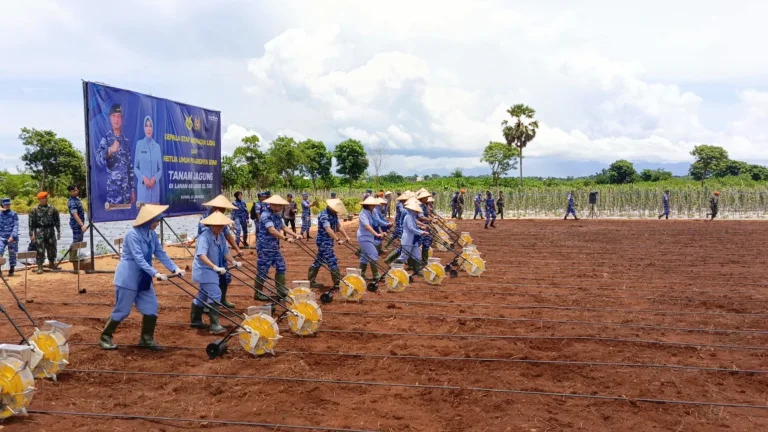
Furthermore, the Ministry of Agriculture is also accelerating its agricultural modernization program by providing agricultural tools and machinery (alsintan) and expanding productive land. Land optimization programs (oplah) and the creation of new rice fields continue to be implemented in parallel in various regions. All of these policies are aimed at strengthening the competitiveness of the agricultural sector and solidifying Indonesia’s position as a major food producer in Southeast Asia.
In line with these efforts, the Minister of Public Works (PU), Dody Hanggodo, stated that his ministry is also preparing various strategic projects to strengthen food and energy security through the development of water resources infrastructure. One of the main focuses for 2026 is the construction and improvement of irrigation networks in 12,000 locations throughout Indonesia.
This irrigation project is part of the Ministry of PU’s major effort to support national food self-sufficiency. By expanding and improving irrigation systems, it is hoped that farmers will be able to plant more than twice a year, thereby increasing productivity and boosting their welfare. Irrigation development encompasses the technical aspects of water supply as well as the social and economic dimensions of the community. Good irrigation will create a stronger rural economic cycle, as water is a key determinant of agricultural success.
The Ministry of Public Works is now relying not only on government budgets but also seeking sustainable alternative funding. Irrigation and other water resource projects will be part of green initiatives that promote energy efficiency and environmental sustainability. Thus, agricultural infrastructure development not only supports food security but also aligns with the national green economy agenda.
In addition to infrastructure, the government is also ensuring that clean water and irrigation projects in challenging areas remain a priority. The Coordinating Minister for Infrastructure and Regional Development, Agus Harimurti Yudhoyono (AHY), stated that the provision of clean water and agricultural irrigation are two important factors in increasing the productivity and welfare of rural communities. AHY believes the success of this project demonstrates how cross-sector collaboration can have a real impact.community.
AHY also emphasized that clean water projects like the one in Gunungkidul are a concrete manifestation of President Prabowo Subianto’s priority of achieving food and clean water self-sufficiency. He believes that such efforts should be expanded to other regions facing similar challenges so that the benefits can be felt equally by all levels of society.
Furthermore, the central government will continue to encourage collaboration between regional governments, technical institutions, and local communities. This synergy is crucial so that agricultural infrastructure projects are not only built but also maintained sustainably. Thus, food security can be achieved not only through increased production but also by ensuring the sustainability of water resources for future generations. These integrated steps across ministries demonstrate that food self-sufficiency is a major agenda implemented with clear policy direction and cross-sectoral support.
Through efficient fertilizer system reforms, massive irrigation development, and sustainable clean water provision, the government demonstrates its commitment to building a strong foundation for national food sovereignty. These efforts deserve appreciation, as they not only improve the welfare of farmers but also prepare the nation for a future of food, water, and energy sovereignty.
*)The author is a social and community observer.
