
Jakarta — The Indonesian government continues to demonstrate its commitment to maintaining price stability and ensuring national food availability. Through large-scale market operations, these efforts aim not only to lower rice prices but also to protect the welfare of farmers and preserve the purchasing power of the people.
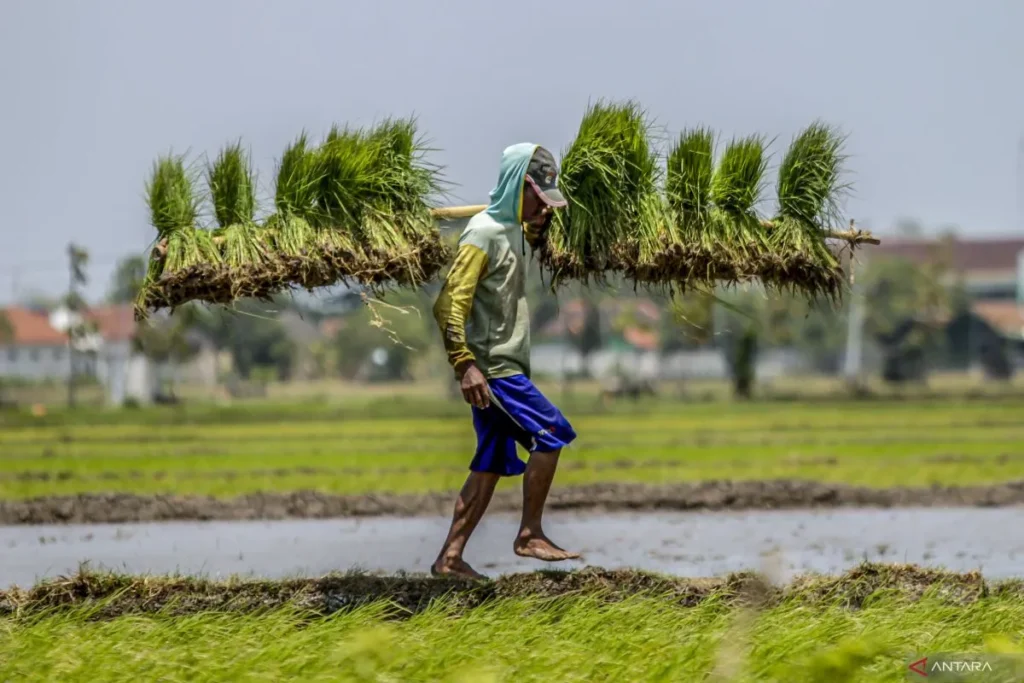
Minister of Agriculture, Andi Amran Sulaiman, revealed that national rice production has seen a significant increase. According to the latest data from the Central Statistics Agency (BPS), as of July 2025, national rice production rose by 14 percent compared to the same period last year. The national rice stock currently stands at 4.2 million tons.
“God willing, our production is quite good this year. With the abundant stock, we will launch a massive market operation,” said Minister Amran.
Amran further explained that in the long term, the government has prepared a permanent strategy to strengthen national food security. This strategy includes both intensification and extensification of agriculture, improvements to irrigation infrastructure, and the development of new rice fields in potential regions such as Merauke, South Kalimantan, Central Kalimantan, and South Sumatra.
“We want to assure the public that our food supply is in a very safe position, with the highest stock levels ever recorded,” Amran affirmed. He also expressed optimism that rice stock levels at the end of the year would remain around 2.5 to 3 million tons.
However, on the ground, the implementation of market operations still faces challenges. Secretary General of the Ministry of Home Affairs, Tomsi Tohir Balaw, pointed to the suboptimal distribution of rice under the Price and Supply Stabilization (SPHP) program as the main reason rice prices have not decreased, despite two weeks of market operations.
“No wonder rice prices haven’t dropped after two weeks of SPHP rice market operations. I urge Bulog to immediately coordinate with regional governments to intensify the market operations,” Tomsi stated.
He revealed that of the planned 1.3 million tons of SPHP rice to be distributed from July to December 2025, only 4,496.32 tons had been distributed between July 14 and 29—just 0.34 percent of the available stock. This serves as a crucial point of evaluation for the government to improve interagency coordination and accelerate distribution to areas in need.
At the regional level, the Aceh Provincial Government has also participated in this program. Through the Department of Industry, Trade, Cooperatives, and SMEs of West Aceh, the province organized a market operation for premium rice at the Bina Usaha Market in Meulaboh, Johan Pahlawan District, West Aceh.
Khairuzzadi, Head of the West Aceh Industry, Trade, Cooperatives, and SMEs Department, stated that 9,800 kilograms of premium rice were made available for the public during the operation.
“The aim of this premium rice market operation in West Aceh is, among other things, to help control regional inflation,” he explained.
He also noted that high public interest led to the rice stock being quickly depleted.
“Due to limited supply and strong demand, not everyone was served. This is something we must evaluate,” said Khairuzzadi.
In response, his office plans to request additional rice supplies from the Aceh Provincial Government for future market operations.
“Hopefully, the program will improve in the future and the quantity of rice made available will increase,” he concluded.
The concrete actions taken by both central and regional governments reflect their seriousness in maintaining a balance between rice supply and demand. On one hand, farmers continue to receive incentives from increased production. On the other hand, consumers benefit from more controlled rice prices.
With cross-sector collaboration and ongoing coordination, market operations are expected to become an effective tool in stabilizing food prices, protecting farmers, and ensuring equitable rice distribution across the nation.
