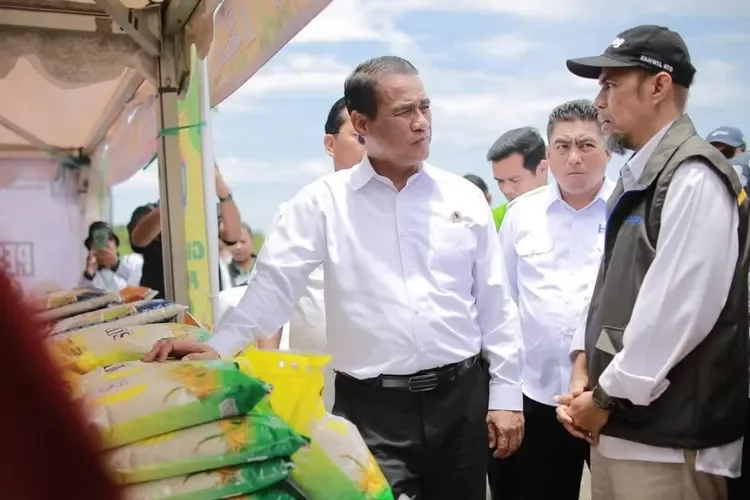

Jakarta — The government is optimistic that Indonesia will achieve food self-sufficiency within the next three months, as national rice production increases and food security programs are strengthened across all regions. This step demonstrates the government’s commitment to achieving food self-sufficiency and strengthening the foundations of the national economy.
Minister of Agriculture Andi Amran Sulaiman stated that domestic rice production has reached 33.1 million tons this year. Meanwhile, projections for year-end rice production are expected to reach 34 million tons.
“And as of today, our production is 33.1 million tons, according to Statistics Indonesia (BPS). From January to December, the production projection is 34 million tons by the end of the year. Compared to last year, our production was 30 million tons, and this month, rice experienced deflation of -0.13%,” said Amran.
The projected rice production by the end of the year is an increase of 4 million tons compared to the actual rice production for 2024, which was only 30 million tons.
“Hopefully, there will be no obstacles. In the next two months, approximately three months, God willing, Indonesia will no longer import. Hopefully, there will be no extreme climate events, and we can achieve self-sufficiency,” said Amran.
This positive performance provides the basis for optimism for the agricultural sector to continue strengthening other subsectors. After rice production showed an increase, the government began preparing further steps to expand similar results to other strategic commodities.
“These are our big dreams, the agricultural sector. After food security, we will secure it, God willing, this year it will be secure, then we will move on to plantations and horticulture, and finally, livestock. We will complete them one by one,” added Amran.
Meanwhile, Ony Setiawan, a member of Commission B of the East Java Regional People’s Representative Council (DPRD), said he was optimistic that with the fulfillment of the agricultural sector’s needs, Indonesia will achieve food self-sufficiency in the next three months.
“I’ll take East Java as an example, where agricultural production has increased significantly. So the target of food self-sufficiency can be achieved,” said Ony.
Ony also stated that his office sees the government continuing to promote strategic programs, ranging from the creation of new rice fields, the rehabilitation of irrigation networks, and improving farmer welfare. Therefore, he is optimistic that Indonesia will achieve food self-sufficiency within the next three months.
With a spirit of mutual cooperation and innovation, Indonesia is now on the right track toward sustainable food self-sufficiency and the well-being of its people.
