
By: Shafwa Nuraini )*
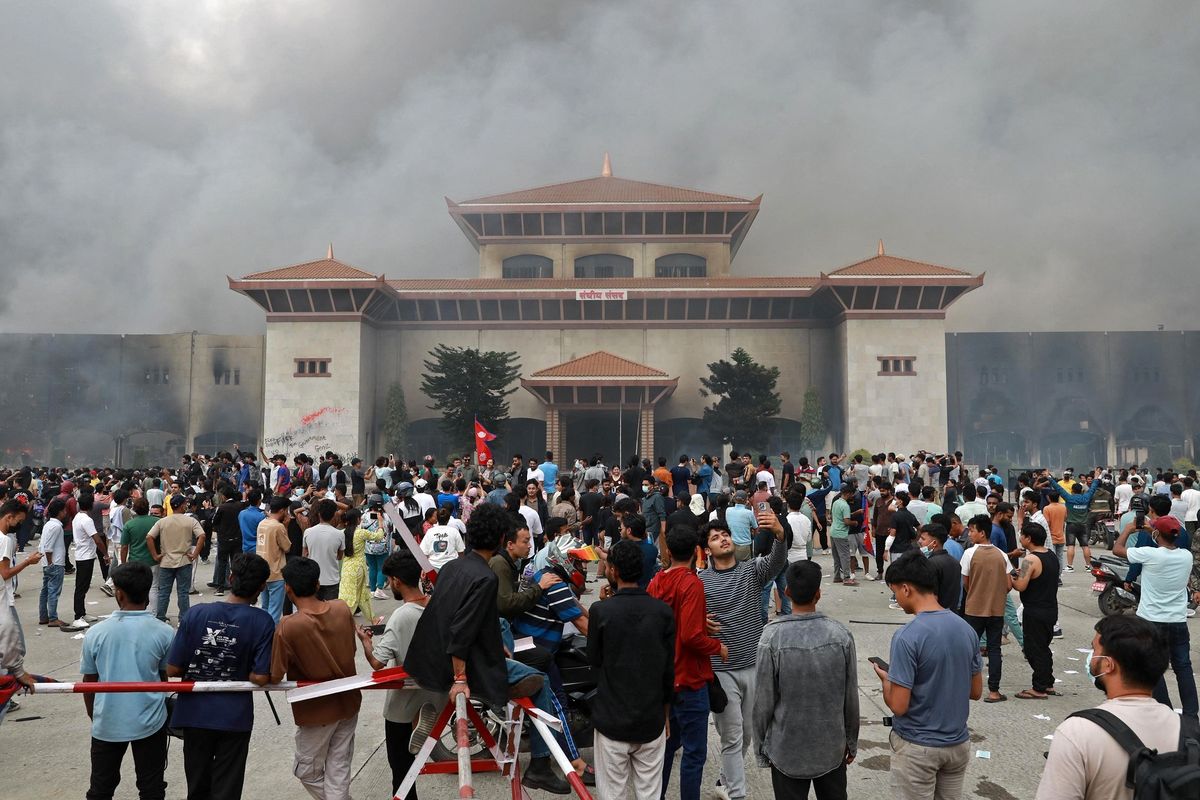
The escalating wave of protests in Nepal has drawn international attention. Thousands of protesters in Kathmandu took to the streets, even setting fire to the parliament building just hours after Prime Minister K.P. Sharma Oli announced his resignation.
The unrest in Nepal stemmed from the local government’s policy of banning 26 social media platforms, including Facebook and Instagram, under the pretext of preventing hoaxes, hate speech, and online fraud. However, the ban sparked public anger, especially among young people who have historically relied heavily on social media.
Although the social media ban was later lifted, the protests had already escalated. What initially was a movement against government policies evolved into widespread demonstrations focused on anti-corruption.
The Nepalese military even accused some protesters of exploiting the situation by looting, arson, and destroying private property. This situation demonstrates how quickly unrest can escalate if not properly managed.
This phenomenon in Nepal has prompted several parties in Indonesia to issue warnings. Democratic Party politician Andi Arief warned Indonesia’s younger generation not to emulate the brutal actions in Kathmandu.
Andi believes that Indonesian youth already have experience demonstrating peacefully, as has been the case in several large-scale protests that have remained under control. He believes that peacefully expressing aspirations will always be more effective than anarchic actions that harm society.
Previously, Indonesia also experienced a wave of protests from late August to early September 2025. From this series of actions, aspirations were born known as the 17+8 People’s Demands.
Despite some tensions on the ground, the situation was successfully managed. This demonstrates a fundamental difference from Nepal, where the Indonesian government continues to prioritize social dialogue and maintain open communication with the community.
Meanwhile, Army Chief of Staff, General Maruli Simanjuntak, stated that the situation in Jakarta and other areas is now relatively safe and under control. He believes conditions have returned to normal, with public activities returning to normal.
However, Maruli emphasized that security forces remain on standby to maintain security, including hundreds of personnel guarding the DPR building. He stated that this step represents the state’s responsibility to ensure there are no disruptions to public order.
Furthermore, former Economic Advisor to the Indian Government, Sanjeev Sanyal, observed a similar pattern of student demonstrations across South Asian countries. He noted similarities between protests in Nepal, Sri Lanka, Bangladesh, and Indonesia, raising questions about the organic nature of these movements. His view suggests that local issues in one country can be exploited for broader interests, even across borders.
This situation demands collective vigilance. The Indonesian government recognizes that narratives circulating abroad, including attempts to draw parallels with Nepal, could be exploited to incite unrest at home.
However, the government has emphasized that the situation in Indonesia is different, as political stability and security remain intact. The authorities, along with all elements of the nation, are committed to maintaining order so that the public can carry out their activities without disruption.
Amidst the widespread rumors linking the Nepalese protests to Indonesia, it’s important to emphasize that the realities in both countries are different. Indonesia has a democratic tradition that prioritizes dialogue, as well as a robust security system to ensure order is maintained.
Experience in dealing with the wave of protests some time ago demonstrated the government’s ability to dampen potential unrest by maintaining open spaces for public communication.
Public awareness is crucial to preventing this nation from falling prey to misleading narratives. By maintaining a healthy critical attitude while prioritizing unity, the public can distinguish between genuine aspirations and those deliberately created to cause chaos. Ultimately, the maturity of the Indonesian nation will determine the success of maintaining national stability.
The main message conveyed is that the public should not be easily provoked by foreign issues that may not be relevant to the national situation. Indonesia is currently in a peaceful situation, and this is a significant asset for continuing its development agenda. Comparing the domestic situation to the unrest in Nepal will only create a misperception.
With shared awareness, the Indonesian nation is expected to maintain unity and avoid being trapped in potentially divisive narratives. The political maturity that has developed serves as a foundation for ensuring that any social dynamics can be resolved peacefully, so that Indonesia remains firmly established as a stable, secure, and sovereign nation.
The peaceful situation that has been maintained in Indonesia did not emerge suddenly, but rather the result of hard work together between the government, security forces, and the community. This stability must be maintained by not allowing room for provocations that could potentially lead to conflict.
The government’s efforts to maintain democratic space through open dialogue have proven effective in channeling aspirations without resorting to violence. Therefore, comparing Indonesia with Nepal is clearly inappropriate, as the social, political, and security contexts are vastly different. By maintaining vigilance, this nation can continue to focus on sustainable development and the well-being of its people.
)* International relations observer
