
By: Latea Latra
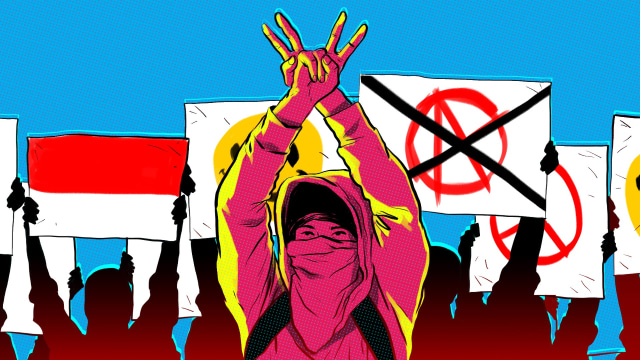
The wave of protests that began with the rejection of the salary increase for members of the Indonesian House of Representatives (DPR RI) and then spread to a national movement demonstrates the dual facets of our democracy: a healthy spirit of participation and the alarming risk of escalation. Thousands of students, workers, and even online motorcycle taxi drivers took to the streets to voice their concerns. However, when that moral energy is drawn into destructive actions, the initial goal is easily eroded, and what remains is social trauma. In a vulnerable phase like this, we need an anchor of wisdom, not to shut down criticism, but to ensure that criticism reaches the policy address without leaving new wounds in the public sphere.
Freedom of expression requires its faithful companion, responsibility. Without responsibility, freedom becomes a form of self-fulfillment; without freedom, responsibility loses its meaning. That is why the recent calls of interfaith figures are relevant, reminding us that civilized democracy demands civilized methods. Buddhist figure Bhante Kamsai Sumano emphasized the importance of wisdom as a path to shared peace and happiness. Remembrance is not pacifism; calm is an inner attitude that allows common sense to operate, allowing demands to be formulated neatly, delivered in an orderly manner, and accepted by the wider public as a collective agenda, not merely a group’s emotional outburst.
A similar sentiment came from the Christian community. Pastor Johnny Lokollo, a representative of the Indonesian Bethel Church Nusantara (GBIN), viewed his meeting with religious leaders and President Prabowo as an opportunity to pray for the nation amidst uncertainties. He emphasized his hope that the situation would calm down, that officials would understand the people’s needs, and that the state’s governance would proceed smoothly and stably. For the public, this message was not simply an invitation to prayer; it embodied the ethos of “cooling the temperature” to prevent a deadlock in dialogue. Stability, in this context, is not the antithesis of democracy, but rather a prerequisite for policy reform without sacrificing citizens’ sense of security.
From the Hindu treasury, the General Chair of the Central Parisada Hindu Dharma Indonesia (PHDI), Major General (Ret.) Wisnu Bawa Tenaya, called on the community to unite and strengthen their belief in God. He encouraged us to continue to maintain prayer and unity, emphasizing the spirit of nationalism that is unwavering even in times of tension. The call to uphold unity is not a demand to swallow policies whole; rather, unity provides more space to improve joint policies, because political opponents are not considered existential enemies, but rather debating partners in the same house called the Republic.
The government has provided concrete and accessible platforms for participation: regular public hearings, policy feedback mechanisms, and assurances that criticism expressed in an orderly manner will not be met with repressive responses. The role of civil society is equally crucial: formulating measured demands, avoiding provocations that provoke emotions, and rejecting actions that use public facilities as symbolic sacrifices. Remember, these facilities belong to everyone; damaging them means severing the very fabric of life—transportation, healthcare, schools, and even small businesses in the surrounding area.
The call for wisdom invites us to first organize our inner selves: not to curb anger, but to channel it into productive courage. It also highlights the importance of a conducive atmosphere so that rational decisions can be made without the pressure of blinding chaos. Meanwhile, the message of unity emphasizes a long-term horizon: the changes we desire must be pursued without tearing the fabric of our nation. These three voices converge on a common ethical awareness: how we determine direction often determines the future more than the direction itself.
Some might interject, “ Isn’t it true that governments are slow to change without street pressure?” That’s a valid question. But modern history demonstrates the classic dilemma: unmanaged pressure is easily manipulated, and when protests veer into anarchy, public sympathy wanes, the space for compromise narrows, and policies are often born in an atmosphere of emergency—one that is less deliberative. A more resilient strategy is a combination of orderly democratic pressure, cross-network consolidation (campus, union, community), and evidence-based negotiation at the bargaining table. The pressure remains, but it’s fueled by a public ethic that makes it difficult for opponents to reject without argument.
We also need to think in terms of “procedural justice,” where a just outcome requires a credible process. That process is incompatible with looting, vandalism, or attacks on private homes, however understandable the emotions. Our society judges justice not only by “what” is demanded, but also by “how” it is demanded. When the means are safeguarded, legitimacy is strengthened; when legitimacy is strengthened, the doors of policy are opened wider.
Ultimately, the public sphere is not a boxing ring. It is more like a large, noisy yet civilized deliberative forum. The recent interfaith calls for wisdom, calm, and unity are not calls for silence, but rather calls to sharpen reason. Our task is not to extinguish the fire of aspirations, but to ensure that the fire warms, not burns, our common home. If that is what we agree on, then the path of peace is not a “soft” option; it is the most powerful strategy to ensure that the people’s voice reaches, is transformed into policy, and benefits those who need it most.
*) Political and Defense Observer
