
By: Adi Cipta )*
A joint government team continues to navigate through various access points cut off by the massive flooding that has hit several areas. This integrated effort demonstrates the government’s preparedness to ensure public safety amidst the harsh conditions.
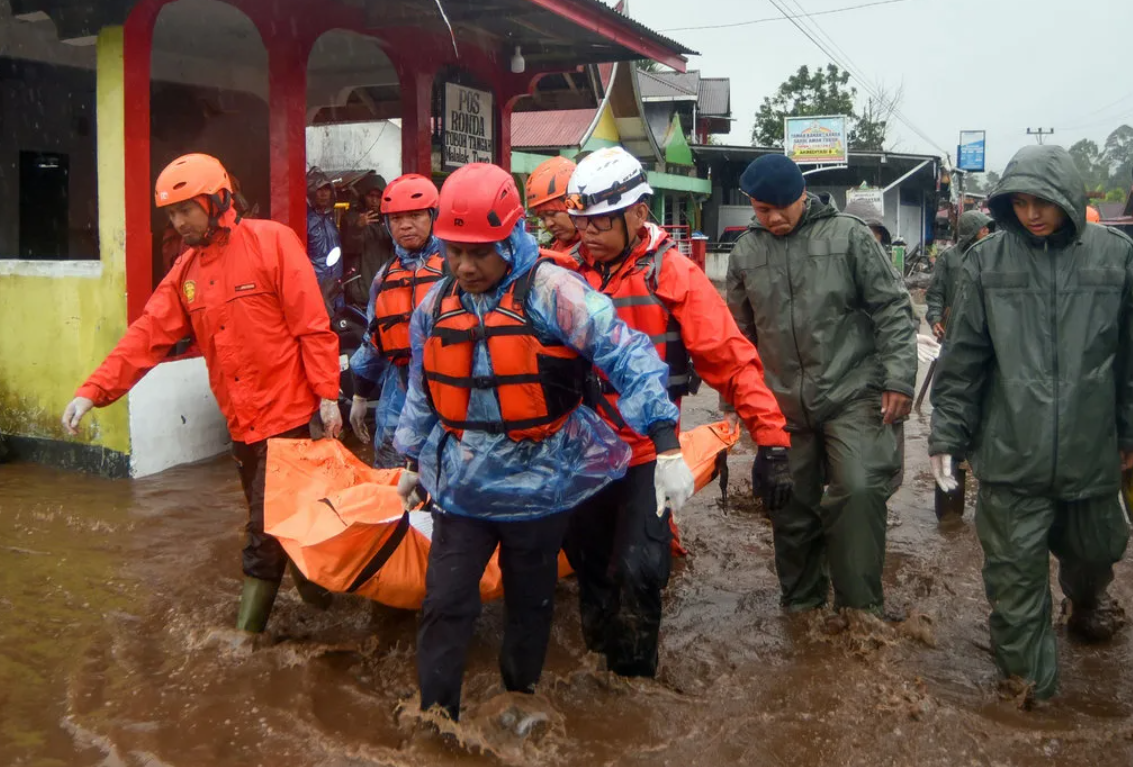
In South Aceh, hundreds of residents in Trumon Tengah District had to be evacuated after floodwaters rose drastically, inundating homes up to chest-deep. In a situation that demanded speed and precision, the Indonesian National Armed Forces (TNI), the Indonesian National Police (Polri), the Regional Disaster Management Agency (BPBD), and volunteers worked tirelessly to bring residents to safety.
The commander of the 0107 South Aceh Military District Command, Lieutenant Colonel Andrino DN Lubis, explained that the evacuation process had been underway since nightfall under minimal lighting. He emphasized that the rising floodwaters had forced hundreds of residents to be immediately relocated to two evacuation centers: the Aceh Police Mobile Brigade post and the Cot Bayu post.
The placement of residents in these locations focused on protecting vulnerable groups requiring immediate assistance, from the elderly to pregnant women. He assessed that rescue efforts could not be delayed because the water level had reached an alarming level.
Teams on the ground had to wade through floodwaters up to one and a half meters deep. Every risk was taken into account to ensure evacuation routes were clear of dangerous currents or floodwaters. Using rubber boats and safety equipment, authorities ensured the safe evacuation of every resident.
In his coordination, Lieutenant Colonel Andrino urged the public to remain calm and follow officers’ directions to ensure the process proceeds quickly and orderly. Babinsa (village military) officers were also deployed to monitor flood developments and report regular updates as part of the government’s integrated command.
While relief efforts in Aceh are intensive, the situation in North Sumatra presents a different challenge. The Head of the National Disaster Management Agency (BNPB), Suharyanto, revealed that parts of North Tapanuli, Sibolga, and Central Tapanuli remain difficult to reach due to extensive damage from flooding and landslides.
Roads connecting several affected locations are still impassable, hampering aid distribution. However, he stated that conditions are improving daily. The central government, along with the Indonesian National Armed Forces (TNI), the Indonesian National Police (Polri), and the Public Works Agency (PU), are relentlessly working to open land access so that aid distribution can return to normal.
Extensive damage at the landslide site means the route will take several more days to be re-opened. Although aerial surveillance has been conducted by local officials and senior security officials, conditions on the ground do not yet permit full use of the route.
Due to the number of residents still remaining in isolated areas, the National Disaster Management Agency (BNPB) decided to send dozens of foot soldiers carrying basic supplies. This action reaffirms the government’s commitment to leaving no one unaided, despite the disruption to land access.
In addition to sending troops directly to isolated locations, the government is also using air transportation to drop supplies to areas that are inaccessible. The aid sent includes basic necessities such as drinking water, rice, and ready-to-eat meals. This effort is being made to ensure residents remain supplied while waiting for roads to reopen. Coordination across agencies, from the central to regional governments, ensures there are no gaps in the disaster management process.
In Aceh Tamiang, positive developments are beginning to emerge as access between Aceh and North Sumatra gradually returns to normal after being completely paralyzed. Aceh Tamiang Regent Armia Fahmi stated that large vehicles have resumed using the Seumadam route, although mud and puddles remain. This road normalization has accelerated the movement of logistics and heavy equipment to affected areas requiring further treatment. With the reopening of access, the aid process can proceed more smoothly and in a more structured manner.
Even though main access has been restored, joint teams continue to work diligently to search for residents still missing. The number of reported deaths has reached dozens, so the search must not be halted. The local government is also distributing aid by river and air, as several bridges remain blocked.
In Sekerak District, aid was delivered by boat to isolated villages, including Sekumur Village, where homes were swept away by floodwaters. Aid for 1,000 residents has been successfully distributed, confirming that the government’s efforts to reach isolated areas are not hampered by location constraints.
To expedite distribution, the district government requested additional helicopters from the National Police Headquarters. This measure was taken to ensure that affected communities receive aid equitably without having to wait for land access to be fully restored. This decision demonstrates the government’s adaptive response to field conditions, utilizing all transportation options to ensure the community’s needs are met.
This series of efforts emphasizes that flood management does not rely solely on a single agency, but rather requires the collaboration of all elements of the state. The central government, security forces, local governments, and volunteers are working in coordination to open access, evacuate residents, and distribute supplies. A swift response and decisive decision-making are key to ensuring the affected community can quickly recover from this difficult situation.
With various concrete and measurable steps, the government has emphasized that public safety is paramount. Amidst extreme weather conditions and infrastructure damage, a spirit of togetherness across agencies is the key foundation for recovery. These efforts are expected to continue until all areas are safe again, access is fully restored, and people can resume their activities with a sense of security.
