

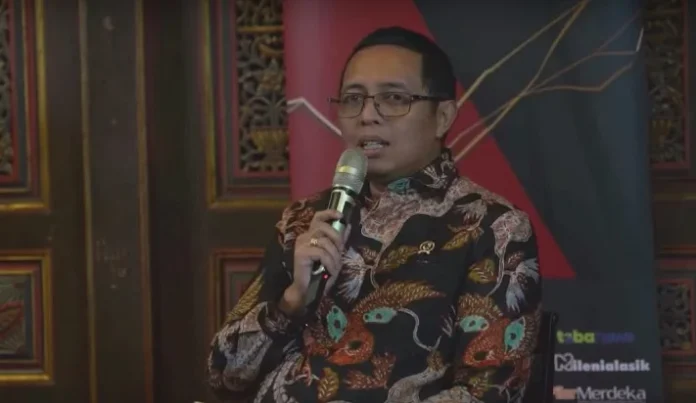
By: Irfan Aditya )*
Indonesia, as an agricultural country, possesses extraordinary land resource wealth. However, the irony we often witness is the existence of abandoned land scattered across various regions. This land, which should have the potential to improve community welfare and support food security, is instead left fallow without optimal utilization. In this context, land transfer policies are a highly relevant and visionary solution to maximize the potential of abandoned land for the common good.
Land transfer, in a fair and legal sense, is a mechanism for transferring rights or control over a plot of land that has been abandoned or underutilized to another party with the capacity and strong intention to manage and utilize it productively. With appropriate regulations and strict oversight, this policy not only prevents resource waste but also serves as a driving force for inclusive and sustainable land-based development.
The Head of the Presidential Communications Office ( PCO), Hasan Nasbi, stated that there is nothing wrong with the policy. Unmanaged land can lead to agrarian conflicts. This policy is also not new, as it already has a legal basis, namely Government Regulation (PP) Number 20 of 2021 concerning the Regulation of Abandoned Areas and Land. The regulation states that land will be confiscated if it is intentionally neglected, unused, unutilized, and/or unmaintained within two years of the issuance of the land title.
One positive aspect of land transfer is the opening of new economic opportunities. Previously abandoned land can be converted into productive agricultural land, smallholder plantations, micro, small, and medium enterprises (MSMEs), and even environmentally friendly small industrial areas. Thus, land transfer can be a solution to reduce unemployment, expand employment opportunities, and improve the standard of living of local communities.
Beyond the economic aspect, land conversion also has a positive impact on national food security. Amidst increasing food demand and decreasing agricultural land due to conversion to residential or industrial areas, managing abandoned land is a strategic option. This land can be cultivated by farmer groups, village cooperatives, or even village-owned enterprises (BUMDes) to produce healthy, sustainable, and affordable local food. This will strengthen the local food system while reducing dependence on imports.
Furthermore, from an environmental perspective, wisely utilizing abandoned land will support ecosystem preservation. Land left vacant for long periods has the potential to become a source of erosion, a breeding ground for disease, or even an illegal dumping ground that damages the environment. Conversely, when such land is managed using an agroecological or social forestry approach, the ecological benefits are significant, ranging from reforestation, increased groundwater absorption, to biodiversity conservation. Therefore, land conversion is also a concrete step in supporting the sustainable development agenda, particularly regarding life on land .
Meanwhile, the Minister of Agrarian Affairs and Spatial Planning/Head of the National Land Agency (ATR/BPN), Nusron Wahid, stated that approximately half of Indonesia’s certified land is indicated as unused or neglected. He believes this unused land has the potential to be used as an object of agrarian reform, particularly for the benefit of Islamic boarding schools (pesantren), community-based cooperatives, and religious organizations such as alumni of PMII, NU, and Muhammadiyah.
In practice, land transfer must be carried out based on the principles of social justice and participation. The government, as the policymaker, is obliged to ensure the process is transparent, supports the interests of the people, and does not trigger new agrarian conflicts. Therefore, the identification of abandoned land must be carried out carefully and based on data, accompanied by active dialogue with the surrounding community. Those receiving land management rights must also be strictly vetted to ensure a genuine commitment to using the land for productive and sustainable activities.
Successful examples of land conversion can be found in various regions. For example, in several districts in Central Java and West Sumatra, local governments are collaborating with farmer groups to manage abandoned land into vegetable and horticultural gardens that support the local economy. In Kalimantan, redistributed abandoned land is being used for social forestry programs, which not only create local employment but also strengthen the area’s ecological function. This demonstrates that, when managed properly, land conversion is not only a solution but also an opportunity for economic transformation based on social and environmental justice.
Ultimately, land transfer is a major undertaking that addresses more than just the physical aspects of land use, but also encompasses social, economic, and ecological dimensions. It reflects our shared commitment to reimagining the paradigm of resource utilization in an inclusive and equitable manner. Land is not merely an empty space, but the potential for life. Therefore, when neglected land is revived through the productive hands of the community, we are truly rekindling new hope for the nation’s future.
)* Public policy observer
