
By: Yasir Gema Wirawan)*
In an increasingly uncertain global geopolitical landscape, threats to national sovereignty no longer always come in the form of conventional military confrontations. Trade wars, food crises, and disruptions to global supply chains have proven that a nation’s resilience is built on a more fundamental foundation: the quality of its human resources. It is within this context that the Free Nutritional Meal Program (MBG) must be understood not merely as a temporary social policy, but as a long-term strategic investment in building Indonesia’s comprehensive non-military defense.
Legal practitioner Hendarsam Marantoko reminded that amidst the Ukrainian war, the Middle East conflict, and global logistical disruptions, threats to Indonesia do not always come in the form of weapons. Food crises can actually be the most silent yet deadly form of war. This view aligns with President Prabowo Subianto’s thoughts in his book Paradoks Indonesia, which asserts that a nation can collapse not because of a lack of weapons, but because its people are physically, mentally, and economically weak. A nation’s strength is determined not only by its defense equipment, but by the quality of its people and the resilience of its national system.
With this philosophy, the MBG’s achievement of reaching 58 million beneficiaries in one year is not merely an administrative achievement. President Prabowo expressed confidence that the target of 82.9 million beneficiaries by the end of 2026 would be achieved. This figure exceeds the speed of implementation of similar programs in other countries. Brazil, for example, took 11 years to reach 41 million beneficiaries. Indonesia, once considered incapable of running a program of this magnitude from a management perspective, is now in the spotlight and a global reference. This proves that when there is strong political will and a well-organized system, Indonesia can effectively execute a massive program.
However, quantitative success alone is insufficient without quality assurance. The government has allocated a budget of IDR 335 trillion for MBG by 2026, a more than fivefold increase compared to the previous year. Of this amount, IDR 255.5 trillion is allocated specifically for the purchase of nutritious food, while IDR 12.41 trillion is allocated for management support. This substantial budget commitment demonstrates the government’s commitment to ensuring that every portion of food served meets the nutritional standards required to build a resilient generation.
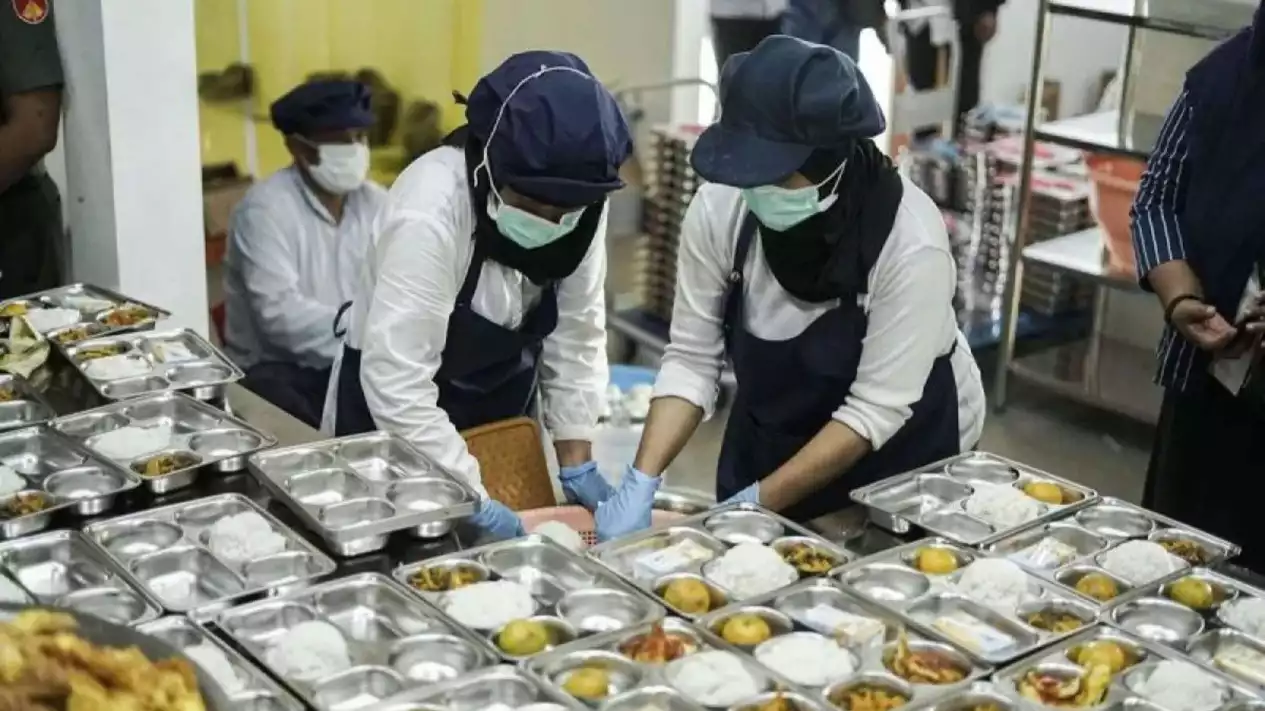
Quality control is strictly enforced through routine, unannounced inspections of Nutrition Fulfillment Service Units (SPPG) throughout the region. Herman Susilo, an investigative expert at the National Nutrition Agency (BGN), emphasized that unannounced inspections have been conducted since the MBG’s inception in January 2025 and continue regularly to this day. Any evaluation findings must be followed up within a maximum of two weeks, and if they are not met, the kitchen will be temporarily closed. This multi-layered oversight approach ensures that each of the more than 20,000 SPPGs established adheres to national and international food safety standards.
Deputy Minister of Health Benjamin Paulus Octavianus added that the Ministry of Health plays a strategic role in maintaining quality by assisting field officers until the issuance of the Hygiene and Sanitation Certificate. The government will not tolerate kitchens that do not meet standards, considering that this program serves 55.1 million beneficiaries, ranging from school children to pregnant women. The Head of the National Agency for National Food Security (BGN), Dadan Hindayana, stated that the ongoing certification process is not due to negligence or technical issues with food safety, but rather purely administrative obstacles that are being expedited.
From an economic perspective, the MBG program offers extraordinary opportunities for strengthening national food security and regional economic growth. Anindya Novyan Bakrie, Chairman of the Indonesian Chamber of Commerce and Industry (Kadin), emphasized that this program is a strategic entry point for agricultural downstreaming. With a daily demand of 52 million eggs, not to mention chicken, vegetables, fish, and other commodities, the MBG program creates demand certainty, a major obstacle to downstreaming in the agricultural sector. Each region is encouraged to utilize its superior protein potential, thus creating a region-based food supply chain ecosystem that strengthens resilience to external shocks.
Furthermore, MBG has the potential to absorb up to 1.5 million workers from the targeted 30,000 kitchens. Economically, its contribution to GDP could reach 3.5 percent, a significant figure as a driving force in achieving national economic growth targets. The Indonesian Chamber of Commerce and Industry (Kadin) has built around 1,000 SPPGs with an investment of Rp1.5 trillion to Rp2 trillion, demonstrating the high level of private sector participation in this strategic program.
The MBG program is a long-term investment in human resources. Children who receive adequate nutrition today will become productive workers, resilient soldiers, innovative scientists, and qualified citizens in the future. As Anin emphasized, of the 82 million targeted recipients, the majority of whom are children, this program is the seed for the birth of more world-class engineers, doctors, teachers, and athletes.
)* The author is a nutrition and food observer
