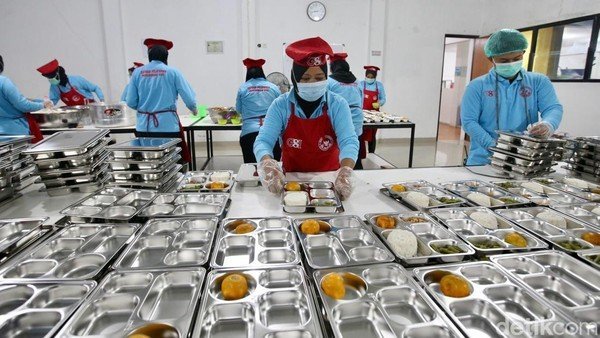

Jakarta – The Free Nutritious Meal Program (Makan Bergizi Gratis/MBG) continues to demonstrate tangible benefits for the public, not only in improving nutritional quality but also in creating jobs and strengthening local economies.
The Ministry of Finance recorded that the realization of the MBG Program budget had reached IDR 52.9 trillion as of December 15, 2025. This figure is equivalent to 74.6% of the total MBG budget ceiling in the 2025 State Budget (APBN) of IDR 71 trillion.
Deputy Minister of Finance Suahasil Nazara stated that this achievement reflects significant progress in the implementation of the government’s priority program for national nutrition fulfillment.
“As of December 15, spending for the Free Nutritious Meal Program has reached IDR 52.9 trillion, or 74.6% of the IDR 71 trillion allocated in the State Budget,” said Suahasil.
In terms of beneficiaries, the MBG program has reached approximately 50.7 million people out of the total target of 82.9 million recipients. Target groups include children, students, and pregnant women across various regions of Indonesia.
Based on the latest data, the implementation of MBG is currently supported by 17,555 Nutrition Fulfillment Service Units (SPPG) spread nationwide. The presence of these units has absorbed a workforce of 741,985 people.
Head of the National Nutrition Agency (BGN), Dadan Hindayana, said that the MBG program is now supported by around 16,503 SPPG units operating on a daily basis.
“This automatically means that more than 700,000 volunteers are directly involved in SPPG operations. So, in all likelihood, around 1.5 million people have been involved in MBG to date,” Dadan said.
He added that the large absorption of labor is inseparable from the involvement of local raw material suppliers. Each SPPG requires at least 15 suppliers, each employing between 2 and 15 workers.
“With a supply chain involving farmers, livestock breeders, food producers, and logistics providers, the MBG program creates massive economic circulation at the regional level,” he added.
Dadan emphasized that the strengthening of local economies is one of the most tangible impacts of the MBG program. These economic benefits are expected to continue growing as SPPG coverage expands across regencies and cities.
“With an increasingly large ecosystem, MBG not only improves nutrition but also serves as a new economic driver at the local level,” he said.
Through a collaborative approach involving the central government, local governments, and communities, MBG is expected to become a driver of welfare as well as a foundation for sustainable human development in Indonesia.
