
By: Marcus Wonda)
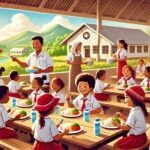
The Free Nutritious Meal (MBG) program is a government initiative aimed at improving the nutritional status of the population, particularly vulnerable groups such as children, pregnant women, and students. In Papua, this program has become part of efforts to enhance quality of life by providing healthy, affordable meals based on local resources. The implementation of MBG is designed to adapt to Papua’s geographic and socio-cultural conditions, supported by synergy between the central government, local governments, educational institutions, and indigenous communities.
The government’s seriousness is evident from various aspects, one of which is the appointment of Cenderawasih University as a Regional Centre of Excellence (RCOE) to support MBG implementation. This step reflects an approach rooted in local strengths. At this center, training, research, and innovation will continue to be developed to create nutrition solutions based on local food that align with the socio-cultural context of Papuan communities. By involving academics, experts, and community leaders, the government seeks to make the RCOE a driving force in advancing food security and nutrition.
Rinna Syawal, Director of Food Consumption Diversification at the National Food Agency, emphasized that the government understands that centralized food distribution must be optimized through synergy with local food resources. Indonesia possesses diverse food sources that have not yet been fully utilized. She noted that more than 77 types of local carbohydrates, 75 types of animal proteins, and hundreds of types of vegetables and fruits can be processed into healthy meals for Papuan children, while still preserving the local food culture.
The importance of utilizing local potential is also part of the government’s broader strategy to stimulate rural economies. Through the development of satellite kitchens in remote areas, the MBG program not only ensures that nutritious meals are served more quickly but also creates jobs and encourages food production in villages. This is where the concept of food sovereignty becomes essential; children are not just eating to fill their stomachs but are also maintaining a connection to their homeland. This concept makes the MBG program a part of sustainable development that balances social, economic, and environmental aspects.
Local government commitment is also a key pillar of this program’s success. Acting Expert Staff to the Governor of Papua for Community and Cultural Development, Matias Mano, stated that the Provincial Government, along with several regency governments in Papua, is actively formulating strategies that involve communities from upstream to downstream. Multi-stakeholder involvement, including strengthening human resource capacities at the grassroots level, is a top priority in supporting MBG’s sustainability. This approach shows that national programs cannot run effectively without local wisdom as their foundation.
Jayapura Regent, Yunus Wonda, underlined the importance of involving indigenous communities in all stages of MBG implementation. According to him, indigenous people not only live alongside local food sources but also possess social and cultural systems that can be integrated into distribution mechanisms and nutrition outreach. The Jayapura Regency Government is even mapping the roles of indigenous communities in each village, from production to consumption, so that communities are not merely beneficiaries but become key actors in development.
Synergy with traditional leaders and customary institutions is also a vital key to building collective awareness about the importance of nutrition and local food. Education on healthy eating patterns is no longer delivered as one-way instructions but is conveyed through cultural narratives that are more readily accepted by the community. This approach not only increases the program’s effectiveness but also enhances its sustainability, as the values promoted by the MBG program become part of everyday life.
In terms of impact, MBG not only plays a role in improving children’s nutritional status but also strengthens rural economic resilience. The circulation of money resulting from MBG kitchen activities—from purchasing garden produce, fish, to livestock—creates new economic potential in villages. Local governments recognize that MBG’s success will have a multiplier effect: not only producing a healthy and intelligent generation but also uplifting local communities through economic and cultural empowerment.
While still in its early stages, the direction of the policy shows that MBG is not just a free meal program. It is a long-term social investment. The government is laying the foundation for Papua’s future through a humane, participatory, and locally driven approach. From a plate of nutritious food emerges new hope that Papua can grow as a region not only strong in cultural identity but also resilient in the quality of its human resources.
The MBG program reflects the government’s commitment to providing equal attention to all communities across Indonesia. Papua, long facing various development challenges, is now receiving greater attention through policies that address basic community needs. Through MBG, the government demonstrates that development does not only occur in city centers but also reaches the regions that need it most.
*) Social Observer / Literacy Activist for Papua’s Development
