
By: Jaya Abdi Keningar
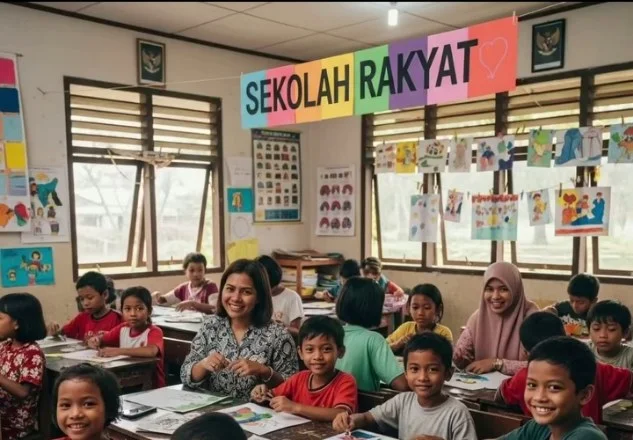
People’s Schools (Sekolah Rakyat) were not conceived as ordinary educational projects. They emerged as a response to a problem that has, for decades, been at the core of inequality in Indonesia’s human development: extreme poverty passed down across generations through limited access to quality education. In this context, People’s Schools are not merely learning institutions, but spaces of transformation—where the state consciously seeks to break the cycle of disadvantage at its very roots.
Unlike conventional formal schools, People’s Schools are designed with an approach that addresses the underlying social causes of exclusion. This explains why the program’s leading sector is the Ministry of Social Affairs, rather than solely the Ministry of Education. Member of Commission X of the House of Representatives (DPR RI), Abdul Fikri Faqih, considers this design a logical policy choice, as the primary targets of People’s Schools are households in the first and second income deciles—those living in extreme poverty who have long been left behind by the regular education system. According to him, this orientation underscores education as an instrument of social mobility, not merely an administrative requirement.
From an educational perspective, this policy reflects a shift in the state’s paradigm. Education is no longer understood simply as a process of knowledge transfer, but as a form of structural intervention to improve quality of life. President Prabowo Subianto has repeatedly emphasized that the goal of development is not to attain high-income country status, but to ensure that people live decently, have sufficient food, access healthcare, and that children receive a good education. Placing People’s Schools within the broader Asta Cita framework signals that education stands alongside food and energy self-sufficiency as a foundation of national sovereignty.
However, the greatest challenge facing People’s Schools lies in the quality of the learning process itself. Many children entering People’s Schools carry severe literacy deficits. In a public dialogue titled “Safeguarding Literacy in People’s Schools” aired on TVRI, the Head of the National Library, E. Aminudin Aziz, emphasized that literacy must not be narrowly defined as the ability to read text, but as the capacity to process information critically in order to improve quality of life. This view reinforces the idea that literacy is the core of transformation, not a mere complement to policy.
This is where People’s School libraries assume a strategic role. Libraries are no longer positioned as silent storage spaces for books, but as safe spaces where children can learn free from stigma. Field experiences show that when libraries are actively managed—through shared reading sessions, book discussions, and writing workshops—children who were initially passive begin to find the confidence to express their opinions. These changes may not immediately appear in statistics, but they are decisive for shaping the children’s future trajectories.
A hybrid approach that combines printed books with digital technology is also key to adapting People’s Schools to contemporary realities. Children today live in a world dominated by gadgets. Keeping them away from technology is not a solution, but an illusion. Through digital reading platforms and student publication spaces, digital literacy can instead be directed as a tool of empowerment. Children become not only consumers of information, but producers of knowledge. This is liberating literacy.
Character formation is another integral component of People’s Schools, particularly through the boarding school system. Minister of Women’s Empowerment and Child Protection, Arifah Fauzi, during her visit to the People’s Junior High School in Medan, emphasized that boarding life cultivates discipline, resilience, and the ability to live together amid differences. She acknowledged that the adaptation process is not always easy, but that the sense of togetherness that develops becomes a vital foundation for children’s character development.
From a public policy perspective, People’s Schools do not stand alone. They operate alongside the Garuda Schools, which are designed as incubators for talented students to access world-class higher education, particularly in STEM fields. Abdul Fikri Faqih views this combination as a simultaneous state effort: one pathway to break extreme poverty, another to catch up with global technological advancement. Two different policies, yet driven by the same vision—pursuing equity and competitiveness.
Nevertheless, the success of People’s Schools cannot be measured by how often they are praised in public discourse. The true measure lies in whether children genuinely change: from lacking confidence to daring to dream, from passivity to critical thinking, from marginalization to becoming active subjects of development. Literacy, in its most substantive sense, is a tool of emancipation. Without living, dynamic literacy, People’s Schools risk becoming little more than administrative programs.
People’s Schools must be safeguarded as consistent spaces of transformation. They are not merely five-year projects; they are tangible long-term national investments. With literacy now firmly positioned as a foundation, there is growing confidence that People’s Schools will not only graduate students, but will nurture a generation capable of escaping poverty with dignity, critical thinking skills, and the self-confidence to shape their own futures.
