People’s Schools as Concrete Proof of Education Equity in the First Year of the Prabowo-Gibran AdministrationBy: Herman Firmansyah

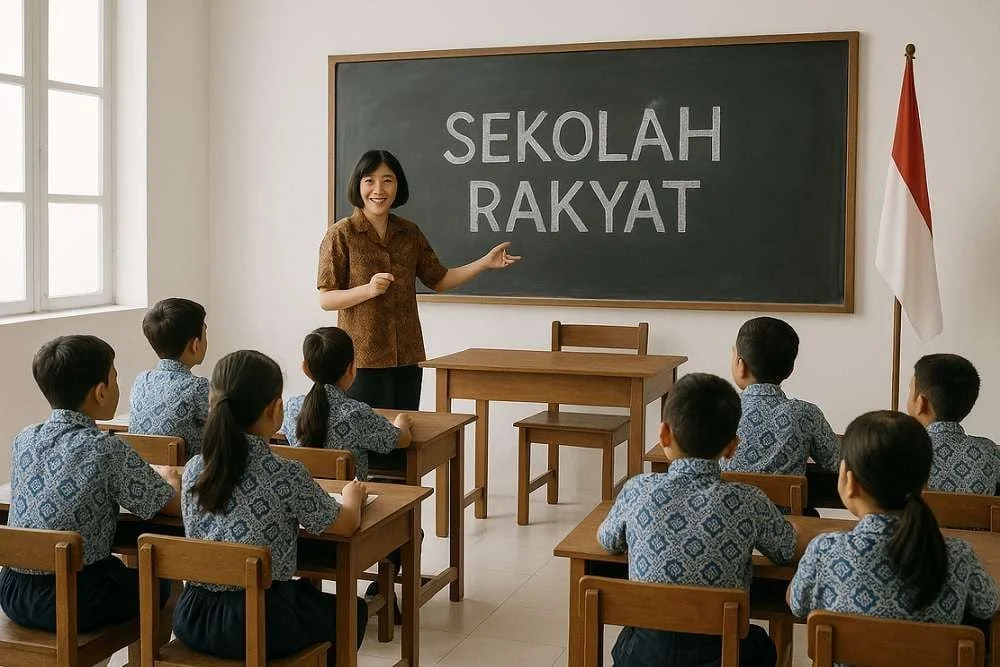
The People’s Schools program has become clear evidence that the Prabowo-Gibran administration is serious about realizing equitable education across all corners of Indonesia. In its first year, this policy has shown a new direction for building human resources that is inclusive, equitable, and socially just. People’s Schools are not merely an alternative educational program but a national movement that revitalizes the spirit of mutual cooperation in enlightening the nation. Through a collaborative approach involving the central and regional governments, the business sector, and communities, People’s Schools have succeeded in opening educational access for children in remote, interior, and border areas who have long been left behind in mainstream development.
Prabowo and Gibran’s commitment to education has been evident from the start of their administration. They place education as the main foundation in their grand agenda of the “Mental Revolution and National Self-Reliance.” People’s Schools are a concrete form of that promise, featuring flexible learning models oriented toward local wisdom and the appropriate use of digital technology. It not only provides learning spaces but also builds an educational ecosystem integrated with community life. Educators are recruited from diverse backgrounds, including formal teachers, education volunteers, university students, and community leaders who are highly dedicated to teaching. This approach proves that quality education can grow not only in big cities but also flourish from villages eager to build themselves up.
The Minister of Social Affairs, Saifullah Yusuf, stated that the People’s Schools program can encourage the self-reliance of 500,000 families across Indonesia each year. This target is achieved through an integrated approach that not only educates children but also empowers their parents’ economy.
The government also ensures that the quality of learning in People’s Schools is on par with other schools. The curriculum is adaptively designed by integrating the national curriculum with local content. Learning materials are made contextual so that students can understand knowledge in relation to their real environment. This contextual approach makes learning more meaningful and relevant while fostering a love for the homeland. On the other hand, the use of digital technology is encouraged through the provision of online learning devices and community-based learning applications. This step strengthens digital inclusion, which is a priority of the Prabowo-Gibran administration in facing the national digital transformation era.
What is even more interesting is that People’s Schools impact not only students but also the surrounding community. This program creates new job opportunities, both for educators and local community facilitators. Parents are actively involved in the learning process through parenting activities and productive economic skills training. Thus, education becomes a gateway to improving family welfare. The government also collaborates with the private sector through corporate social responsibility (CSR) programs to support school facility development, supply of learning materials, and scholarships for outstanding students. This cross-sector collaboration reflects the spirit of mutual cooperation characteristic of Indonesian development.
At the policy level, President Prabowo Subianto and Vice President Gibran Rakabuming Raka emphasize that the success of People’s Schools is part of the grand vision toward Indonesia Golden 2045. They believe that without education equity, Indonesia cannot produce superior and independent generations. Moreover, this program is supported by policies strengthening digital literacy and vocational training based on local needs, so that graduates of People’s Schools have competitiveness in the workforce.
Meanwhile, Coordinating Minister for Infrastructure and Regional Development, Agus Harimurti Yudhoyono, said that People’s Schools are an important strategy in breaking the cycle of poverty. People’s Schools are a priority program of President Prabowo Subianto that must be closely monitored, not just from the infrastructure side. The presence of People’s Schools is expected to provide a positive impact on the development of education in the country.
The success of People’s Schools is inseparable from the empathetic approach the government uses to understand community needs. Instead of imposing a uniform education model, the government allows local creativity to develop. In many regions, People’s Schools have even become symbols of cultural revival. Local songs, folklore, and traditional games are integrated into learning methods, creating a fun learning atmosphere while preserving the nation’s heritage. This shows that education is not only about knowledge transfer but also about character building and national identity formation.
One year into the Prabowo-Gibran administration, the People’s Schools program has brought new hope for millions of Indonesian children. Under their leadership, education is again placed as a tool for social liberation and a key to national progress. Through this program, the government proves that human development does not have to depend on grand infrastructure but can start from care and commitment to leaving no one behind. People’s Schools are proof that education equity is not an utopian dream but a reality achievable with courage, vision, and collective effort. With the foundation laid in this first year, Indonesia’s educational future looks brighter — a sure step toward an intelligent, sovereign, and just nation.
