
By: Abdul Razak)*
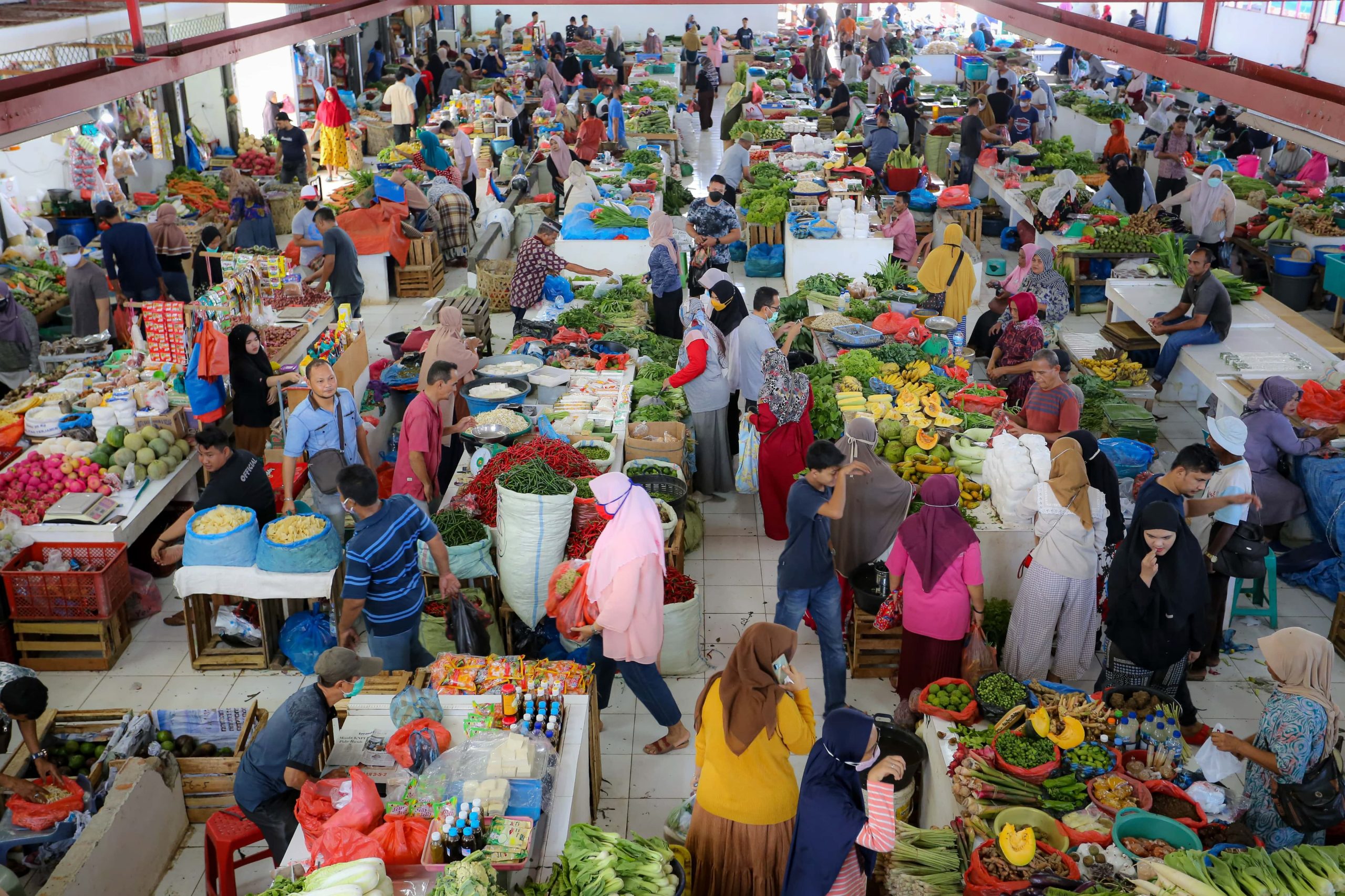
The central and regional governments are strengthening monitoring of food prices, supply, and safety during Ramadan 1447 H. This measure is being taken to ensure that the surge in demand during the National Religious Holidays (HBKN) does not trigger price fluctuations or the circulation of food that does not meet health standards. Several officials visited traditional markets and snack centers to ensure supply stability and maintain consumer protection.
At Jonggol Market in Bogor, which serves as a buffer market for the Bogor, Bekasi, and Jakarta areas, Sarwo Edhy, the Principal Secretary of the National Food Agency (Bapanas), conducted a surprise inspection to monitor the prices and distribution of strategic commodities. He emphasized that the government must remain vigilant during Ramadan and must ensure prices remain under control and distribution runs smoothly. If any discrepancies are found, his office will immediately take corrective action.
Based on monitoring results, most food prices were relatively stable. Local medium-grade rice was around Rp 13,000 per kilogram and premium rice was Rp 14,500 per kilogram. Shallots were sold for around Rp 40,000 per kilogram and garlic for Rp 36,000 per kilogram. For animal protein commodities, broiler chicken was priced between Rp 40,000 and Rp 42,000 per kilogram, eggs for Rp 30,000 and Rp 32,000 per kilogram, local beef for Rp 130,000 and Rp 140,000 per kilogram, and imported beef for around Rp 120,000 per kilogram. Meanwhile, packaged sugar was sold for Rp 19,000 per kilogram and bulk sugar for Rp 18,000 per kilogram.
Sahril, a meat trader at Jonggol Market, stated that beef prices remain stable at Rp 140,000 per kilogram, with a discount of Rp 130,000 per kilogram available to bargain buyers, as supplies are sourced directly from nearby slaughterhouses. This demonstrates that the relatively short distribution chain helps maintain competitive prices. Consumers also benefit from this stability. Yulis, a buyer, admitted to preferring traditional markets because prices are more competitive. He hopes that staple food prices will remain stable during Ramadan, allowing people to observe their religious obligations in peace.
However, special attention was paid to Minyakita cooking oil, which is still being sold above the Highest Retail Price (HET) of Rp 15,700 per liter. At Jonggol Market, Minyakita prices were found to be in the range of Rp 18,000–18,500 per liter. Sarwo Edhy explained that the increase was driven by distributor prices, which were already at Rp 17,000–17,500 per liter, making it difficult for retailers to sell at the HET.
The government has established a tiered pricing system for Minyakita, from producers to retailers. The National Food and Drug Monitoring Agency (Bapannas) and the Food Task Force will trace the distribution chain all the way to the upstream level to ensure there are no irregularities. Sarwo Edhy emphasized that the distribution chain must be transparent and that no party should be allowed to manipulate the distribution of basic commodities.
The Head of the National Food and Agriculture Agency (Bapanas), Andi Amran Sulaiman, also warned against exploiting Ramadan to manipulate prices. He urged all businesses to seek reasonable profits without disrupting the fasting public. The government, he emphasized, will not tolerate excessive profiteering from the people’s basic needs.
Oversight efforts are also being carried out by state-owned food companies. Perum BULOG President Director Ahmad Rizal Ramdhani conducted spot checks at Johar Market, Kepanjen Market, and Kanjengan Market in Semarang. Based on the monitoring results, the price of premium rice was recorded at IDR 14,900 per kilogram, medium rice at IDR 13,500 per kilogram, and SPHP rice at IDR 12,500 per kilogram. Beef prices dropped to IDR 130,000 per kilogram, chicken around IDR 35,000 per kilogram, and red chilies around IDR 32,000 per kilogram. Rizal stated that the experience of maintaining price stability during the Christmas and New Year period is capital to ensure conditions remain stable during Ramadan and Eid al-Fitr. BULOG wants to ensure the public obtains basic necessities at fair prices according to regulations and guarantee adequate stocks until the holidays.
In addition to pricing and supply, food safety monitoring has also been tightened in various regions. In Banda Aceh, Mayor Illiza Sa’aduddin Djamal, along with the Aceh Health Office and the Food and Drug Monitoring Agency (BPOM), conducted a surprise inspection of the Ramadan Takjil Market in the Baiturrahman area. The team conducted sampling and rapid tests to detect possible forms of formaldehyde, borax, and hazardous textile dyes.
The Pekalongan City Health Office, along with 14 community health centers, conducted a three-day inspection, collecting hundreds of samples of takjil snacks. Maysaroh, a young sanitarian at the Pekalongan City Health Office, explained that routine inspections were conducted because hazardous chemicals were still found in a number of products in previous years. The four substances being monitored were formalin, borax, Rhodamine B, and Methanyl Yellow.
He explained that formalin is often misused in wet noodles and tofu to prolong their shelf life, borax in meatballs and sempol snacks to enhance their chewy texture, and textile dyes in brightly colored snacks. If rapid tests show a positive result, the sample will be retested at the regional health laboratory and followed up back to the source of production. Vendors whose products are declared safe will receive a special sticker as a token of appreciation and as a way to inform consumers.
With tightened supervision and controlled distribution, it is hoped that the public will be able to observe the fast and celebrate Eid al-Fitr with a sense of security and comfort, while avoiding price fluctuations and the risk of dangerous food products.
)* The author is a Policy Analyst
