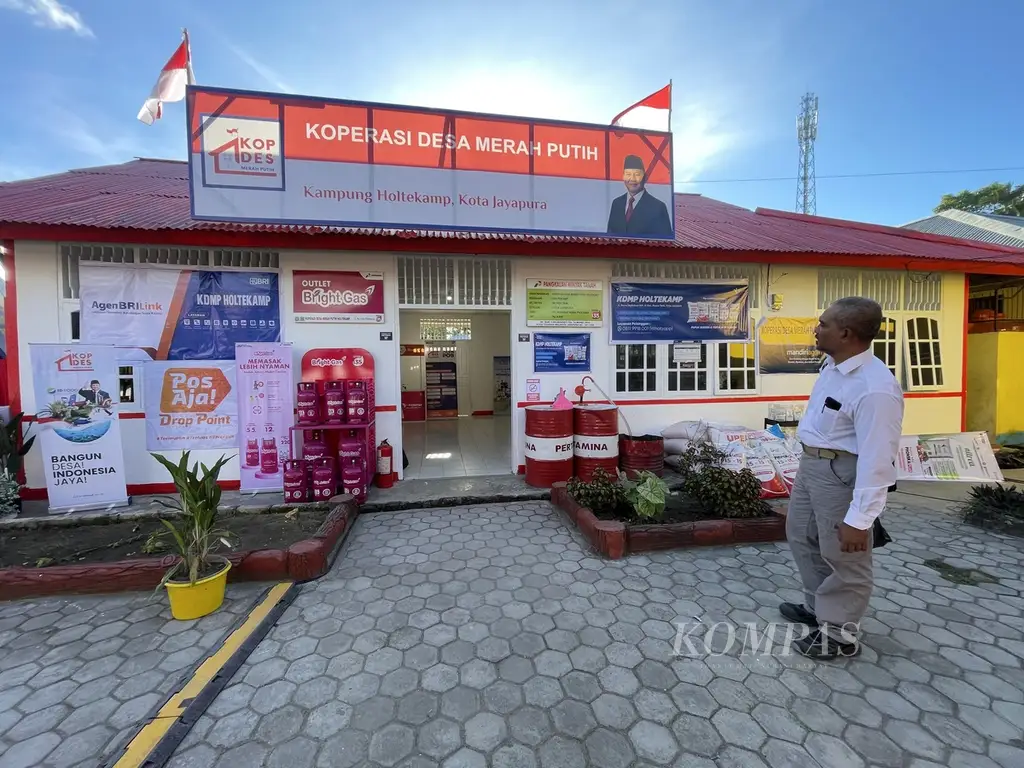
Red and White Village Offices Prepared to Become Village Economic Hubs, Supporting Local Businesses

The government has positioned the Merah Putih Village Cooperative (Kopdes Merah Putih) as the center of the people’s economy at the village level. Its role not only supports the distribution of basic necessities but also serves as a key hub for local business operations, including supporting the implementation of the Free Nutritious Meals (MBG) Program.
Cooperatives Minister Ferry Juliantono emphasized that the Red and White Village Cooperative is designed as a distribution hub connecting producers, stalls, street vendors (PKL), and MSMEs in one integrated ecosystem.
“We discussed several things. The first was building an ecosystem with street vendors across Indonesia, including the Merah Putih Village/Sub-district Cooperative, which will serve as a hub for selling goods to stalls and members of the street vendor association at relatively lower and more affordable prices,” Ferry said.
According to him, Kopdes will act as distribution agents, ensuring that basic necessities and local products circulate more efficiently within villages. This scheme is expected to streamline the supply chain and strengthen the competitiveness of small businesses.
“We will promote local MSME products for sale at outlets owned by the Merah Putih Village/Sub-district Cooperative,” said the Coordinating Minister.
He added that village cooperatives were designed from the outset to be integrated with BUMDes, traditional markets, stalls, and MSMEs to create a mutually reinforcing economic circulation at the local level.
Political support for strengthening the Red and White Village Cooperatives also came from the Chairman of Commission XI of the House of Representatives, Mukhamad Misbakhun. He described cooperatives as a key instrument for stabilizing the village economy amidst global pressures.
“We hope that the Merah Putih Village Cooperative will become the center of village economic activity,” said Misbakhun.
This program also involves banks from the Association of State-Owned Banks (Himbara) such as BRI, Mandiri, and BTN to expand access to financing to remote areas.
“So, basic necessities, agricultural production facilities, and even MSME products can circulate within the village itself. If the village economy is growing, national growth will also be boosted,” he said.
In addition to strengthening the village economy, Kopdes is also projected to become a strategic partner in supporting the MBG, particularly in the provision and distribution of locally produced food. With this model, the government hopes that villages will become not just markets, but centers of new economic growth.*
