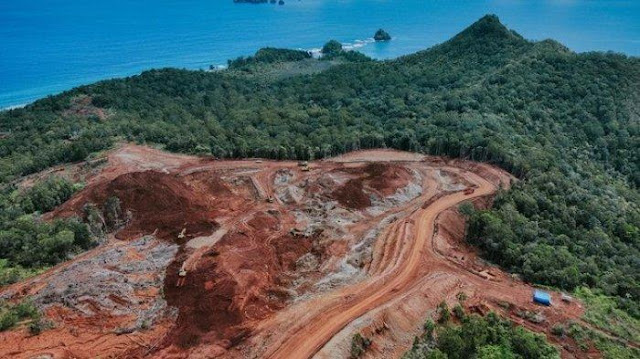
Revocation of IUP in Raja Ampat, Evidence of Government’s Commitment to Protecting the Environment

By: Martin Sani *)
The Indonesian government recently revoked four Mining Business Permits (IUP) operating in the Raja Ampat region of Southwest Papua. This decision was taken as part of an evaluation of mining activities in an area known to have high ecological value. Raja Ampat is one of the areas with the highest marine biodiversity in the world, so industrial activities in the area continue to be in the public spotlight, both nationally and internationally. The policy of revoking these permits has sparked a variety of responses, ranging from appreciation for the environmental side to hopes that similar steps will be implemented more widely in other conservation areas.
The four companies whose IUPs were revoked, namely PT Anugerah Surya Pratama, PT Nurham, PT Mulia Raymond Perkasa, and PT Kawei Sejahtera Mining, previously operated in an area that is included in the world’s center of marine biodiversity. Raja Ampat is widely known as one of the richest and most pristine marine ecosystems on the planet, making it an ecological asset not only for Indonesia, but also for the international community. The decision to revoke mining permits in this area indicates that the government places environmental preservation as a national strategic priority.
This move has also received international attention. One foreign media outlet, AFP, highlighted how Indonesia has revoked most mining permits in an area known as the world’s diving paradise. In its report, the media outlet emphasized that this action was a response to growing concerns about the impact of environmental damage in the Coral Triangle region. The international community is watching closely, and this decisive action has strengthened Indonesia’s position as a country that is serious about preserving its natural heritage.
Domestically, the decision has received widespread acclaim from various groups, including legislative leaders. Deputy Chairman of the MPR Eddy Soeparno stated that the revocation of the IUP in Raja Ampat is clear evidence that Indonesia is not soft on environmental issues. He considered this decision a strong signal to the global community that Indonesia is carrying out economic development while still respecting the sustainability of the ecosystem. According to him, respect for the environment is part of the nation’s moral and political responsibility in maintaining a balance between development and sustainability.
The same attitude was also expressed by the Chairman of the Prosperous Justice Party (PKS) Faction of the Indonesian House of Representatives, Jazuli Juwaini. He appreciated President Prabowo Subianto’s steps which he considered to be in favor of the future of the nation’s ecology. Jazuli emphasized that Raja Ampat is not just a mining area or natural resource, but is a world heritage that must be protected together. Therefore, the government’s decision to revoke mining permits is considered appropriate and strategic to save the ecosystem which is very vulnerable to damage.
Minister of Energy and Mineral Resources, Bahlil Lahadalia, stated that this decision was taken after going through a strict evaluation process. Violations of licensing provisions and concerns about ecological impacts were the main reasons for the revocation of the permit. Bahlil also emphasized that another company, namely PT Gag Nikel, which is a subsidiary of PT Antam Tbk, is still allowed to operate but is under strict government supervision. This shows that the government’s approach is not just to prohibit, but to ensure that every industrial activity runs in accordance with the principles of sustainability.
It cannot be ignored that Indonesia has the largest nickel reserves in the world and is developing a massive downstream metal industry. However, strategic interests in the mining sector must not sacrifice areas that have been identified as key conservation areas. This step taken by the government shows that national industrial development still has clear ethical and ecological boundaries. Not all areas are worthy of being exploited, especially when the ecological value far exceeds the short-term economic potential.
In the context of natural resource governance, this decision can be seen as a concrete form of policy reform. The government is not only talking about its commitment to the environment, but also showing its willingness to take politically and economically risky actions in order to preserve nature. This reflects a courage that deserves to be appreciated and supported by all elements of the nation.
In addition, this decision is expected to be the beginning of a series of similar policies in other areas that are also facing ecological pressures due to industrial activities. A comprehensive evaluation of mining permits in conservation areas should be a national agenda, so that there is no longer a conflict between development policies and environmental protection. The government has set a new standard, and the community is looking forward to the continuation of this step.
President Prabowo’s firm action in revoking four IUPs in Raja Ampat marks a new chapter in the management of Indonesia’s natural resources. This is not just an administrative policy, but a moral statement that the future of the nation is determined by choices that favor the sustainability of life. Raja Ampat is a symbol of biological wealth that cannot be risked for momentary gain. And the government has taken the right position, namely protecting the irreplaceable for future generations.
*) Environmental observer from Southwest Papua
