
By: Reza Ramadhan)*
The government has shown a strong commitment to providing the best service for Indonesian hajj pilgrims through various concrete programs and breakthroughs such as special terminals and the idea of reducing the cost of the hajj pilgrimage and Indonesian villages. A number of efforts continue to be made to ensure that this holy pilgrimage can be carried out comfortably, safely, and increasingly affordable for the community.
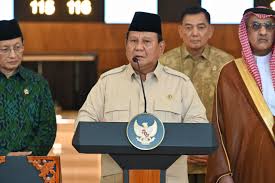
One significant step was realized with the inauguration of the Special Hajj and Umrah Terminal at Soekarno-Hatta Airport by President Prabowo Subianto on Sunday, May 4, 2025. The terminal, located in Terminal 2F, is designed to be modern, spacious, and comfortable, and can accommodate up to 94 million people per year. In his speech, President Prabowo emphasized that his government will work as hard as possible to provide the best service for hajj and umrah pilgrims, while continuing to reduce costs to make them cheaper.
The new terminal is also equipped with the Makkah Route, a service innovation that allows Indonesian pilgrims to undergo the Saudi Arabian immigration process directly in Indonesia through 10 special counters. That way, pilgrims no longer need to queue for long at the arrival airport in Saudi Arabia, which has been one of the points of fatigue and discomfort.
However, the government’s efforts do not stop at providing physical facilities alone. President Prabowo also directed the Ministry of Religion and the Hajj and Umrah Organizing Agency (BP Haji) to find concrete solutions to reduce the cost of the hajj, even hoping to be lower than other countries such as Malaysia. Currently, the government has succeeded in reducing the 2025 Hajj Pilgrimage Cost (BPIH) to IDR 89.41 million, or down IDR 4 million from the previous year. As a result, the Hajj Pilgrimage Travel Cost (Bipih) paid directly by the pilgrims has also decreased to IDR 55.43 million.
This efficiency step is certainly very meaningful, especially for prospective pilgrims who have saved and waited for years to depart for the Holy Land. The President assessed that pilgrims have saved and waited a long time, so it is only natural that they get decent services and rational costs.
To support further efficiency efforts, the government is conducting active diplomacy with the Saudi Arabian Government. One of the plans currently being explored is the development of the Indonesian Village near the Grand Mosque, which will be a special accommodation for pilgrims from Indonesia. President Prabowo has conveyed this intention directly to the Crown Prince of Saudi Arabia, Prince Muhammad bin Salman, and stated that the response received was very positive.
If the plan to build the Indonesian Village is realized, then not only will the comfort of the pilgrims increase significantly, but also cost efficiency can be reduced even further. The government has also assigned the Minister of Religion and a special advisor for Hajj affairs to discuss the technicalities of this plan with the authorities of the Kingdom of Saudi Arabia.
On the other hand, the Ministry of Religion also continues to improve domestic services. Secretary of the Directorate General of Hajj and Umrah Organization, Arfi Hatim, stated that all Hajj dormitories in 14 national embarkations are ready to serve pilgrims with one-stop service standards. Starting from health checks, distribution of Hajj equipment, to the immigration process is carried out in one integrated system, thus speeding up and simplifying the process of pilgrims’ departure.
Digitalization is also present to improve comfort. Through the “Munah Osah” application, pilgrims can now find out their room number and go straight to the dormitory without having to carry a cabin bag, which is usually inconvenient. Breakthroughs like this are real proof that the Hajj service continues to be improved along with technological developments.
All of these policies show that the government is not just managing the Hajj pilgrimage as an administrative obligation, but making it a form of dignified spiritual service for Indonesian Muslims. Through various synergies between institutions, international diplomacy, and domestic improvements, the Hajj pilgrimage is now more humane and oriented towards the satisfaction of the pilgrims.
It is also worth appreciating that the government has shown a spirit of justice in its financing policy. When compared to Malaysia which provides large subsidies to low-income pilgrims through the Tabung Haji Institution, Indonesia is also taking a similar path, although in the form of comprehensive efficiency to reduce the burden on pilgrims in general. This is a positive note that the state is present in the affairs of its people’s worship, not only as a facilitator but also as a protector.
The steps taken at this time are a strong foundation for continuous improvement in the implementation of the Hajj. President Prabowo’s commitment shown through direct instructions to the relevant ministries reflects the seriousness of the state in responding to the hopes of Muslims. The President even emphasized that he was not yet satisfied withan will continue to push for the cost of the hajj to be reduced as cheaply as possible without sacrificing the quality of service.
With Indonesia’s hajj quota reaching 221,000 people this year, the government is faced with a major challenge, but also an opportunity to show its best capacity in serving its people. All of these efforts are not merely infrastructure projects or technical policies, but rather a form of government devotion to the people who want to carry out the fifth pillar of Islam solemnly.
The public should appreciate all of these government programs. From modern hajj terminals, efficient digital services, strategic diplomacy, to gradual cost reductions—all are part of the government’s determination to glorify the hajj pilgrimage as a sacred spiritual journey. This sincere commitment deserves to be supported and maintained together.
)* The author is a public policy observer
