
By: Laila Anggina Nuraini*
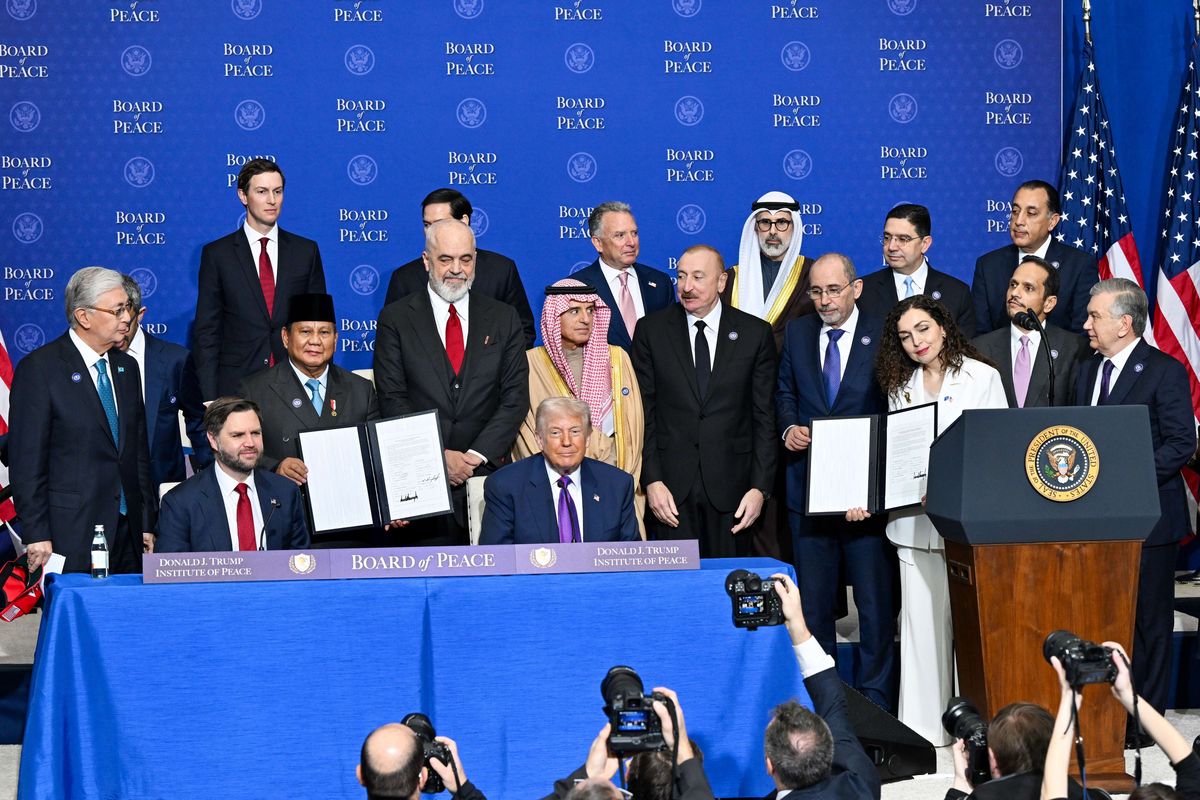
Indonesia’s decision to join the Board of Peace (BoP) marked a new chapter in the articulation of a foreign policy that is increasingly adaptive, flexible, and results-oriented. Amidst global dynamics fragmented by great power rivalry, Indonesia no longer merely asserts the principle of freedom and activity as a normative doctrine, but translates it into measured strategic steps. The BoP, initiated by then-US President Donald Trump, became a new arena for global diplomacy that Indonesia utilized to expand its sphere of influence.
In this context, this move is not an ideological shift, but rather an expression of a new style of non-aligned politics. Indonesia maintains its strategic autonomy while actively engaging in various global power configurations, including its involvement in BRICS. This balance reflects Indonesia’s foreign policy acumen: its ability to navigate a diverse spectrum of cooperation without becoming trapped within the orbit of any particular power. On the one hand, Indonesia maintains intensive communication with Western powers through the BoP; on the other, Indonesia continues to build South-South solidarity and strengthen multipolar cooperation through BRICS.
The commitment to Palestine is a concrete test of the consistency of this balanced policy. President Prabowo Subianto emphasized that a two-state solution is the only lasting path to resolving the conflict. This statement, delivered during a meeting with Jordan’s King Abdullah II in Amman, demonstrates that Indonesian diplomacy is moving simultaneously across multiple channels. Indonesia’s participation in the BoP is not interpreted as a compromise on the Palestinian cause, but rather as an additional instrument to champion a two-state solution within an influential forum.
Foreign Minister Sugiono also affirmed Indonesia’s full support during his meeting with Palestinian Foreign Minister Varsen Aghabekian Shahin on the sidelines of the UN Human Rights Council in Geneva. Indonesia expressed its readiness to play a substantive role through the BoP and the International Stabilization Force. Moreover, the establishment of a Liaison Office by the Palestinian Authority to coordinate with the BoP demonstrates the continued expansion of diplomatic space. This demonstrates Indonesia’s combination of idealism, namely unwavering support for Palestinian independence, with realism, utilizing all available diplomatic channels to push for concrete results.
From the perspective of international relations observer Teuku Rezasyah, this step represents a rational strategy that allows Indonesia to influence the structure and working practices of the BoP from within. Indonesia’s global credibility, as a country with the largest Muslim population and a tradition of active diplomacy, serves as capital to ensure the forum remains aligned with the principles of international justice. Meanwhile, international law researcher Muhammad Arbani views Indonesia’s participation as a real contribution to the establishment of alternative peace mechanisms at a time when traditional multilateral forums face limited effectiveness. Both views demonstrate optimism that Indonesia is not merely a participant, but also a norm-forming actor.
The concrete dimension of this involvement is evident in Indonesia’s appointment as Deputy Commander of the International Stabilization Force in Gaza. This trust affirms Indonesia’s credible military and diplomatic capacity to carry out the stabilization and reconstruction mandate. Foreign policy observer Rizal Mallarangeng views this position as a strategic honor that places Indonesia in the mainstream of global geopolitics. The involvement of troops within the framework of the stabilization mission is not merely a symbol of solidarity but a direct implementation of the constitutional mandate to contribute to world peace.
Broadly speaking, the combination of participation in the BoP and involvement in BRICS demonstrates a mature political balance. Indonesia has chosen neither a confrontational nor exclusive approach, but rather maintains relationships with various global powers. Amid international polarization, this strategy expands its maneuvering space and enhances its bargaining power. Indonesia is able to speak the language of the West when discussing security stabilization and the language of solidarity with the Global South when advocating for global governance reform.
Indonesia’s political acumen lies in its ability to read the momentum. Early participation in the BoP provides an opportunity to shape norms and agendas. At the same time, strengthening its role in BRICS ensures Indonesia remains part of the emerging multipolar architecture. Thus, Indonesian diplomacy avoids being trapped in an East-West dichotomy, but instead practices an adaptive and progressive policy of balance.
In an increasingly fluid geopolitical landscape, Indonesia is leveraging the Peace Council and BRICS as instruments of political balance. This move emphasizes its role as an adaptive middle power, bridging global interests, and prioritizing peaceful solutions based on dialogue, stabilization, and long-term national interests. It also strengthens its international bargaining position amidst major rivalries.
Ultimately, Indonesia’s actions through the Board of Peace reflect a transformation from rhetorical diplomacy to operational diplomacy. Support for Palestine remains a moral foundation, while engagement in strategic forums serves as a pragmatic instrument. Observers’ positive views of BRICS and the BoP demonstrate that this strategy is understood as an extension, not a deviation, of the principle of freedom and independence. Indonesia is asserting itself as an intelligent, balanced international actor capable of bridging diverse global interests to achieve a just and sustainable peace.
*The author is a Geopolitical Analyst and Foreign Policy Researcher
