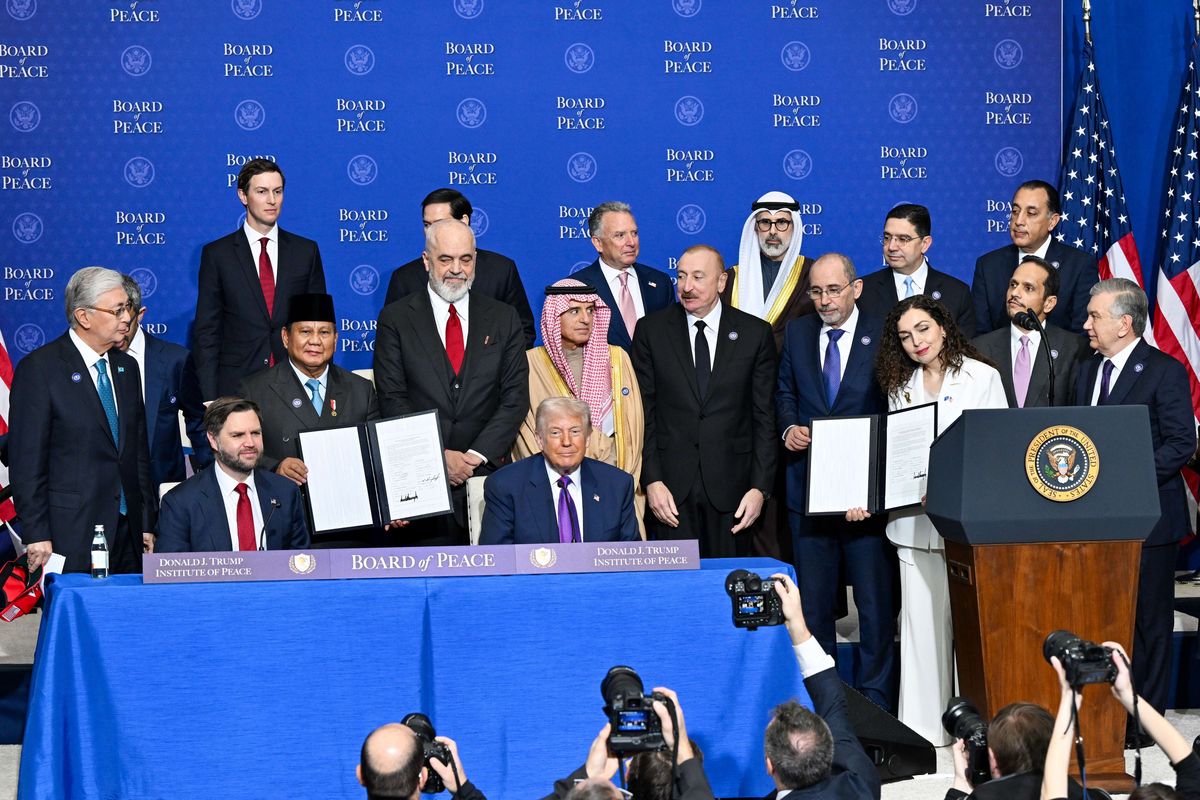
The Board of Peace and Indonesia’s Political Strategy of Balance Amidst Global Polarization

By: Dimas Aryasetya
Indonesia’s decision to join the Board of Peace (BoP) and accept the position of Deputy Commander of the International Stabilization Force (ISF) in Gaza marks a new phase in its foreign diplomacy, one that is both more active and cautious. Amid increasingly sharp global polarization, this step is not merely a symbol of humanitarian solidarity, but rather a reflection of political balance and an effort to maintain Indonesia’s strategic position among major powers without abandoning its constitutional principle of defending world peace.
Foreign policy observer Rizal Mallarangeng sees this international trust as a sign that Indonesia is now at the forefront of global geopolitics. He views the position of Deputy Commander of the ISF as a recognition of Indonesia’s credibility in international peacekeeping missions, as well as proof that Indonesia’s participation is not merely a formality. In his view, this involvement represents a concrete implementation of the principle of an independent and active foreign policy that has long been the hallmark of Indonesian diplomacy.
This perspective demonstrates how the politics of balance works. Indonesia does not position itself as a dominant force, but neither does it choose to be a spectator. By sitting within the ISF command structure and the BoP decision-making forum, Indonesia seeks to distance itself from geopolitical rivalries while ensuring humanitarian interests remain a priority. This position allows Indonesia to remain critical of the conflict dynamics without losing access to the global negotiating process.
From an international law perspective, Satya Wacana Christian University Salatiga lecturer, Theofransus Litaay, assessed that the government’s move to join the BoP is in line with the constitutional mandate and has international legal legitimacy through UN Security Council Resolution Number 2803. He views Indonesia’s participation not as a form of normalization of relations with Israel, but rather as a strategic presence in a multilateral forum aimed at protecting civilians, ensuring stability, and encouraging the reconstruction of Gaza.
This analysis confirms that Indonesia’s policy of balance is not a compromise of principle, but rather a strategy to remain at the center of global decision-making. By joining forces with Middle Eastern countries such as Qatar, Egypt, the United Arab Emirates, Saudi Arabia, Pakistan, Jordan, and Turkey, Indonesia demonstrates its ability to bridge the interests of the Western and Islamic worlds. In this context, Indonesian diplomacy does not stand in a single bloc, but rather moves between diverse interests to maintain room for maneuver.
Foreign Minister Sugiono also viewed Indonesia’s appointment as Deputy Commander of ISF Operations as a sign of respect for the track record of Indonesian soldiers in global peacekeeping missions. This statement demonstrates Indonesia’s internationally recognized strategic significance and opens up opportunities for Indonesia to influence operational dynamics on the ground.
However, the policy of balance is not always universally accepted domestically. A survey by the Median Survey Institute indicates a polarization of public opinion. Some respondents believe the government will remain consistent in its support for Palestine despite joining the BoP, while others are concerned about the dominance of the United States and Israel or the potential for significant costs. Median Research Director Rico Marbun believes there is still strong social capital to support the government’s actions, although public criticism remains a factor that needs to be considered.
This situation reflects a classic challenge in balancing diplomacy: maintaining international legitimacy without losing domestic trust. While the government strives to be at the global negotiating table, the public is also demanding that its principle of siding with Palestine remain intact. It is precisely at this point that the politics of balancing is tested: whether Indonesia can play a strategic role without creating a perception of shifting from its historical stance.
Khairul Fahmi, Co-Founder of the Institute for Security and Strategic Studies (ISESS), noted that Indonesia’s diplomatic history since independence demonstrates the importance of multilateral forums as strategic negotiation spaces. He noted that the experience of the UN Good Offices Committee in 1947 teaches us that international forums are often arenas of vested interests, but can still serve as a bridge to political legitimacy if used wisely.
This historical reflection provides context that Indonesia’s presence on the Peace Council is not a new step, but rather a continuation of a diplomatic tradition that has shaped the nation’s identity since the dawn of independence. Just as Indonesia once utilized international diplomatic space to gain recognition of its sovereignty, Indonesia is now attempting to leverage its strategic position to promote a two-state solution for Palestine.
In an increasingly fragmented world, a policy of balance is a rational choice for a mid-sized country like Indonesia. Joining the Board of Peace allows Indonesia to remain relevant on the global stage without being completely drawn into great power rivalries. At the same time, this step creates space for Indonesia to address humanitarian issues directly, rather than solely through political statements.
Ultimately, Indonesia’s decision to join the Peace Council can be interpreted as a strategy to maintain a balance between idealism and realism. Indonesia seeks to maintain its moral commitment to Palestine while ensuring its position remains significant within the global geopolitical landscape. In an increasingly complex international landscape, the policy of balance is not merely a tactical choice, but rather a middle ground that allows Indonesia to remain true to its principles of freedom and activity while playing a significant role in maintaining world peace.
*) Foreign Policy Analyst
