The Board of Peace and the Politics of Balance: Free and Active is Increasingly Strategic in the Prabowo Era

By: Landres Octav Pandega *)
Indonesia’s participation in the Board of Peace (BoP) is not merely a presence at a hotly debated new forum. It is a clear foreign policy signal that Indonesia is strengthening its policy of balance, maintaining room for maneuver amidst the tug-of-war between major powers, while remaining true to its independent and active roots, ingrained since the founding of the republic. In an increasingly polarized global context, this step also aligns with Indonesia’s strategic decision to join BRICS, effective January 2025.
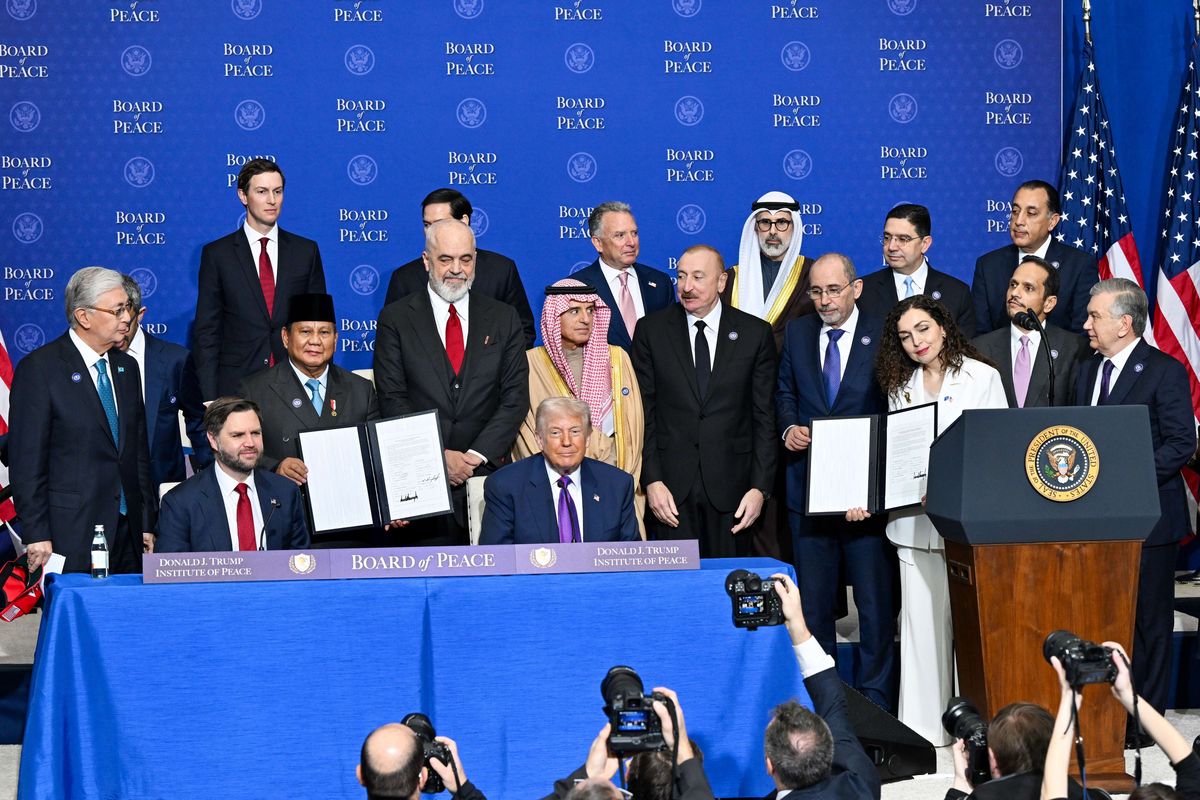
The BoP itself emerged as an international initiative spearheaded by United States President Donald Trump, primarily related to the stabilization and reconstruction of post-conflict Gaza, and served as a new coordination channel outside the previously dominant multilateral mechanisms. At the inaugural meeting in Washington, President Prabowo Subianto delivered a message that Indonesia did not want to be a bystander in the restructuring of the region’s security and humanitarian architecture, especially as the Palestinian issue once again became a moral and diplomatic test for many countries.
Domestically, political support for this move is growing. The Speaker of the People’s Consultative Assembly (MPR), Ahmad Muzani, views Indonesia’s involvement in the BoP as strategic diplomacy and a significant breakthrough by President Prabowo Subianto’s administration to strengthen Indonesia’s position on the international stage. He also believes the forum can provide a concrete path to promoting Middle East peace and supporting Palestinian independence through an active commitment to the global arena.
From an academic perspective, Bachruddin Meikiansyah, an academic at the Faculty of Law at Achmad Yani University in Banjarmasin, views Indonesia’s participation in the BoP as a strategic step that strengthens international legitimacy while also affirming the consistency of the mandate of the Preamble to the 1945 Constitution: to participate in implementing world order based on freedom, eternal peace, and social justice. He believes that Indonesia’s long track record in UN peacekeeping missions, as well as its identity as a democratic country with a moderate Muslim majority, are diplomatic assets to build cross-civilizational dialogue, enrich conflict resolution, and promote stability, which ultimately have a positive impact on investment, trade, and sustainable development.
This broad framework is crucial, as Indonesia seeks to position the Palestinian issue not only as a matter of moral solidarity but also as an operational diplomatic agenda. Therefore, joining the BoP can be seen as an effort to shift Indonesia’s position from merely conveying calls to becoming an actor influencing the design of solutions.
A more practical argument comes from M. Imam Satria Jati, Chairman of the South Kalimantan Regional Leadership Council (DPD) of the Indonesian National Movement for the Poor (KNPI). He believes that Indonesia’s membership in the BoP reflects the success of diplomacy, not only strengthening its global political position but also integrating security interests, protecting sovereignty, and national economic growth within a single strategic framework. He believes that membership expands Indonesia’s advocacy space in forums such as the UN, ASEAN, and the G20, while also opening up opportunities for constructive collaboration with Egypt, Qatar, Turkey, and Azerbaijan, ranging from efforts to resolve the Gaza conflict and strengthen the protection of Indonesian citizens to converting political stability into concrete economic cooperation, including investment in renewable energy and market expansion.
However, criticism has also emerged, particularly regarding the composition of the BoP membership and the fact that Israel is present at the same forum. This is where public debate often falls into the trap of “presence equals approval.” Theofransus Litaay, a lecturer in international law at the Faculty of Law at Satya Wacana Christian University (UKSW) in Salatiga, believes this accusation is flawed. He emphasized that Indonesia needs to be at the center of global discussions to voice the interests of the Palestinian people, as such forums are filled with debates and negotiations that determine the direction of solutions. He also believes that, constitutionally, Indonesia’s presence aligns with its mandate to contribute to achieving world peace.
Theofransus Litaay also assessed Indonesia’s credibility due to its concrete humanitarian commitments, such as assistance in building health facilities and supporting education for Palestinians. With this capital, he believes Indonesia can help push the discussions toward a two-state solution, while also influencing the dynamics of the negotiations from within, rather than through external commentary.
This is where the BoP intersects with the politics of balance and Indonesia’s decision to join BRICS. While the BoP demonstrates Indonesia’s ability to enter US-led negotiating circles, BRICS signals the diversification of strategic networks beyond the Western orbit, including access to development financing and alternative economic cooperation. Indonesia’s entry into BRICS, announced effective January 2025, reflects a strategy of expanding options, not changing course.
This means that Indonesia is building a diplomatic portfolio that can continue to work with the US and Western partners on humanitarian and security issues (such as Gaza), while deepening South-South channels through BRICS to support the economic transformation and national resilience agenda. The two are not contradictory, but rather a more adaptive form of free-and-active, free from bloc ties, actively securing national interests through multiple negotiating tables.
The measure of success of the BoP for Indonesia is not simply the number of forums attended, but the extent to which Indonesia is able to translate attendance into influence, strengthening its principled pro-Palestinian diplomatic position, promoting credible solutions, and maintaining regional stability, which impacts the global economy and domestic interests. If implemented consistently, the BoP and BRICS can become two complementary pillars. One strengthens Indonesia’s role in the peace agenda, the other strengthens Indonesia’s resilience in geoeconomic competition. In an increasingly violent world, the politics of balance is not a fashionable choice, but an absolute strategic necessity.
*) international relations observer
