
By: Anggina Kuswandari*
Food security is a key pillar in maintaining national sovereignty. As an agricultural nation, Indonesia has significant potential to become the world’s food basket, yet in reality, over the past few decades, it has faced serious challenges in the form of dependence on imports. Therefore, the government’s move to accelerate food self-sufficiency through land expansion is a crucial strategy that is not only visionary but also urgently needed.
President Prabowo Subianto has firmly ordered his administration to manage unlicensed land throughout Indonesia so that it can be converted into productive agricultural land managed by the state. This policy demonstrates a development direction oriented towards maximizing natural resource utilization while simultaneously addressing the potential waste of idle land. With this approach, the state not only expands agricultural areas but also restores the land’s function as a basis for food production.
In his state address, the President emphasized that utilizing idle land is key to strengthening national food security. This effort has already shown tangible results, with Indonesia successfully re-exporting rice and corn after a decades-long absence. National rice stocks have reached over four million tons, a historic high. This is not merely an administrative achievement, but proof that the extensification and intensification strategies are on track.
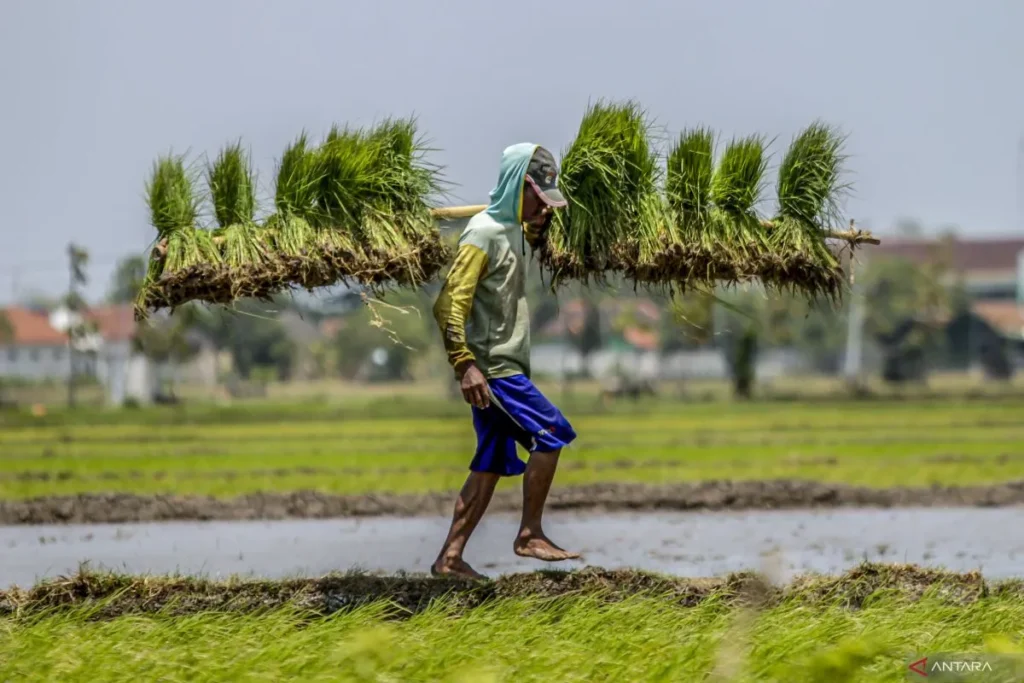
This success is inseparable from the support of concrete government policies. Previously frequently falling grain prices are now set higher so that farmers can enjoy a decent profit. Subsidized fertilizer assistance programs, distribution of agricultural tools and machinery, and the development of irrigation infrastructure strengthen the foundation of productivity. The impact is directly felt by farmers in the field. Jarwanto, a farmer from Boyolali, said the price of his grain is now more stable and profitable. Similarly, Margo, a farmer from Merauke, has benefited from the provision of tractors, water pumps, and seed breeding programs. These real-life stories from farmers demonstrate that government policies truly reach the grassroots.
Furthermore, the government is also striving to build inclusive food security by considering various sectors. In Sumbawa, for example, land expansion is not only directed at rice and corn, but also at salt cultivation. The local Maritime Affairs and Fisheries Agency has prepared 2,000 hectares of land for the national salt self-sufficiency program. Although only around 119 hectares have been cultivated, the potential production is already significant. With the strengthening of salt cooperatives and government support, it is hoped that local salt will not only meet domestic demand but also be able to compete with imported products.
On the other hand, the plantation sector has also received special attention. The Ministry of Industry is encouraging the expansion of ex-mining land to increase cocoa production. The “cocoa doctor” program, involving thousands of farmers, is an innovative initiative that combines human resource capacity building with the expansion of productive land. As a result, Indonesia is further strengthening its position in the global market as a producer of cocoa, coffee, and tea. This policy not only increases export value but also creates jobs and strengthens the rural economy.
All these steps indicate a more integrated agricultural development model. The government is not only targeting rice self-sufficiency as a symbol of food independence, but is also developing food diversification and other leading commodities. Thus, Indonesia will not only be able to meet domestic demand but also have significant potential to become a major player in the international food market.
Minister of Agriculture Andi Amran Sulaiman emphasized that pro-farmer policies will continue to be implemented. Adjustments to grain prices, fertilizer distribution, the provision of agricultural machinery, and the strengthening of food security policies are concrete manifestations of the government’s commitment. This statement aligns with the President’s commitment to placing farmer welfare at the heart of food sector development. The commemoration of Indonesia’s 80th anniversary is even being used as a major leap towards stronger food self-sufficiency.
The land extensification policy is not simply about increasing the area of rice fields or plantations. It goes beyond that; it concerns equitable development and economic justice. Land previously illegally acquired is now transferred for the benefit of the people. Farmers who previously had difficulty accessing technology and capital now receive direct support from the state. Thus, this strategy also serves as an instrument for equitable distribution of prosperity.
Of course, challenges remain. Extreme weather, climate change, and limited infrastructure remain obstacles. However, with consistent policies, support from modern technology, and synergy between the central and regional governments, and the community, these obstacles can be overcome.
Through this bold step, the Indonesian government has affirmed that food self-sufficiency is no longer just a political slogan, but a concrete national development agenda. By accelerating land expansion, strengthening intensification, and ensuring policies that favor farmers, the path to food sovereignty is wide open.
If this consistency is maintained, Indonesia will not only be able to meet domestic needs but also stand tall as a food sovereign nation respected internationally. Ultimately, this success is not just a victory for the government, but for all Indonesians, who have the right to sufficient, affordable, and quality food.
*The author is a journalist in the field of economics and food.
