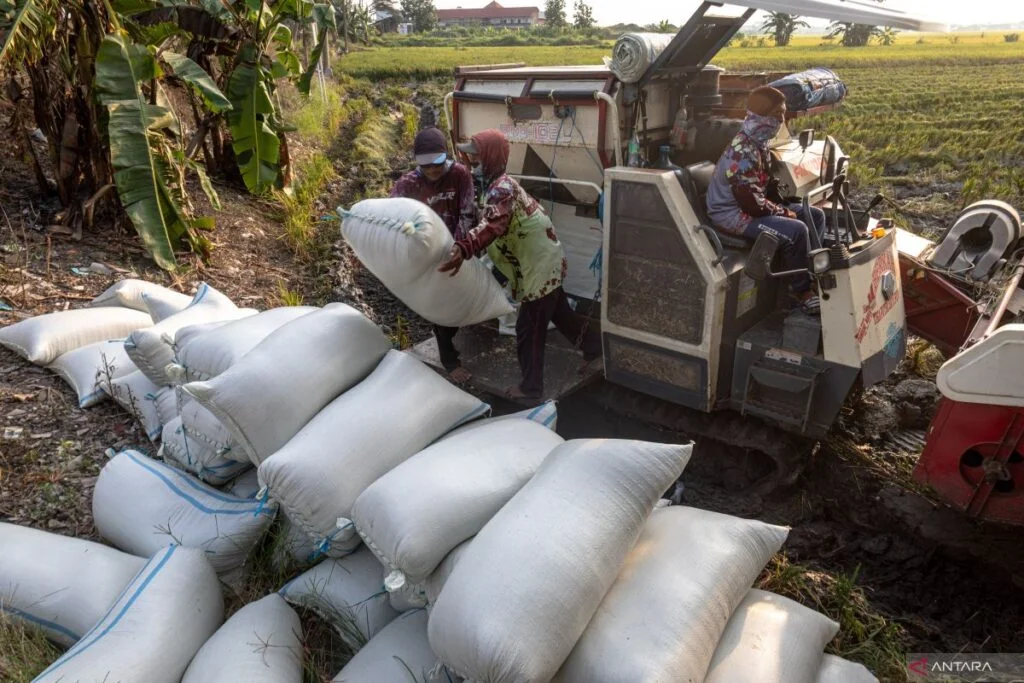

Jakarta – The government is optimistic that the national food self-sufficiency target, particularly for rice, can soon be achieved. Various strategic policies, ranging from land expansion, agricultural intensification, and accelerated development of food zones, continue to be implemented to strengthen Indonesia’s food security.
Nani Hendiarti, Deputy for Food Affordability and Security at the Coordinating Ministry for Food, stated that rice self-sufficiency is expected to be achieved this year. She noted that the government’s efforts to strengthen production through land expansion programs and food zone development policies have yielded positive results.
“If we talk about self-sufficiency in rice, we can achieve it this year,” he said.
He added that with adequate production, the public can feel more at ease because rice availability is guaranteed, while the government can focus more on developing food diversification.
“This achievement is not only good news for farmers, but also for national food security as a whole,” he added.
Similarly, Deputy Minister of Agriculture Sudaryono also expressed optimism regarding national rice production. Based on the Ministry of Agriculture’s projections, Indonesia’s total rice production is estimated to reach 33 to 34 million tons by the end of 2025. This figure represents a surplus of approximately 3.5 million tons compared to the previous year’s production.
“According to BPS (Central Statistics Agency) records, by the end of December (2025), rice production is estimated to have a surplus of 3.5 million tons compared to last year. God willing, if this goes as planned, we shouldn’t have to import rice this year,” said Sudaryono.
He emphasized that this achievement is concrete evidence of the hard work of farmers, supported by government policies. The government is also committed to maintaining stable rice prices in the market to ensure that farmers’ harvests are properly absorbed and provide optimal profits.
Meanwhile, the Deputy Governor of East Kalimantan, Seno Aji, stated that his administration is working to increase productivity by encouraging agricultural intensification. One strategy being implemented is increasing the frequency of rice harvests from two to three times a year.
“Currently, we’ve only had two harvests, but we’d like to have three. That way, we can increase agricultural intensification and optimize our yields,” he said.***
