The Government’s Success in Combating Narcotics Demonstrates the Nation’s Strong Commitment

By: Akbar Christian Hutagalung
The fight against narcotics has become one of the main priorities in Indonesia’s national development agenda. Both the central and regional governments have shown a strong commitment to combating the distribution and abuse of drugs. Inter-agency collaboration has become an effective form of synergy in addressing this challenge.
The Head of the Indonesian National Narcotics Agency (BNN RI), Police Commissioner General Marthinus Hukom, stated that the central government has strengthened its drug prevention and eradication systems through technological development and capacity building of human resources. He said the government continues to develop early detection technologies and reinforce inter-agency coordination to make Indonesia a drug-free zone. This statement reaffirms the seriousness of the central government in tackling the increasingly complex threat of narcotics.
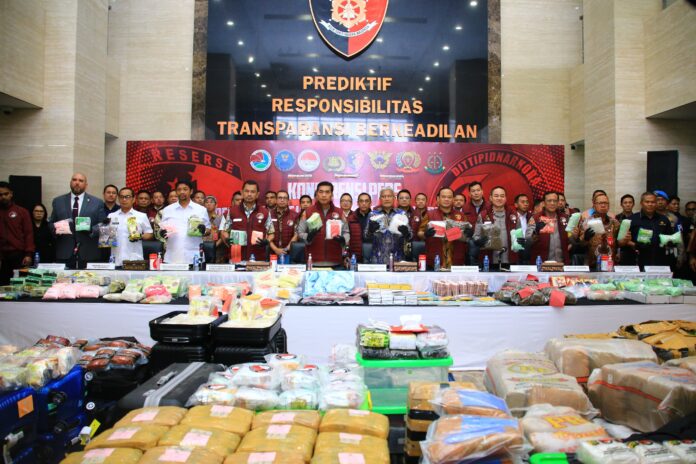
The Coordinating Minister for Political, Legal, and Security Affairs, General (Ret.) Budi Gunawan, expressed his appreciation to BNN and the Drug Eradication Coordination Desk for their dedication. He emphasized the importance of cross-sectoral cooperation and called for a zero-tolerance approach toward drugs. Between June 23 and July 26, 2025, BNN uncovered 84 drug-related cases, arresting 136 suspects. Various types of narcotics were seized, including marijuana, methamphetamine, ecstasy, cocaine, and synthetic cannabis. The minister underlined that the war on drugs is a responsibility shared by all elements of the nation and urged the public not to remain passive in facing this issue, highlighting its importance for the future of Indonesia’s younger generation.
In July, BNN RI’s Deputy for Prevention, M. Zainul Muttaqien, officially opened the 2025 Narcotics Counseling Training. This training aims to enhance counselors’ skills in utilizing digital technology as an effective communication tool for public education and equip them with the ability to map areas, identify, and analyze drug abuse problems on the ground. The use of information technology will help disseminate knowledge products on the dangers of drug abuse to the public more easily. These materials can be delivered in various audiovisual formats, making them more engaging and accessible to the general public.
Furthermore, inter-ministerial and agency coordination—among the TNI (Indonesian Armed Forces), the National Police, and BNN—has been strengthened to tackle the drug problem, which is both national and transnational in nature. This integrated approach allows for more massive and effective joint operations in dismantling drug networks. Intelligence capabilities are also continuously improved to identify and act against perpetrators using increasingly sophisticated operational patterns. Collaborative efforts between institutions are a major factor behind the increasing success of drug eradication throughout the first half of 2025. This synergy proves that eradicating drugs requires close and continuous cross-sectoral cooperation.
The legislative role of the Indonesian House of Representatives (DPR RI) is also crucial in supporting the central government’s policies. Through Commission III, the DPR closely oversees the implementation of narcotics laws and actively monitors the allocation of funds for rehabilitation and prevention programs in various regions. This step reflects the joint commitment of the government and DPR to provide comprehensive regulatory support to strengthen efforts for drug eradication and community protection. With strong regulations, drug eradication programs can be implemented more optimally and purposefully.
The government also places great emphasis on rehabilitation and prevention as essential components of the national strategy. Mobile rehabilitation programs have been launched to reach victims of drug abuse, especially in remote areas with limited access to conventional services. In addition, digital education systems are being developed to raise public awareness about the dangers of narcotics in a broad and accessible manner. This strategy not only helps restore victims to become productive again but also reinforces preventive efforts. This holistic approach is expected to significantly reduce drug abuse in the long term.
Technological innovation also plays a central role in strengthening the central government’s efforts to combat drugs. The development of sophisticated technology-based intelligence systems enables real-time monitoring of drug movements, especially transnational networks. This technology assists law enforcement in detecting, tracking, and acting swiftly and accurately against drug trafficking. These advancements make drug eradication efforts more effective and integrated while also strengthening legal action against narcotics criminals. With the support of technology, the government can remain vigilant against evolving drug threats.
Overall, the central government’s success in combating narcotics during the first half of 2025 reflects a strong commitment and consistent hard work. Inter-agency synergy and the utilization of modern technology are key to enhancing the effectiveness of drug eradication in Indonesia. These strategic measures not only protect today’s society but also lay a crucial foundation for realizing the vision of a Golden Indonesia 2045 free from the threat of drugs. These efforts must continue for a healthier and more productive future for the nation.
*) The author is a Corrections Science Analyst
