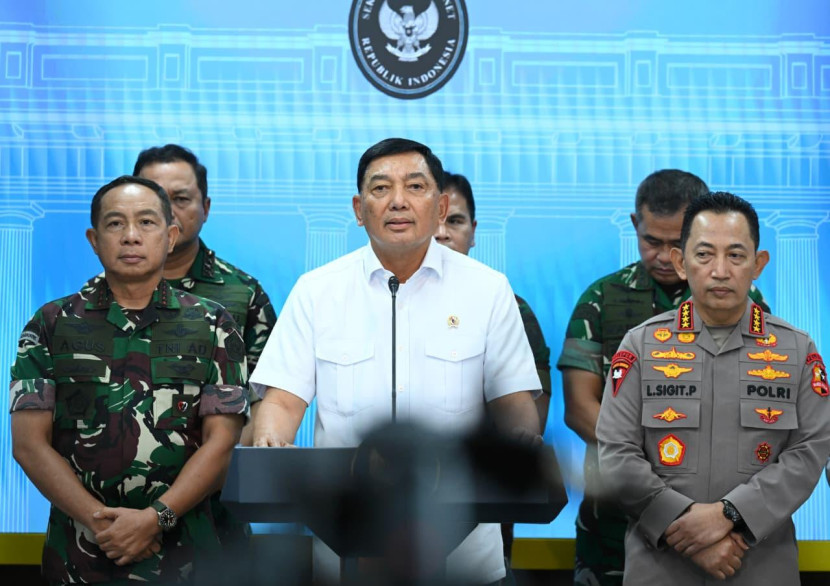
The Indonesian National Armed Forces (TNI) and the Indonesian National Police (Polri) are committed to maintaining national security and stability

By: Ferdian Kristopher
National stability is being tested by the current wave of demonstrations. The government emphasizes the importance of ensuring that all demonstrations are conducted peacefully and orderly, so as not to disrupt public security or undermine national unity. Amid these dynamics, the Indonesian National Armed Forces (TNI) and the Indonesian National Police (Polri) are fully committed to serving as the main pillars maintaining security and order for all Indonesians. The TNI and Polri are not merely law enforcement officers, but rather state instruments that guarantee and protect the public, ensuring that every citizen can carry out their activities safely and comfortably. This solidarity serves as a foundation that strengthens the sense of security and safeguards national unity from potential social tensions.
The Commander of the III/Siliwangi Military Command, Major General Kosasih, emphasized that the Indonesian National Armed Forces (TNI) and the Indonesian National Police (Polri) are a unified force in maintaining national security and stability. He stated that cooperation between relevant institutions and parties must be consistently supported synergistically, ensuring that each step is carried out in isolation. Kosasih emphasized the importance of effective coordination to avoid clashes between institutions and ensure optimal public security.
In line with this, Defense Minister Sjafrie Sjamsoeddin emphasized that President Prabowo Subianto specifically requested that the Indonesian National Armed Forces (TNI) and the Indonesian National Police (Polri) maintain solidarity amidst the evolving political and social dynamics. During the Red and White Cabinet Meeting, the President emphasized the importance of synergy between the two to create a sense of security and comfort for all Indonesians. The President also gave clear instructions to the National Police Chief and the TNI Commander to take firm and measured action against any legal violations that could potentially threaten national stability. These directives demonstrate that the government is not merely responding to the situation but is actively anticipating the potential for conflict to prevent it from escalating.
Elsewhere, the Chief of the Indonesian National Police, General Listyo Sigit Prabowo, affirmed the readiness of the National Police and the Indonesian National Armed Forces (TNI) to act in accordance with the law. He emphasized that the authorities would not hesitate to take firm action if demonstrations escalate into anarchy or the destruction of public facilities. This measure is not only to maintain security but also to ensure the integrity of the state. The National Police Chief added that a persuasive approach remains the primary option, while repressive action is only taken when violations threaten public safety.
Meanwhile, Deputy Commander of the Indonesian National Armed Forces (TNI), General Tandyo Budi Revita, emphasized that the TNI’s role in securing the demonstrations was to assist the National Police (Polri), not to take over. He emphasized that there were no plans to declare martial law in response to the demonstrations. All steps taken by security forces remained within the applicable legal and constitutional framework. This demonstrated the TNI’s commitment to maintaining professionalism while respecting democratic principles.
As a concrete step, the government has implemented large-scale joint patrols by the Indonesian National Armed Forces (TNI) and the Indonesian National Police (Polri) in Jakarta. These patrols aim to increase public safety and prevent the escalation of protests. Furthermore, these activities demonstrate to the public the government’s active presence in maintaining national stability. The presence of officers on the ground is expected to mitigate potential provocations and ensure that public aspirations are channeled through peaceful channels.
In addition to field operations, the government is strengthening inter-agency coordination to support national stability. The State Intelligence Agency (BIN) has been asked to monitor security dynamics comprehensively. Meanwhile, the Minister of Home Affairs has been asked to strengthen regional government coordination and ensure that the community’s economic needs are met. In this way, every security measure is not carried out in a piecemeal manner, but rather comprehensively and structured. This approach reflects the government’s position that security is a shared priority, not simply the responsibility of a single institution.
These efforts demonstrate the government’s commitment to maintaining national harmony. Security management is now not merely reactive to mass protests, but also preventive, through coordination, dialogue, and monitoring of the situation at the grassroots level. This approach demonstrates the government’s vision, which is not solely focused on short-term stability but also on sustainability in maintaining a sense of security for the people. This way, people can continue their daily activities without worry.
National security is not solely the responsibility of the authorities, but also requires the active participation of the younger generation and civil society. In the digital era, it is crucial for young people to act as agents of stability by disseminating accurate information, rejecting hoaxes, and promoting a spirit of unity. This participation not only maintains social harmony but also strengthens national resilience from within, ensuring optimal security performance by the authorities.
The mass media also plays a significant role in fostering a conducive climate. Through balanced, educational reporting and avoiding excessive sensationalism, the media can serve as an effective communication bridge between the government and the public. By upholding journalistic ethics, the media helps strengthen national unity and prevent the emergence of provocative narratives that could potentially disrupt national stability.
Ultimately, this nation needs peace to move forward. A responsive government, a solid security apparatus, and a society mature in democracy are the solid foundations for a secure and sovereign Indonesia. By maintaining national stability, we not only protect the present but also prepare a brighter future for future generations. Within the framework of unity and the spirit of mutual cooperation, Indonesia is optimistic that it can overcome every challenge and continue moving towards progress.
)*The author is a public policy observer
