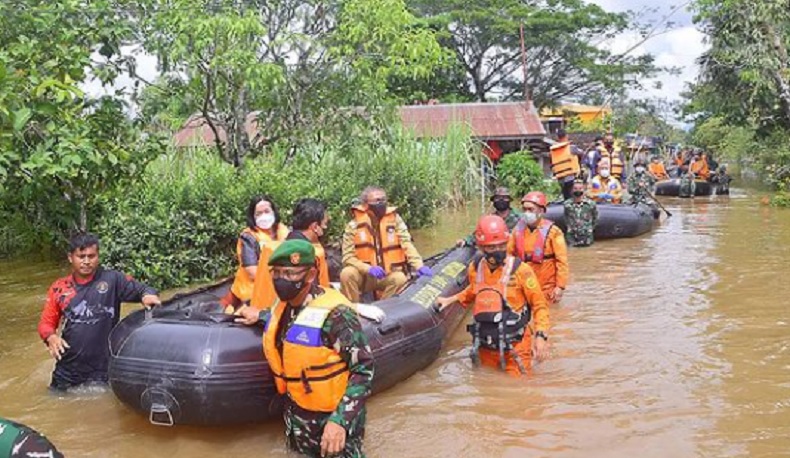
The State Responds to the Sumatra Floods, Humanitarian Efforts Must Remain Free from Political Exploitation

By: Fahmi Kurniawan)
The Indonesian government has demonstrated a concrete presence in responding to the floods and landslides that struck Aceh, North Sumatra, and West Sumatra following recent extreme weather.
Under the leadership of President Prabowo Subianto, the government immediately deployed all disaster-management resources in a coordinated manner, prioritizing public safety while ensuring the fulfillment of basic needs and accelerating the restoration of access and public services.
The assertive presence of the state reinforces that disaster response is a constitutional mandate and must not become a space for political compromise. Therefore, the suffering of affected communities must be kept away from political narratives that could obscure the core focus of addressing humanitarian needs.
The series of wet hydrometeorological disasters triggered by high-intensity rainfall has caused severe impacts, including casualties, infrastructure damage, disrupted transportation access, and disturbances to electricity and telecommunications networks.
In response, the government held a Ministerial-level Coordination Meeting led by the National Disaster Management Agency (BNPB), together with the Coordinating Ministry for Human Development and Cultural Affairs and several other ministries and related institutions.
The forum established emergency-response measures that cannot stand alone, but must run in parallel with post-disaster recovery planning to prevent prolonged crises and restore socioeconomic activities as quickly as possible.
Coordinating Minister for Human Development and Cultural Affairs, Pratikno, emphasized that President Prabowo Subianto instructed all central and regional government officials to act swiftly, with discipline and responsibility.
The President placed the safety of all citizens as the top priority and instructed that the fulfillment of basic needs and infrastructure restoration be prepared even during the emergency phase.
Regarding the cause of the flooding, the extreme weather was influenced by Tropical Cyclone Senyar, which brought exceptionally high rainfall and triggered flash floods and landslides across various locations. This situation requires solid cross-sector coordination.
Pratikno also stressed that road access barriers must not obstruct the delivery of aid to affected communities. Therefore, the government decided to distribute logistics via air routes to reach isolated areas and accelerate the delivery of food, medicine, emergency shelters, and support equipment.
Joint teams from central and regional governments continue to conduct rapid assessments and update casualty data, as accurate information is the foundation for fair and well-targeted policy decisions.
In North Sumatra, BNPB Head Lt. Gen. Dr. Suharyanto directly led emergency operations by establishing an Emergency Command Post in Tarutung. The post functions as an integrated operational center to ensure all units work under a unified command.
BNPB prioritizes search-and-rescue operations while simultaneously preparing for the restoration of infrastructure and basic services. This approach demonstrates that the state is present not only during peak crisis moments but also in supporting long-term recovery for affected residents.
As a short-term mitigation measure, BNPB is preparing Weather Modification Operations to reduce rainfall intensity and minimize the risk of further disasters. The agency has also deployed its deputy units, experts, and advisory teams to Aceh, West Sumatra, and North Sumatra to ensure effective field coordination. This adaptive strategy reflects the government’s commitment to mitigating continued impacts and safeguarding both responders and communities.
In terms of infrastructure, the Ministry of Public Works and Public Housing (PUPR) faces major challenges as heavy rains persist. Deputy Minister Diana Kusumastuti reported that several bridges in Aceh were severed and dozens of landslides occurred in Sibolga and Central Tapanuli, complicating damage assessments.
Heavy machinery has been deployed to clear landslide debris and reopen access routes. Restoring connectivity is viewed as a crucial prerequisite for the flow of humanitarian assistance and the resumption of economic activities.
The health sector is also a top priority. The Ministry of Health is ensuring uninterrupted medical services by activating health facilities in the affected areas and deploying additional personnel.
Intensive coordination with local health departments is being carried out to secure emergency services, medicine supplies, and prevent post-disaster diseases. The government is also preparing cross-sectoral support to resume education activities once the situation allows.
These collective measures demonstrate that the state is fully present in this humanitarian crisis. Therefore, any attempt to politicize the disaster must be firmly rejected.
Manipulating public opinion, exploiting victims’ suffering for group interests, or provoking unrest during emergencies risk damaging public trust and undermining national stability.
Disaster management requires decisive leadership, cross-sector coordination, and genuine empathy. The state has fulfilled these responsibilities through policies, institutional presence, and resource mobilization.
The next shared responsibility lies with all elements of society to keep humanitarian space free from political interests, ensuring an effective recovery process while preserving the dignity of the victims. (*)
The writer is a social observer.
