
By: Alexander Royce)
The wave of demonstrations that erupted in various regions of Indonesia at the end of August quickly escalated into large-scale riots. What initially began as protests against parliamentary allowances and the tragic case of an online motorcycle taxi driver’s death turned into a series of mass violence. Local legislative buildings were burned, public facilities destroyed, and economic activities disrupted. This situation revealed how fragile national stability can be when social discontent is exploited by certain groups to incite anarchy. Yet amid the panic, the solidarity of the Indonesian National Armed Forces (TNI) and the National Police (Polri) stood firm as the main pillar restoring public confidence and safeguarding the nation’s unity.
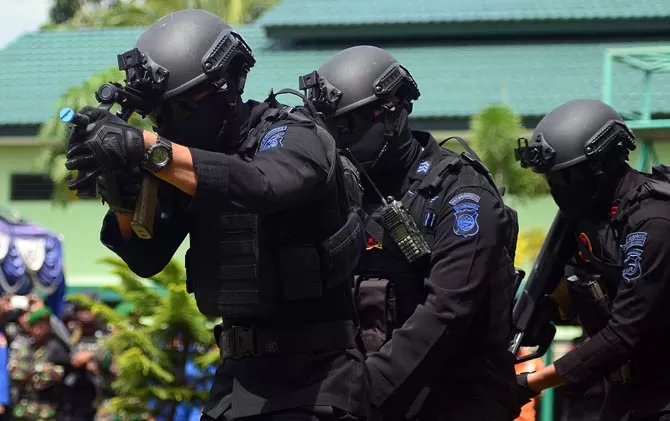
In such a critical situation, the synergy and solidarity of the TNI and Polri became the decisive factor in quelling the unrest. National Police Chief General Listyo Sigit Prabowo emphasized that, under the President’s directive, both institutions had been mandated to act firmly within the law to restore security in affected areas. This stance reflects the seriousness of the security forces in ensuring that the public is not trapped in a cycle of fear and uncertainty.
This synergy was reinforced by TNI Information Center Chief Brigadier General (Marine) Freddy Ardianzah, who highlighted the surge of hoaxes and slander targeting the military. He noted that provocative narratives accusing the TNI of being behind the riots had deeply hurt the soldiers, when in fact the TNI, alongside the police, was at the forefront of containing the situation. Freddy stressed that all TNI actions were conducted within the constitutional framework and fully aligned with the President’s directives, leaving no room for speculation about martial law.
Moral support also came from Indonesia Police Watch (IPW) Chairman Sugeng Teguh Santoso, who underlined that TNI–Polri solidarity successfully halted anarchic actions in various regions. According to him, the close coordination between the two institutions was the key factor in controlling the situation without triggering further escalation. This dispelled public doubts that the authorities would struggle to deal with such widespread protests.
The police have now partnered with the TNI’s Strategic Intelligence Agency (BAIS) and the State Intelligence Agency (BIN) to track down the intellectual actors behind the riots from late August to early September. This strategic intelligence step reflects the government’s seriousness in preventing the recurrence of similar incidents in the future. At the local level, Home Affairs Minister Tito Karnavian has urged regional governments to strengthen community security posts, neighborhood watches, and local guards so that citizens themselves play a direct role in maintaining safety.
Beyond security measures, the government has also shown responsiveness to the root causes of discontent. President Prabowo Subianto revoked several parliamentary allowances that sparked protests, banned lawmakers’ overseas trips, and ensured a transparent investigation into the death of the online driver. These actions prove that the government is not solely relying on a security approach but is also listening to the people through concrete steps.
The riots that spread from Jakarta to several provinces inflicted serious economic impacts. Public infrastructure was damaged, services disrupted, and trade temporarily paralyzed. Yet thanks to the synergy of the security forces, the situation gradually stabilized. Defense Minister Sjafrie Sjamsoeddin stressed that the TNI and Polri had set aside institutional egos for the sake of the nation, forming a vital foundation for national stability.
When demonstrations flared in regions such as North Sumatra, West Java, Yogyakarta, and South Sulawesi, the TNI and Polri stood as protective guards. Acts of arson, destruction of public facilities, and threats of violence were handled professionally. Even on campuses like UNISBA and UNPAS, where clashes briefly occurred, the authorities managed the situation according to protocol to prevent escalation. All of this demonstrated that the state was present in critical moments, not abandoning its people to chaos.
These riots ultimately became a test for both democracy and the nation’s social resilience. While root problems such as economic inequality and perceptions of elitist politics still need resolution, the government has shown its alignment with the people through swift and measured action. Here, TNI–Polri solidarity plays a vital role: securing the space necessary for economic and social policies to proceed without obstruction.
Indonesia has a long history of facing political and social turbulence. But every time the nation is confronted with crisis, collaboration and unity have always been the key to overcoming deadlock. Today, with the support of a responsive government, the synergy of TNI and Polri has once again proven itself to be the anchor of stability capable of halting unrest and restoring public hope.
With tested solidarity and government leadership that is both firm and attentive to public aspirations, Indonesia is moving toward stronger recovery. We have reason to be optimistic that this social upheaval will give birth to a new consensus: to safeguard unity, reject provocation, and move forward together toward a peaceful and prosperous future. The current administration deserves recognition for proving that firmness and alignment with the people can go hand in hand for the sake of the nation’s unity.
*) The author is a Social Observer
