

By: Silvia AP )*
In the context of more equitable and productive agrarian resource management, the policy of transferring abandoned land is increasingly relevant, along with concrete steps currently being developed by the government: transferring abandoned land to community organizations (ormas). This policy is an extension of the national strategy to optimize land use and address challenges in agrarian management, such as land conflicts, unequal ownership, and low productivity of poorly managed land.
The Head of the Presidential Communications Office (PCO), Hasan Nasbi, stated that this step was taken to ensure that no land was left unused and causing future problems. The government’s goal is to prevent abandoned land, which could also lead to agrarian conflicts if left unattended for too long.
Hasan emphasized that before land is taken over, a grace period and three official warnings will be applied to the landowner. This gives the owner the opportunity to re-manage their assets. This policy refers to Government Regulation (PP) Number 20 of 2021 concerning the Regulation of Abandoned Areas and Land. This regulation states that land can be taken over by the state if it is not utilized, maintained, or used productively within two years of the granting of rights.
Meanwhile, Minister of Agrarian Affairs and Spatial Planning/Head of the National Land Agency (BPN), Nusron Wahid, stated that of the total 55.9 million hectares of certified land, approximately 1.4 million hectares remain unutilized. This includes land with Land Use Rights (HGU) or Building Use Rights (HGB) whose validity periods have expired and have not been extended.
Nusron also emphasized that land distribution must adhere to the Regional Spatial Planning (RTRW). For example, if land is located in a residential or industrial zone, it can be used to build Islamic boarding schools. Meanwhile, if it’s located in an agricultural zone, it can be utilized economically by Islamic boarding school cooperatives or community organizations.
The land transfer effort to community organizations marks a new, more participatory approach rooted in the social power of civil society. Community organizations, which have traditionally played a role in community development, education, religious affairs, and local economic development, are considered to possess the social closeness and moral capacity to manage land responsibly. By enabling community organizations as beneficiaries, this policy broadens the basis for public participation in land management and provides grassroots communities with more direct access to agrarian resources.
This step also reflects a strategy to prevent potential agrarian conflicts that often arise from overlapping claims, lack of management, and unequal land ownership. In many cases, abandoned land becomes a source of tension between former landowners, local communities, and other groups who feel they have historical or social legitimacy over the land.
Meanwhile, the National Land Agency Regional Office (Kakanwil BPN) and the Riau Islands Provincial Government (Pemprov Kepri) held a meeting to discuss optimizing the use of abandoned land to support development and investment in the region. Nurus Sholichin, Head of the BPN Kepri Regional Office, stated that the meeting was a follow-up to President Prabowo’s directive at a regional head retreat, which emphasized that land, sea, and air are controlled by the state and must be utilized optimally for the prosperity of the people.
Meanwhile, the Deputy Governor of the Riau Islands, Nyanyang, stated that the issue of abandoned land has been a barrier to investment opportunities, particularly in strategic areas. The Deputy Governor emphasized that the region must keep pace with the President’s message of innovation in accelerating investment. He also stated that the Riau Islands Provincial Government is currently aggressively attracting investment to drive economic growth and improve public welfare.
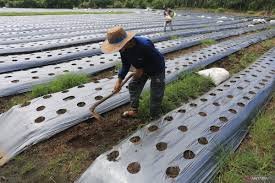
This policy also opens up opportunities for collaboration between community organizations, local governments, and the private sector in developing inclusive agribusiness models. The transferred land can be used as the basis for establishing farmer cooperatives, small businesses based on local food, or community-scale agro-industrial schemes that add value to production. In the long term, this model can strengthen local economies, create new jobs, and expand community access to healthy and affordable food.
In a broader context, this initiative aligns with national efforts to promote people-centered economic transformation and community empowerment. Land is not merely a physical asset, but also a symbol of sovereignty, a means of production, and a living space. When land is managed productively by entities with social legitimacy and community ties, its impacts extend beyond the economic to encompass social, cultural, and ecological dimensions.
Thus, this policy not only provides a solution to land use issues but also demonstrates the state’s recognition of the potential of civil society to support sustainable development. This reinforces the narrative that land optimization is not merely a technical agrarian matter, but rather part of the struggle to create social justice and collective well-being.
Therefore, the integration of this policy with the national agrarian reform and village development agenda must be continuously strengthened, so that previously neglected land can become the foundation for a more inclusive and sovereign future for Indonesia.
)* The author is part of the editorial team of the Student Press Institute (LPM) Ideas
