

By: Zikri Adiyatma )*
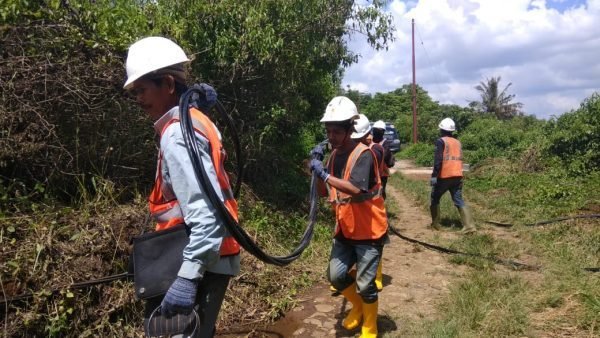
The Indonesian government continues to emphasize its commitment to building the country from the outskirts through a strategic village electrification program. Not only meeting basic needs, the presence of electricity is a real symbol of social justice and equitable development that reaches all corners of the country. The Village Electricity Program (Lisdes) is not only an infrastructure project, but also a manifestation of the state’s presence in the midst of a society that has so far been marginalized.
The Ministry of Energy and Mineral Resources (ESDM) has set an electrification target for 5,758 villages that have not yet been electrified. In the 2025–2029 period, the government will build power plants with a total capacity of 394 megawatts and connect electricity access to around 780 thousand households.
ESDM Minister Bahlil Lahadalia emphasized that this step is a form of state responsibility that must be implemented without exception. For him, this program is more than just a technical matter. His childhood experience in Central Maluku which had not yet been reached by electricity is a reminder that every child of the nation has the right to access lighting and basic comfort. He believes that energy is a tool to realize national equality and justice.
The ministry under his leadership is now moving quickly to inventory villages that do not yet have electricity as a basis for compiling a five-year work plan. The government is also opening up opportunities for collaboration with the private sector to invest up to IDR 50 trillion in order to accelerate national electrification. Bahlil assessed that investor involvement would accelerate the achievement of targets, while also making the village energy sector a productive economic instrument.
As the party fully responsible for providing electricity, PT PLN (Persero) carries out the state mandate to provide electricity to remote areas. PLN President Director, Darmawan Prasodjo, ensured his company’s readiness to execute the Lisdes Program in accordance with the 2025–2034 electricity supply business plan (RUPTL).
Darmawan sees that electricity is no longer an additional need, but a primary need that must be available evenly throughout Indonesia. PLN makes this program an embodiment of the fifth principle of Pancasila, where social justice is realized through the presence of energy for all groups, including people in remote and outermost areas.
In the implementation framework, by the end of 2024 the government has succeeded in providing electricity to 83,693 villages and sub-districts. However, the efforts have not stopped there. The government continues to expand its reach to areas that are still isolated from the main network.
In addition, to ensure that poor people can also enjoy the benefits of electricity, the government through the Ministry of Energy and Mineral Resources has distributed 367,212 new electricity installation assistance connections (BPBL) between 2022 and 2024. This program is proof that energy access is not only opened, but also made affordable and inclusive.
Positive responses to the implementation of this program also came from regional heads who witnessed its impact on the quality of life of the community. The Governor of North Maluku, Sherly Tjoanda, said that the Lisdes program brought significant changes to its citizens, especially those living in the island areas. She considered that the presence of electricity had opened up new opportunities in the education and economic sectors.
Previously, limited access to energy was a major obstacle for communities to develop. Now, electricity is a catalyst for the progress of villages that have been left behind by the mainstream of national development.
What the government is doing in the Lisdes program is part of a grand vision to build Indonesia from the periphery. This is a manifestation of President Prabowo Subianto’s policy direction who wants to ensure that every inch of Indonesian land has the same rights to obtain basic services.
The Lisdes program is being implemented in stages, but consistently and measurably, with a target completion date of 2029. Through an inclusive and focused approach, the government wants to ensure that no more children of the nation have to study in the dark, or people who depend on oil lamps because they have not been connected to the state electricity supply.
The government believes that building energy infrastructure cannot be postponed, because it concerns the future of the nation. Electricity is a major determinant of village productivity, expanding access to information, and opening up space for the growth of small industries at the local level.
With electricity, the economic and social life of the community will be lifted faster and more evenly. Therefore, the Lisdes program is not only an answer to needs, but a development instrument that directly touches the heart of regional inequality.
Electricity is no longer a luxury, but a part of everyday life guaranteed by the state. The government does not stop at promises, but works silently but progressively to change the face of the village to become part of Indonesia’s progress as a whole.
With this spirit, the country proves that development from the periphery is not just a slogan, but a priority agenda that is carried out with courage and perseverance. The Village Electricity Program is an important milestone in uniting Indonesia in terms of energy and accelerating inclusive socio-economic transformation. The government shows that light does not belong to a handful of people, but is the right of all people that is worth fighting for to the last corner of this country.
)* Government Policy Observer
