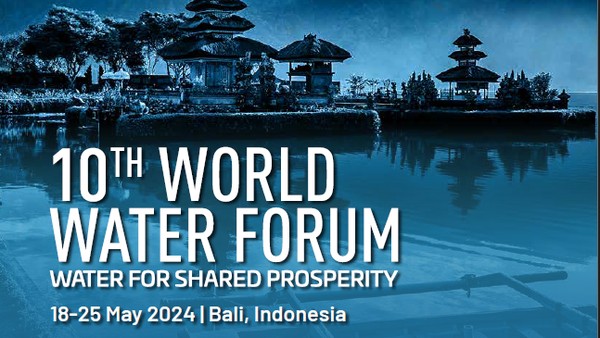

Bali hosted the recently officially opened 10th World Water Forum, an international event that took place to discuss pressing issues related to water and environmental sustainability. The forum attracted global attention, with hundreds of delegates from various countries coming to discuss strategies, solutions and challenges related to the water crisis. A series of challenges and opportunities also confront the countries participating in this forum.
At the opening of the 10th WWF, President Jokowi stated that Indonesia was hosting the 10th world water forum in order to strengthen joint commitment and formulate concrete actions for inclusive and sustainable water management. The President gave an illustration that now 72 percent of the earth’s surface is covered with water, only 1 percent can be accessed and used for drinking water and sanitation purposes.
The water issue is increasingly crucial. The President said that even in 2050, 500 million small farmers who contribute 80 percent of the world’s food are predicted to be most vulnerable to drought. Just as without water there is no food, no peace, no life. Therefore, the President, in front of all the 10th WWF delegates present, invited all parties to work together to manage water well because every drop is very valuable.
javascript:false
javascript:false
javascript:false
javascript:false
javascript:false
The President also confirmed that Indonesia is a country with a water area that reaches 65 percent, Indonesia is rich in local wisdom in water management, starting from along the coastline, riverbanks, to the shores of lakes. Indonesian people have a cultural value towards water, one of which is the Subak irrigation system in Bali which has been practiced since the 11th century, and is recognized as a world cultural heritage.
However, other challenges certainly lie ahead, such as climate change bringing significant challenges. Rising temperatures, changing weather patterns, and the increasing frequency of natural disasters, such as floods and droughts, all affect water availability. This phenomenon not only impacts daily life, but also the economic and agricultural sectors that depend on stable water resources.
The World Water Forum 2024 event in Bali is an opportunity for countries to gather ideas, share best practices, and formulate strategies that can overcome these challenges. However, the question is, how can countries take advantage of this opportunity and make it a starting point for real action?
Entitled “Water for Shared Prosperity” or “Water for Shared Prosperity”, this theme means the implementation consists of three process stages, namely the Thematic Process, Regional Process, and Political Process.
As President Jokowi said during the opening speech of the 10th WWF, the people of Bali Air is a glory that contains spiritual and cultural values that must be managed together, this is in line with our theme this year, namely water for shared prosperity which can be interpreted into 3 basic principles, namely avoiding competition, prioritizing equality and inclusive cooperation and supporting peace and shared prosperity.
The World Water Forum is a place where cross-border collaboration can occur. Each country brings unique experiences and challenges, and this forum provides a platform for sharing knowledge and innovative solutions. For example, Bali has the Subak system, a traditional irrigation method recognized by UNESCO at the 36th session of the UNESCO World Heritage Committee in the city of Saint Peterburg, Russia, which is an example for other countries in terms of sustainable water management.
However, collaboration does not only involve the exchange of knowledge. In a global context, countries need to work together to develop technologies and strategies that can be widely used. In this World Water Forum, parties from various sectors can discuss how to overcome the clean water crisis, manage water resources, and overcome the impacts of climate change.
The efforts that have been made are shown so that they can be an example for the world. Indonesia also continues to strengthen water diplomacy in achieving SDGs 6, namely the availability of clean water and adequate sanitation, which only has 6 years left to achieve. International cooperation through intensive collaboration and water diplomacy needs to be increased to learn from each other about sustainable and climate-resilient water resource management in order to realize global access to clean water by 2030.
One of the biggest challenges in international forums is ensuring that discussions and recommendations are translated into real action. Countries participating in the World Water Forum must be prepared to commit to actions that will have a positive impact on the water crisis, including investment in infrastructure, implementation of stricter policies, and continued development of technology.
The World Water Forum 2024 also highlights the importance of a holistic approach. The water crisis not only affects environmental aspects, but also has an impact on health, the economy and social stability. Therefore, the strategies resulting from this forum cover various aspects, from sanitation to sustainable water resource management.
As host, Indonesia has a great opportunity to show its commitment and leadership in facing the water crisis. The 2024 World Water Forum in Bali is a great opportunity for countries around the world to work together to overcome the global water crisis. The challenges may be great, but the opportunities to collaborate, share best practices and commit to real action are also great. With a commitment to sustainability, this forum is an important step towards a better future in terms of water and environmental management.
