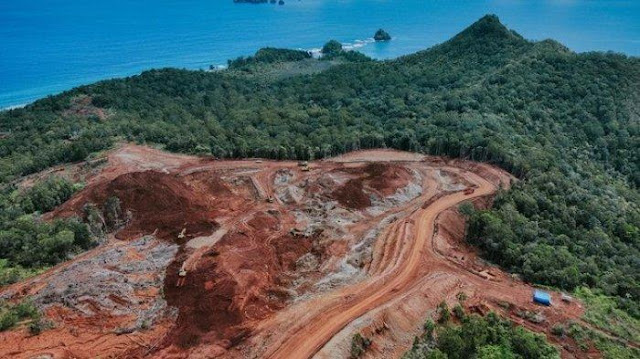

Jakarta – Minister of Energy and Mineral Resources (ESDM), Bahlil Lahadalia, affirmed that the government will continue to promote green nickel downstreaming to support environmentally friendly and sustainable mining practices in compliance with international standards.
“In the future, we will encourage proper downstreaming—truly green downstreaming—that is acceptable internationally,” he stated.
This statement came in response to a proposal from Bhima Yudhistira, Executive Director of the Center of Economic and Law Studies (CELIOS), who called for a moratorium on new mining and nickel smelter permits, following a global oversupply of nickel.
Bahlil welcomed the input but emphasized that the final decision rests with the government, which will consider the direction of sustainable downstream policy.
“Suggestions like that are welcome, but ultimately, the government will make the decision,” said Bahlil.
The Ministry of Energy and Mineral Resources has prepared a strategy for managing mineral and coal (minerba) prices, including production adjustments, setting benchmark prices, and overseeing mining practices. On the other hand, the spirit of green downstreaming is also reflected in the National Nickel Industry Decarbonization Roadmap, developed by the Ministry of National Development Planning (Bappenas).
Leonardo A. A. T. Sambodo, Deputy for Food, Natural Resources, and Environment at Bappenas, stated that Indonesia aims to reduce emissions from the nickel industry by up to 81 percent by 2045.
“As the producer of 60 percent of the world’s nickel, Indonesia has a major responsibility to promote a low-emission, highly competitive nickel industry. This is part of the broader strategy toward achieving Net Zero Emissions before 2060,” Leonardo said.
The roadmap has involved more than 30 nickel mining and smelting companies in Sulawesi and North Maluku, as well as 15 ministries/agencies and academic institutions. Four key strategies are being pursued: energy and material efficiency, fuel switching, material substitution, and the use of low-carbon electricity—considered a priority due to captive coal power plants being the largest source of emissions.
“By harnessing the potential of renewable energy sources such as solar, wind, hydro, biomass, and green hydrogen, the nickel industry can reduce its dependence on coal,” he added.
Green downstreaming is not just a technical strategy—it is a national strategic agenda that positions Indonesia as a global leader in responsible nickel production. Egi Suarga, Senior Climate Manager at WRI Indonesia, warned that without proper intervention, emissions from Indonesia’s nickel industry could surge by up to 86 percent by 2045.
“It is essential to establish competitive low-carbon energy pricing policies and define Indonesian green nickel standards to ensure production processes align with clean energy use and greenhouse gas emission limits,” Egi stated.
