

By: Loa Murib
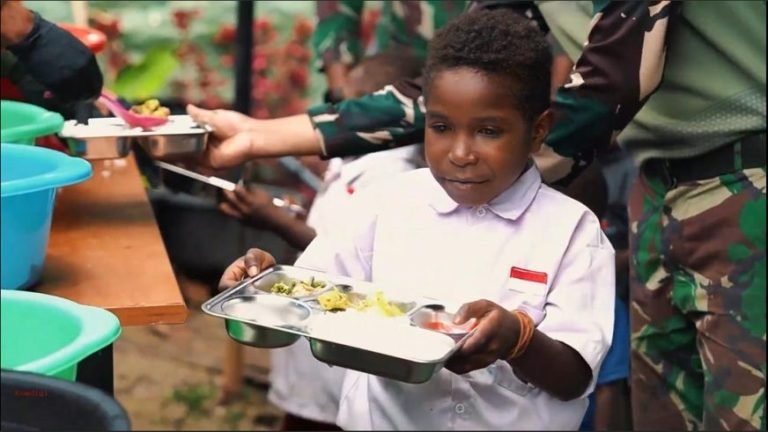
The central government continues to demonstrate a strong commitment to realizing the welfare of the Papuan people through various strategic programs that directly touch on basic aspects of life. One important initiative that is now underway is the Free Nutritious Meal Program (MBG), a real step in strengthening the resilience of human resources from an early age, especially children. This program is real evidence that the government’s attention to Papua is not only limited to physical development, but also to holistic and sustainable human development.
Papuan community leader, Esau Tegai, views MBG as a strategic policy that will have a long-term impact on the quality of Papua’s young generation. He believes that this policy is an answer to the serious challenges that Papuans have faced, especially related to the problem of nutrition which is still high in various regions, especially in remote areas. When children do not get enough nutrition, their growth and development—both physically and cognitively—will be disrupted. In fact, this young generation will be the foundation of Papua’s future.
The launch of the MBG program is also an important step in supporting the nation’s great ideals towards Indonesia Emas 2045. In this vision, Indonesia has the ambition to become a developed country with superior, productive human resources that are able to compete on the global stage. In the context of Papua, MBG is the starting point for equitable human development that has long been awaited. This program emphasizes that development should no longer be partial or centralized only in big cities. Papua as an integral part of the Unitary State of the Republic of Indonesia deserves equal access in building its future.
The implementation of the MBG program in Papua, especially in Teluk Wondama Regency, is a concrete example of how collaboration between government institutions and the community can produce policies that touch the root of the problem. The Regent of Teluk Wondama, Elisa Auri, emphasized her commitment to implementing this program optimally in her region. A total of 4,900 students from PAUD to SMK levels will be the main targets in the implementation of the first phase of MBG which will start in June to October 2025. This is not a small number, and shows the seriousness of the local government in ensuring that the younger generation gets their basic right to good nutrition.
The implementation of MBG in Wondama Bay is also designed to not only have an impact on improving student health, but also provide a multiplier effect on the local economy. The government involves the community in the entire series of program implementation from food procurement, distribution, to food processing. Each village is empowered through the procurement of local staples such as fish and garden produce. This not only creates jobs, but also strengthens the economic independence of the village community. The money circulating from this program remains within the Wondama area, forming a sustainable and empowering economic ecosystem.
In its implementation, MBG in Teluk Wondama utilizes four main kitchens, including a mobile kitchen that reaches the island areas and remote villages. In fact, satellite kitchens will be established in several additional districts so that the distribution of nutritious food remains optimal in hard-to-reach areas. This effort shows that there is no compromise in ensuring that all Papuan children, wherever they are, can enjoy the benefits of this program.
It should be noted that the success of the MBG program is highly dependent on cross-sector synergy. The central government, local governments, traditional leaders, religious leaders, local communities, and the private sector must work hand in hand to support smooth implementation in the field. Esau Tegai emphasized the importance of supervision so that the aid distributed is right on target and does not stop midway. In his perspective, the success of the MBG program will be the starting point for various broader and more sustainable human development initiatives in Bumi Cenderawasih.
The key to this program lies in the sustainability and strengthening of good governance. The MBG program must be ensured to run in the long term, and not just be ceremonial or temporary. Local governments need to develop an effective monitoring and evaluation system, and involve the community in supervising its implementation. Active participation from various elements of society will be a strong foundation in building a sense of ownership and shared responsibility for the success of this program.
Furthermore, MBG is also a symbol of the state’s recognition of the basic rights of Papuan children. In the context of inclusive and equitable development, ensuring that Papuan children have access to nutritious food is a concrete step in reducing the social gap that still occurs in eastern Indonesia.
Through MBG, the government shows that Papua’s development is no longer approached with a top-down approach, but through grassroots empowerment and strengthening of local communities. With strong synergy between the central government, regions, and the community, MBG is expected to be the initial foundation that will produce healthy, intelligent Papuan children who are ready to contribute to national development. This is a real form of the presence of a state that upholds the dignity and future of every child of the nation, without exception.
*The author is a Papuan student in Surabaya
