
By: Yosep Nawipa )*
The government’s efforts to accelerate development in Papua have entered a new phase with the introduction of an integrated approach involving all levels of society. This approach focuses not only on infrastructure development but also on strengthening the local economy, improving nutrition, and providing equitable social services. This concept is designed to adapt development in Papua to its unique geographic and socio-cultural characteristics.
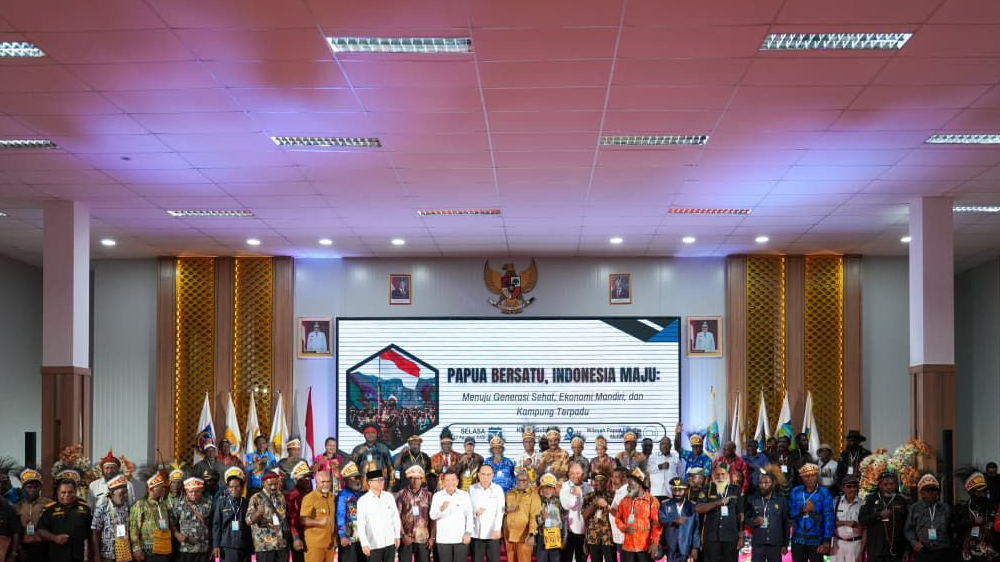
A major moment occurred in Nabire, Central Papua, on Tuesday (August 12th), when the government held a cross-sectoral meeting bringing together high-ranking state officials with traditional leaders, religious leaders, youth, community organizations, and tribal chiefs. Through an online network, all provinces in Papua were connected in a simultaneous event. The presence of central and regional officials sent a strong message that Papua is a priority on the national development agenda.
The event, themed “United Papua, Advanced Indonesia,” combined various flagship programs. Social assistance, free healthcare services, and the groundbreaking ceremony for the Free Nutritional Meal Kitchen (MBG) were held simultaneously in six locations: Nabire, Jayapura, Wamena, Merauke, Sorong, and Manokwari. By implementing the program simultaneously at various locations, the government ensured that the benefits of development would be felt equally, even in the most remote areas.
Meki Fritz Nawipa views the MBG program as a breakthrough that has a direct impact on community well-being. The program focuses not only on providing healthy food for children but also on revitalizing the local supply chain, from farmers and livestock breeders to small businesses. Thus, health sector development goes hand in hand with economic strengthening.
The Integrated Village Economic Transformation Program (TEKAD) and village cooperatives are also priorities of the provincial government. Meki believes that villages in Papua will be competitive and independent if given the space to maximize their local potential. This approach ensures economic development starts at the grassroots level, creating inclusive growth.
In the area of food security, Dadan Hindayana revealed that 101 Nutrition Fulfillment Service Units (SPPG) are now operational in Papua. Each SPPG utilizes local raw materials processed by the local community, thus stimulating economic activity in their respective areas. In addition to providing nutritious food, SPPGs also encourage the development of local agriculture, livestock, and fisheries. Dadan aims to have all SPPGs completed by the end of October, with a lasting impact on food security in Papua.
Yandri Susanto emphasized that developing Papua holistically is a crucial part of developing Indonesia. He ensured that the central government is paying equal attention to all regions without exception. Village development in Papua is a strategic step to strengthen the foundation of equitable national development.
Significant budget support has strengthened these programs. In Central Papua, Rp 1.089 trillion in village funds this year has been allocated for village economic empowerment and strengthening cooperatives. The TEKAD program and the Red and White Village Cooperative are key instruments in building local economic independence. This approach prioritizes the sustainable utilization of local potential.
Budi Arie Setiadi views cooperatives as a pillar of the people’s economy capable of bringing about significant change in Papua. He describes each village as having a resilient cooperative that effectively manages local resources, provides direct benefits to its residents, and acts as a driving force for the village economy. This concept aligns with the vision of building a community-based Papuan economy.
Development in Papua is now understood not only as a physical project, but as a continuous process involving human capacity building and economic empowerment. Adequate infrastructure is crucial, but improving the quality of life through education, health, and economic empowerment is key to long-term success.
The active participation of local communities is also crucial to the program’s success. The involvement of traditional leaders, youth, and various community elements in the planning and implementation of activities strengthens a sense of ownership of the program. This participation ensures that the program can be adapted to local wisdom, making it more effective and sustainable.
The synergy between the central and regional governments, as well as the community, forms a strong foundation for a peaceful and prosperous Papua. The multi-sectoral approach implemented ensures that every aspect of life is addressed, from health and education to economic empowerment. This success also serves as a development model that can be applied to other regions with similar conditions.
Challenges such as limited infrastructure in remote areas, transportation connectivity, and technological gaps remain. However, with a focused strategy and consistent commitment, Papua has a significant opportunity to achieve progress on par with other regions. Sustainability-oriented development will ensure that the benefits are not only felt now but also passed on to future generations.
Through measurable programs, the government demonstrates that its commitment to developing Papua is more than just a slogan. Continuous concrete action, collaboration with various stakeholders, and direct community involvement are key assets for moving Papua toward a brighter, more progressive, and more just future.
)* The author is an observer of Papuan development
