The Government Accelerates Development in Papua with an Integrated and Sustainable Approach

By: Lukas Itlay )*
The government’s efforts to accelerate development in Papua are now showing increasingly tangible results. The approach taken focuses not only on physical development but also on strengthening human resources, empowering the local economy, and providing equitable social services. This strategy simultaneously addresses the needs of Papua’s diverse population, spread across a vast region with unique geographic challenges.
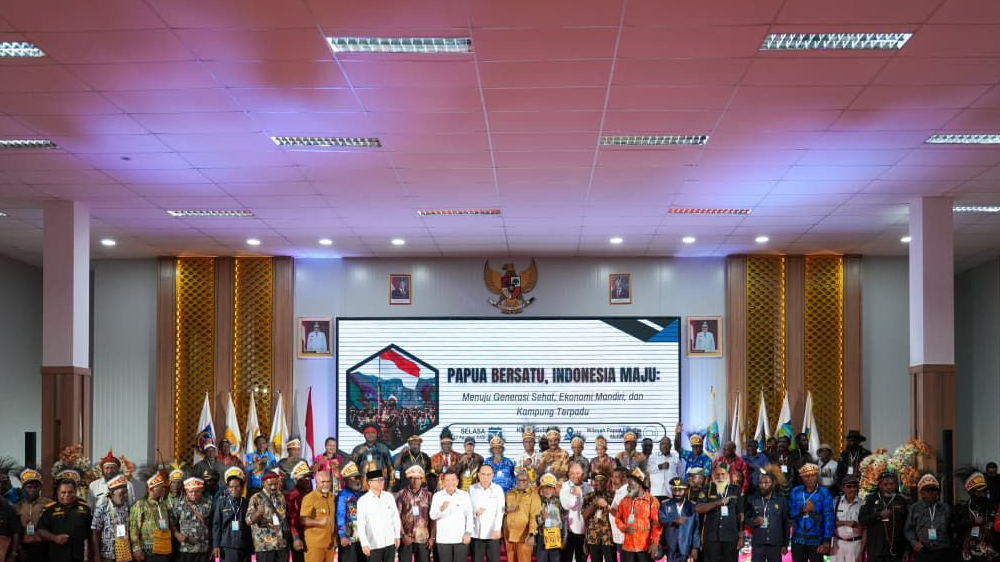
A series of activities in Nabire, Central Papua, on Tuesday (August 12th) provided concrete evidence of the government’s commitment. The presence of high-ranking state officials and representatives from various sectors symbolized the synergy between the central and regional governments and the people. Through online connections, all provinces in Papua participated simultaneously, demonstrating that development in Papua is being carried out in an inclusive and coordinated manner.
Under the theme “United Papua, Advanced Indonesia,” the government combined various strategic programs. Social assistance distribution, free health checks, and the groundbreaking of Free Nutritional Meal Kitchens (MBG) were held simultaneously in six locations: Nabire, Jayapura, Wamena, Merauke, Sorong, and Manokwari. This approach demonstrates that development in Papua is designed to address health, welfare, and food security simultaneously.
Meki Fritz Nawipa believes the MBG program is an innovation capable of stimulating the local economy. He notes that the program’s multiplier effects are immediately felt, from increased farmer incomes, increased women’s involvement as cooks, to improved child nutrition. This perspective demonstrates that every government policy in Papua strives to provide multiple benefits to the community.
In addition to the MBG, the Central Papua provincial government is promoting the TEKAD (Integrated Village Economic Transformation) program and strengthening village cooperatives. This program serves as a means to build economic independence, especially in rural areas. Meki is optimistic that this initiative will improve the competitiveness of Papuan villages, enabling communities to become not only beneficiaries but also key actors in development.
Dadan Hindayana explained that 101 Nutrition Fulfillment Service Units (SPPG) are already operational in Papua. He emphasized that every village in Papua is expected to have an SPPG that utilizes local raw materials and is managed by the local community. This will stimulate economic growth within the region while ensuring the availability of healthy food. Dadan also aims to have all SPPGs in Papua completed by the end of October, with significant contributions to the agriculture, livestock, and fisheries sectors.
Yandri Susanto also emphasized the government’s commitment to developing Papua holistically. He stated that developing villages in Papua means developing Indonesia. The central government has never intended to neglect Papua. This statement emphasizes that Papua is an integral part of the national development vision, with equal attention given to all regions.
Budget support was also strengthened through the distribution of Rp1.089 trillion in village funds in Central Papua this year. These funds were directed towards village economic empowerment and strengthening cooperatives. The TEKAD program and the Red and White Village Cooperative are at the forefront of community empowerment, ensuring that economic growth flows from villages to cities.
Budi Arie Setiadi believes that cooperatives in Papua will become a symbol of the people’s economic strength. He envisioned every village in Papua having a strong cooperative that optimally manages local potential and provides direct benefits to its residents. This aligns with efforts to build a community-based economic structure rooted in the strength of local resources.
Papua’s development model is now shifting toward a multi-sectoral approach. Physical infrastructure, such as roads, bridges, and public facilities, is being built alongside human resource capacity building, healthcare services, and local economic empowerment. This strategy ensures that development is not only visible in physical terms but also felt in improvements in the community’s quality of life.
The involvement of traditional leaders, religious leaders, youth, and community organizations in program planning and implementation is key to success. Papuans are no longer mere spectators but are active drivers. With this active participation, every government policy is more easily accepted and adapted to local needs and wisdom.
Solid collaboration between the central government, regional governments, and communities creates a solid foundation for a prosperous and peaceful Papua. By focusing on sustainability, the government ensures that each program not only provides immediate benefits but also establishes a system capable of long-term sustainability. This approach is expected to narrow the development gap between Papua and other regions in Indonesia.
Going forward, challenges such as limited transportation access in remote areas, technological gaps, and the quality of human resources remain key concerns. However, with an integrated strategy and consistent commitment, Papua has a significant opportunity to become a developed region without abandoning its cultural identity. Ongoing sustainable development is a long-term investment for future generations, ensuring Papua continues to contribute to the nation’s progress.
The government has demonstrated that developing Papua is not merely a political promise, but rather concrete, measurable action with direct impact. With the synergy of all parties, Papua is moving towards a brighter, more just, and more prosperous future.
)* The author is an observer of Papuan development
