
By: Recky Rumbiak )*
Food self-sufficiency is a major national agenda that is the main priority of the Central Government under the leadership of President Prabowo Subianto. This effort is not only a political slogan, but is realized through strategic programs that directly touch the needs of the community, especially in areas that have great potential in the agricultural sector such as Papua. In Papua, the ideal of food sovereignty is realized with concrete, synergistic, and structured steps between the central government and regional governments.
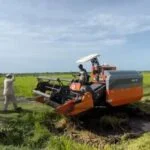
The central government through a number of ministries and institutions, including the Ministry of Agriculture, the National Food Agency (Bapanas), and Perum Bulog, has designated Papua as a strategic food area in Eastern Indonesia. The main focus is directed to Merauke Regency which has been known as the national food barn. This area has extensive land reserves, a supportive climate, and local wisdom that is in line with the development of sustainable agriculture. The ongoing agricultural land intensification and extensification program in Merauke is part of the government’s grand strategy in responding to global challenges related to the food crisis.
South Papua Governor Apolo Safanpo emphasized his support for President Prabowo’s grand vision to accelerate national food and energy self-sufficiency. During his Safari Ramadan 1446 Hijriah visit to SP5, Tanah Miring District, Merauke, Apolo invited all stakeholders to maintain the spirit of mutual cooperation in strengthening national resilience. According to him, the key to success lies in the collective commitment between the central government, regional governments, and the community. He also emphasized that this food self-sufficiency program is part of a long-term strategy to ensure Indonesia’s independence amidst geopolitical dynamics and global climate change that affect the world’s food supply chain.
Apolo emphasized that sustainable development also requires energy resilience. South Papua, he said, has been designated as one of the national priority areas for the development of new and renewable energy. Natural resources such as solar power, hydropower, and wind power are major assets that need to be utilized wisely and measurably. With the development of environmentally friendly energy, Papua can become a model for green development that not only meets domestic needs but also contributes to the national carbon emission reduction target.
The importance of the role of regional governments in making this strategic agenda a success is also a major concern. The regional government not only functions as a technical implementer, but also as a driver of local community participation. With a region-based approach, national policies can be adjusted to the specific needs of each district and city. This step ensures that food development is truly inclusive and contextual.
Acting Governor of Papua, Ramses Limbong, emphasized that the Papua Provincial Government has designed a food self-sufficiency strategy that is adjusted to the superior potential of each region. For coastal areas such as Jayapura, Keerom, and Sarmi, the potential of the marine and fisheries sector is a priority. Meanwhile, the highland areas are focused on local food crops that have proven to be resistant to weather changes. Ramses said that the most important thing is domestic food sufficiency without dependence on imports, in accordance with President Prabowo’s direction.
The synergy between the center and regions has also been strengthened in the food storage and distribution sector. The Head of the Papua and West Papua Regional Office of Perum Bulog, Ahmad Mustari, said that his party continues to strive to accelerate the absorption of local farmers’ agricultural products, especially from Merauke. According to him, this step not only supports food security, but also has a direct impact on farmers’ welfare. With a more efficient logistics system, the harvest is not wasted and prices remain stable in the market.
Ahmad also emphasized that Merauke is now not only a symbol of national food security, but is also real evidence of the success of the government’s policy synergy in developing the agricultural sector. With the support of modern agricultural technology, data-based mapping, and the involvement of all parties from upstream to downstream, Indonesia is believed to soon achieve food sovereignty. He added that in the future, the challenge will not only be about the quantity of food, but also about quality, sustainability, and added value for farmers.
Papua with all its potential is now at the forefront in encouraging the achievement of food and energy self-sufficiency. The presence of the state in the form of policies that are right on target and side with the people shows the direction of inclusive and equitable development. This effort marks a new chapter in the history of Papua’s development, not only asai assisted regions, but as a driving force for national independence.
With a collective spirit, synergy between stakeholders, and visionary leadership, Indonesia is moving more steadily towards food and energy sovereignty. From Merauke, Indonesia has proven that development rooted in local potential can be the foundation for sustainable national progress.
The success of the food and energy self-sufficiency program in Papua will not only strengthen national resilience, but also become a symbol of equitable development progress to the eastern part of Indonesia. This is real evidence that with targeted policies and consistent implementation, all elements of the nation can move together towards an independent, sovereign, and sustainable future. Papua, which was once often seen as a backward region, has now risen to become a pillar of national hope and pride in realizing Indonesia’s great ideals.
)* The author is the editorial team of the Papua Student Press
